
Introduction
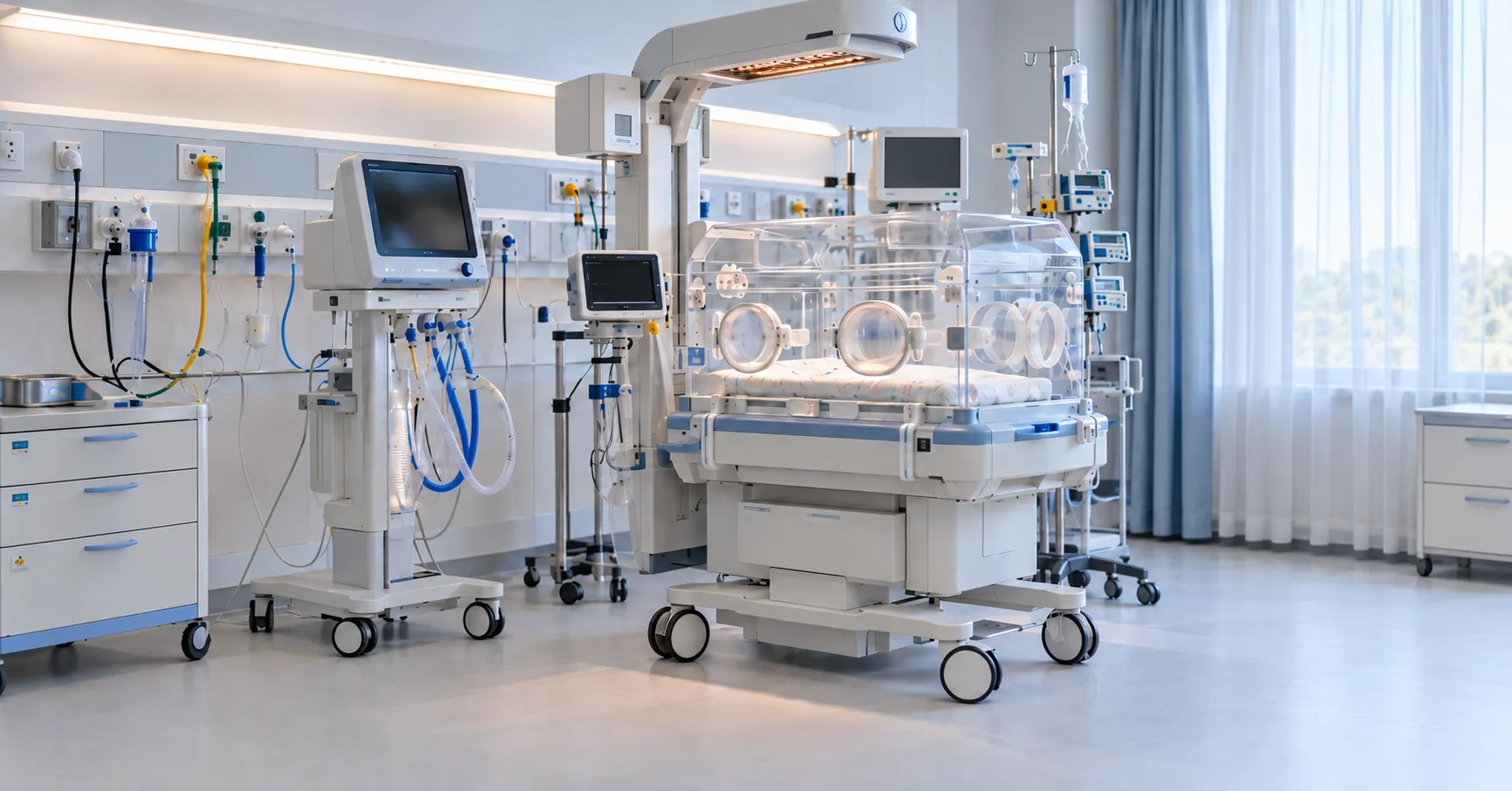
The smallest patients are the most fragile, and the most closely watched. A sick or premature newborn in a neonatal unit is surrounded by equipment doing gently what the baby cannot yet do reliably alone — helping them breathe, keeping them warm, watching every vital sign. Into that careful, high-stakes environment, artificial intelligence is adding an extra layer of watchfulness.
This article explains what artificial intelligence in neonatal care equipment does — monitoring the fragile newborn, catching trouble early, and easing the load on the teams and families around them. It is written for neonatal, procurement and biomedical engineering teams across the UK, Europe, the US, the Gulf and South Africa who want to understand where AI genuinely helps in caring for the youngest patients.
The short version
-
Newborns in neonatal units are fragile and monitored with great care.
-
AI helps by watching continuously and catching subtle deterioration early.
-
It suits a setting where tiny changes matter and constant vigilance is needed.
-
The high stakes demand especially careful validation, gentleness and oversight.
The most delicate of settings
Few places in a hospital demand more care than a neonatal unit. The patients are tiny, their reserves are small, and they can change from stable to seriously unwell with alarming speed. At the same time, they cannot tell anyone how they feel, so everything must be read from continuous, careful monitoring of their vital signs and behaviour.
This combination — fragility, speed of change, and dependence on monitoring — makes the neonatal unit a setting where tireless, attentive watching is genuinely life-saving, and where the smallest early sign can matter enormously. It is exactly the kind of environment in which artificial intelligence, watching without pause and alert to subtle patterns, can add real value alongside the neonatal team.
Catching trouble when it is still small. AI's central contribution in neonatal care is early warning. Serious problems in a newborn — a developing infection, a breathing difficulty, a slide towards instability — are often preceded by subtle changes across several vital signs, changes too faint or too gradual to be obvious moment to moment. AI trained on such patterns can recognise the early shape of trouble and raise a flag while there is still time to act gently.
In babies who can deteriorate quickly, those saved minutes and hours are precious. An early, well-founded warning lets the team intervene sooner and more gently, which in the fragile newborn often means a milder intervention and a better outcome. The AI does not diagnose or treat; it draws the team's attention to the baby who needs it, sooner than they might otherwise have known.
Watching gently, around the clock
A particular virtue of AI-supported monitoring in neonatal care is that it watches continuously without adding to the handling of an already vulnerable baby. Much of what it needs can be drawn from the monitoring already in place, so it adds vigilance without adding disturbance — an important consideration when every unnecessary intervention on a tiny patient carries a small risk of its own.
This gentle, unbroken watching complements the neonatal team rather than competing with it. Nurses and doctors cannot be at every cot every second; a system that keeps a baby's full trend in view and raises its hand the moment something drifts helps the team be at the right cot at the right time. It is an extra, tireless layer of watchfulness laid over expert human care.
Where AI helps in neonatal care
|
Task |
What AI adds |
Why it matters |
|
Early warning |
Detects subtle deterioration |
Gentle action, sooner |
|
Continuous watching |
Never looks away |
The right cot, the right time |
|
Non-invasive |
Uses existing monitoring |
Vigilance without disturbance |
|
Alarm management |
Sharpens the alerts |
Trustworthy warnings |
Easing the strain on people
There is a human dimension too. Neonatal care is intense and emotionally demanding work, carried out under the constant weight of how much is at stake. By shouldering part of the relentless watching, AI can ease some of that strain on staff, helping them stay fresh for the judgements and the care that only they can give.
For families, meanwhile, knowing a tireless system is helping watch over their baby alongside skilled staff can be a quiet reassurance in a frightening time. None of this replaces the human care at the heart of a neonatal unit; it supports the people providing it, which in such a demanding setting is a benefit worth having.
The stakes demand great care.
Nowhere are the consequences of error less forgivable than in the care of newborns, so any AI here must clear an especially high bar. When such software serves a medical purpose,se it is a regulated medical device; in Great Britain,n the MHRA sets out how it is classified, and the FDA frames the same ground in the United States. The cleared intended use defines exactly what a tool may do with these most vulnerable of patients.
The cautions apply with unusual force. A model reflects the data it learned from, and neonatal patients are a specialised, varied group, so validation on genuinely relevant data and careful monitoring matter enormously — concerns that responsible-AI bodies such as the World Health Organisation place at the centre of trustworthy AI in health. And above all, the neonatal team decides: the AI watches and warns, but qualified people interpret and act.
Questions worth asking
-
Was it validated specifically on neonatal patients, not adults or children?
-
Does it add vigilance without adding handling of a fragile baby?
-
Does it make alarms more trustworthy rather than simply more numerous?
-
How does it integrate with your neonatal monitoring and records?
-
Is it unmistakable that the neonatal team decides, not the software?
Built for the smallest patients
Neonatal patients are not simply small adults or children; they are physiologically distinct, and what is normal for them differs in ways that matter. A tool built or trained on older patients can be quietly wrong when applied to a newborn, so equipment intended for neonatal care must be designed and validated specifically for these patients. General-purpose tools do not transfer safely to the cot-side.
This specialisation is one of the most important things to check. The right question is not whether a tool works in general, but whether it has been shown to work for babies like those in your unit — the premature, the very small, the critically unwell. Only equipment proven on genuinely relevant patients belongs in such an unforgiving setting.
Reassurance, not replacement
For the exhausted staff and frightened families of a neonatal unit, technology that helps watch over a fragile baby can be a genuine comfort — but only if it is trusted, and trust is earned by reliability and by never overstepping. A system that supports the team quietly and dependably reassures; one that cries wolf, or seems to take decisions out of human hands, unsettles instead.
The right posture, then, is unmistakably one of support. The neonatal team remains the constant, expert presence at the cot-side; the AI is an extra, tireless set of eyes that helps them do their demanding work. Kept firmly in that role, it adds reassurance rather than anxiety, which in such ansuch an emotional setting is a real benefit.
A gentle extra guardian
Artificial intelligence in neonatal care equipment does not replace the watchful eyes and gentle hands of the neonatal team; it adds a tireless, non-invasive layer of watchfulness over the most fragile patients — catching subtle trouble early, watching gently around the clock, and easing the strain on the people who care. Held to the highest standards the setting demands, it is a quiet extra guardian at the bedside, supporting expert human care.
More from Business
-
Buyers — source approved, well-documented equipment.
-
Suppliers — list your equipment and reach buyers worldwide.
-
Advertise — promote your products and services to a clinical audience.
-
Business overview — explore everything MediGear offers healthcare organisations.
Disclaimer
This article is general information, not clinical or procurement advice. Use Neonatal AI only within its approved intended use and under continuous qualified neonatal supervision; confirm current requirements with the relevant authority. medigear.uk accepts no liability for actions taken based on this content.
Neonatal equipment you can build on
Genuine, approved, well-documented neonatal equipment — the dependable foundation that good neonatal AI works from, wherever you care for the youngest patients.
Frequently Asked Questions
Newborns in neonatal units are fragile and closely monitored. AI helps by monitoring continuously and catching subtle deterioration early—a developing infection, breathing difficulty, a slide toward instability—often using the monitoring already in place, so it adds vigilance without adding disturbance. It supports the neonatal team, which interprets and decides.
The patients are tiny, their reserves small, and they can change from stable to seriously unwell with alarming speed, yet they cannot say how they feel — so everything must be read from continuous monitoring. That combination of fragility, speed of change and dependence on monitoring makes tireless, attentive watching genuinely valuable, which is exactly what AI can add.
Serious problems in a newborn are often preceded by subtle changes across several vital signs, too faint or gradual to be obvious moment to moment. AI trained on these patterns can recognise the early shape of trouble and raise a flag while there is still time to act gently — which, in babies who deteriorate quickly, can mean a milder intervention and a better outcome.
It need not be. Much of what AI needs can be drawn from the monitoring already in place, so it adds vigilance without adding handling to an already vulnerable baby — an important consideration when every unnecessary intervention on a tiny patient carries a small risk of its own. It watches continuously and gently, complementing the team.
No. It adds a tireless, non-invasive layer of watchfulness over the most fragile patients, but the neonatal team interprets and acts. Nurses and doctors cannot be at every cot every second; a system that keeps a baby's full trend in view and raises its hand when something drifts helps them be at the right cot at the right time.
The stakes demand a high bar. A tool must be validated specifically on neonatal patients, not adults or children, since they are a specialised, varied group. It must hold the appropriate approval for its intended use, add vigilance without disturbing the baby, make alarms more trustworthy, and leave the neonatal team unmistakably in charge of every decision.