A vendor may remain on an approved supplier list for years even when its delivery performance, documentation quality or technical support has declined. Unless procurement teams conduct structured reviews, poor performance may not become apparent until equipment fails to arrive, a warranty claim is disputed, or an essential spare part becomes unavailable.
For healthcare buyers, a review of hospital equipment vendors provides evidence that an existing supplier remains suitable for future purchases. It examines more than competitive pricing. Compliance, equipment quality, delivery reliability, service capability and issue resolution all affect whether the relationship continues to support safe clinical operations.
Vendor reviews should be proportionate to risk. A supplier providing basic furniture may require less frequent assessment than a vendor supporting ventilators, diagnostic systems or surgical equipment. The same principles apply, but the depth and frequency of evidence should change.
This guide explains how procurement teams can measure vendor performance, review documentation, assess after-sales support and decide whether a supplier should remain approved.
Why Vendor Reviews Protect Clinical Procurement
Supplier approval should not be treated as permanent. Company structures, product ranges, certifications and technical support arrangements can change after onboarding.
Continuing compliance verification — Procurement teams should confirm that company registrations, quality certificates, product documentation and manufacturer authorisations remain valid. A document that was acceptable during onboarding may have expired or may no longer cover the equipment being purchased.
In practice, procurement teams often find that supplier records contain older certificates even though newer versions are available. Document control, therefore, matters as much as initial collection.
Equipment quality monitoring — Reviewers should assess damaged deliveries, missing accessories, installation defects, early failures and recurring product complaints. Individual incidents may be manageable, but repeated patterns can indicate weak supplier controls.
The assessment should distinguish manufacturer-related defects from problems caused by storage, transport or incorrect configuration.
Clinical service protection — Vendor failure can affect equipment availability, patient scheduling and departmental capacity. Procurement teams should consider the operational effect of delayed deliveries, slow repairs and unavailable consumables.
A supplier providing clinically critical equipment should therefore face stronger performance thresholds than one supplying low-risk items.
Commercial accountability — Quotations, invoices and contract terms should remain accurate and consistent. Unexplained price changes, recurring invoice errors, or incomplete order confirmations increase administrative workload and create budget uncertainty.
Evidence-based approval decisions — A structured review prevents decisions from depending only on personal experience or recent communication. Performance records provide procurement teams with a defensible basis for continued approval, corrective action, or suspension.
Regular vendor reviews support stronger procurement governance by linking supplier status to current evidence rather than historical relationships.
How Vendor Review Priorities Change Between Facilities
Healthcare settings use equipment differently, so vendor performance should be evaluated against the conditions of the actual service environment.
Large hospitals and teaching facilities — Major hospitals may purchase several equipment categories from the same supplier. Reviews should therefore consider performance by product group, department, and contract rather than relying on a single overall score.
A vendor may perform well for standard devices while struggling to support complex imaging or laboratory systems.
District and regional hospitals — Regional facilities may depend heavily on supplier logistics and remote technical support. Procurement teams comparing established international healthcare equipment supplier distributors should assess whether service commitments are achievable at each destination.
Experienced clinical supply managers typically review actual engineer attendance and parts-delivery records rather than accepting a general statement about regional coverage.
Community clinics and outpatient centres — Smaller facilities may place fewer orders, making annual performance data limited. Their reviews can combine order accuracy, communication, product quality and support experience across a longer period.
The review should remain documented even where the supplier relationship appears straightforward.
Diagnostic centres and laboratories — Vendor performance may depend on reagent continuity, calibration support, quality-control materials and software access. A delayed consumable shipment can interrupt testing even when the main analyser remains operational.
Mobile and remote healthcare services — Equipment used in outreach settings may require replacement batteries, protective components and remote troubleshooting. Vendor reviews should consider whether the supplier understands field conditions and responds effectively without on-site access.
Multi-facility healthcare networks — Central procurement teams should collect performance information from each site. A supplier may meet head-office expectations while causing repeated delivery or service problems at individual facilities.
Review criteria should therefore reflect equipment risk, local support conditions and the consequences of supplier failure.
Evidence Procurement Teams Should Examine
A reliable review uses measurable evidence gathered from purchasing, clinical, technical and financial records. General impressions should support the assessment, not replace documented performance.
Delivery accuracy — Buyers should compare confirmed dates with actual arrival dates and record incomplete, incorrect or damaged shipments. Delivery performance should be measured against the supplier’s accepted commitment, not an informal estimate.
Repeated partial deliveries can create installation delays even when the main equipment arrives on time.
Product conformity and configuration — Delivered models, serial numbers, accessories and software versions should match the purchase order. Substitutions should require written approval before shipment.
Unexpected product differences can affect compatibility, training and regulatory records.
Documentation quality — Procurement teams should examine invoices, packing lists, conformity documents, manuals, calibration certificates and warranty records. Missing or inconsistent documents may delay customs clearance, asset registration, commissioning or future servicing.
Technical service records—service response time, first-time repair rate, repeat failures, and parts availability—provide meaningful evidence of after-sales capability. The review should distinguish scheduled maintenance from emergency support.
Complaint and corrective-action history — Complaints should be assessed by severity, recurrence and closure quality. A vendor that investigates problems promptly may remain suitable, while repeated unresolved issues indicate weak control.
Stakeholder feedback — Clinical users, biomedical engineers, finance teams and logistics staff may experience different aspects of supplier performance. Their feedback should be collected using specific questions rather than broad satisfaction ratings.
Commercial performance — Buyers should review the accuracy of quotations, price consistency, payment administration, and adherence to contract terms. Unexpected charges should be investigated and recorded.
A vendor review becomes useful when evidence leads to clear actions, ownership and follow-up dates.
How to Score Vendors and Decide Their Approval Status
Procurement teams should establish review criteria before scoring suppliers. Changing the method after concerns arise can lead to inconsistent decisions.
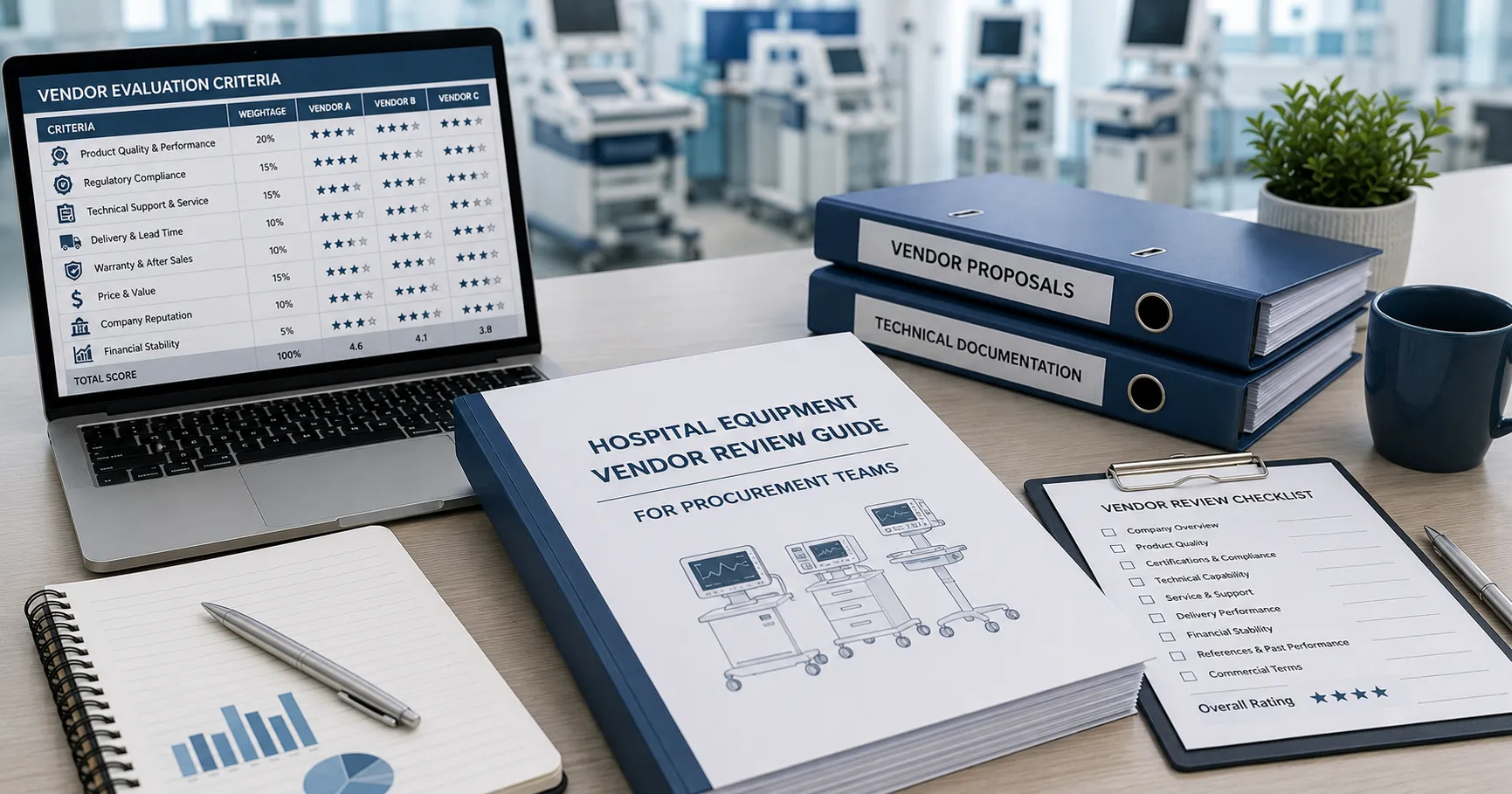
Use weighted performance categories — Equipment quality, compliance, delivery, service and commercial performance may carry different weightings. High-risk equipment vendors should receive greater weight in technical support and regulatory documentation.
Set measurable thresholds — Performance targets may include on-time delivery, document accuracy, complaint closure and service response. Thresholds should be realistic, contractually supported and appropriate to the equipment category.
Assess product information carefully — Medical equipment advertising intended for international procurement teams should accurately communicate product specifications, regulatory status, configuration, and support terms. Reviewers should compare published claims with delivered equipment and formal documentation.
Separate minor and critical failures — A single invoice correction should not carry the same consequence as supplying unapproved equipment or failing to respond to a critical breakdown. The scoring system should reflect severity and clinical impact.
Document the decision — Possible outcomes may include continued approval, conditional approval, corrective action, reduced purchasing scope, temporary suspension or removal. The decision record should state the evidence reviewed, the required actions, and the next review date.
Allow controlled improvement — Suppliers should have an opportunity to explain problems and submit corrective actions where appropriate. Procurement teams should verify that promised changes have been implemented before restoring full approval.
Healthcare groups seeking greater consistency across facilities may establish structured distribution and reseller partnership arrangements. These relationships still require performance targets, escalation routes and regular review rather than automatic renewal.
Reviewing Service Support Across Equipment Life
After-sales support often determines whether equipment remains clinically available beyond the initial warranty period. Vendor reviews should therefore consider the full service life, not only purchasing performance.
Preventive maintenance delivery — Buyers should confirm whether scheduled servicing occurred on time and whether reports were complete. Missed maintenance can increase the risk of failure and affect compliance with local equipment management requirements.
Service records should identify work completed, measurements taken and any recommended corrective action.
Breakdown response — Review the time taken to acknowledge, diagnose and resolve faults. For critical equipment, long delays may require backup arrangements or alternative service providers.
Response targets should reflect the actual location of the facility and the availability of qualified engineers.
Spare-parts continuity — Vendors should provide realistic information about parts availability, lead times and product discontinuation. Procurement teams should monitor whether frequently required components become difficult or expensive to obtain.
Technical competence — Engineer training, diagnostic capability, and access to service tools affect repair quality. Repeated unsuccessful visits may indicate that the vendor lacks adequate technical support.
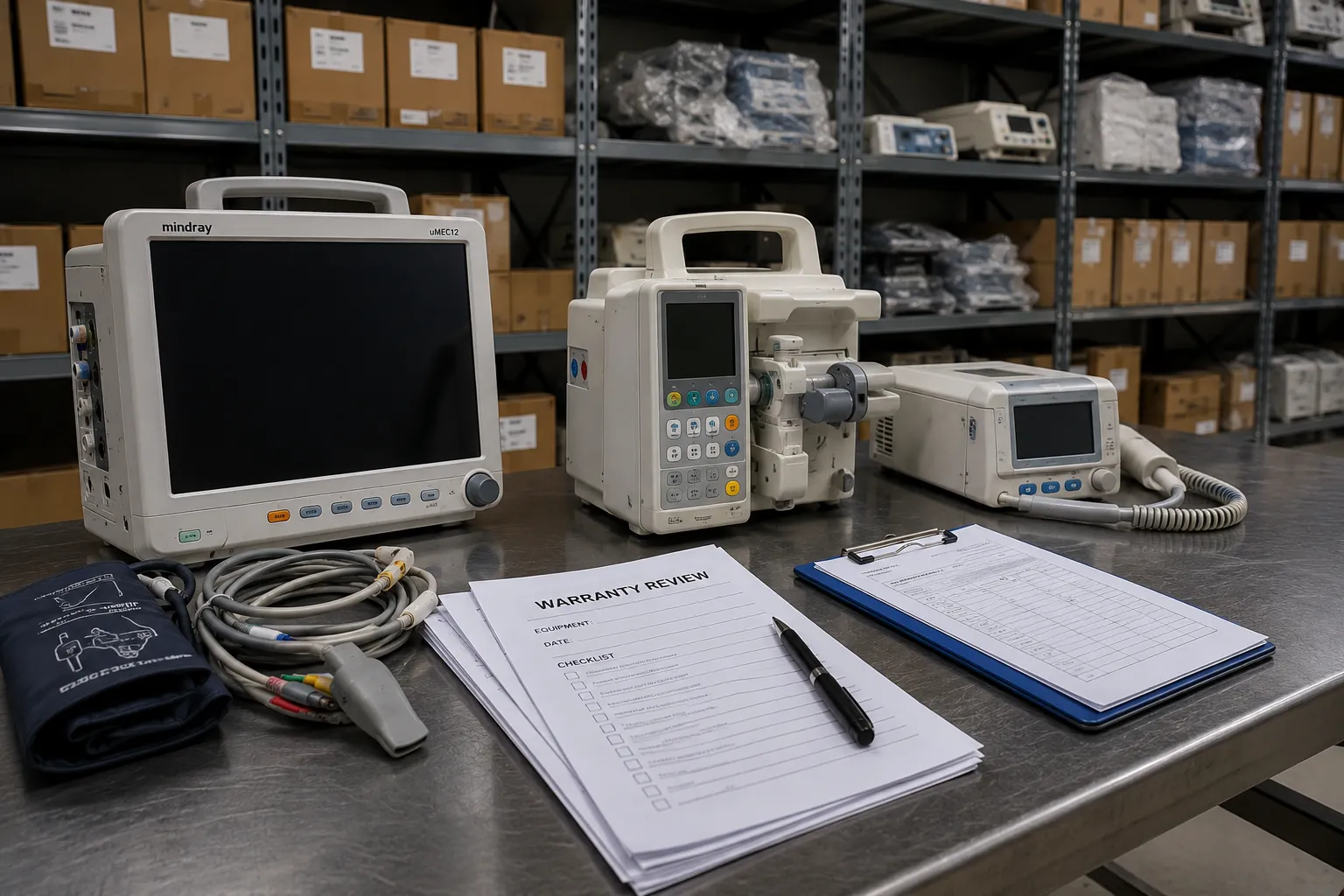
Warranty administration — Buyers should assess how quickly warranty claims are accepted, parts are authorised, and disputes are resolved. Exclusions should match the original commercial agreement.
Service cost control — Labour, travel, freight, software and parts charges should remain transparent. Facilities with limited local support often find that international engineer travel and equipment downtime result in greater costs than the repair itself.
Vendor performance across servicing and repairs should feed directly into replacement planning and future purchasing decisions.
International Vendor Reviews and Supply-Chain Risk
International equipment vendors require additional review because delivery, documentation and service may involve several organisations and jurisdictions.
Export documentation performance — Procurement teams should assess the accuracy and timeliness of invoices, packing lists, conformity evidence and certificates of origin. Documentation errors can delay customs clearance and increase storage costs.
Destination compliance support — Vendors should understand which documents they can supply and which registrations remain the buyer’s responsibility. Requirements vary by equipment classification and local regulatory framework.
Shipping and packaging quality — International orders should arrive with packaging suitable for the equipment, the transport route, and the environmental conditions. Damage patterns may indicate unsuitable packing or poor freight coordination.
Currency and commercial consistency — Buyers should monitor quotation validity, exchange-rate arrangements and unexpected changes between order and payment. Commercial responsibilities for insurance, customs and local delivery should remain clear.
Regional service capability — A vendor may have international sales experience without dependable technical support in the buyer’s location. Reviewers should examine actual parts shipments, engineer attendance, and remote support outcomes.
Sourcing and review support — Procurement teams evaluating international vendors, volume requirements, or multi-category projects can contact Medigear.uk for procurement assistance. A useful request should include the destination, equipment categories, quantities, service expectations and current vendor concerns.
International vendor reviews should separate the performance of the seller, manufacturer, logistics provider and service organisation where different parties are involved.
Final thoughts
Hospital equipment vendor reviews help procurement teams determine whether an approved supplier continues to provide compliant products, reliable delivery and effective support. Historical approval alone does not demonstrate current suitability.
A strong review uses evidence from purchase orders, delivery records, technical service reports, complaints and stakeholder feedback. It also distinguishes minor administrative errors from failures that could affect patient safety, equipment availability or regulatory compliance.
Procurement teams should score vendors using consistent criteria, document every approval decision and verify corrective actions before closing performance issues. Review frequency should reflect equipment risk, purchasing activity and the operational consequences of supplier failure.
Regular vendor assessment improves accountability and supports procurement relationships that remain dependable throughout the equipment lifecycle.
Disclaimer
Medigear.uk is a global medical equipment supplier, exporter, and distributor. The content published on this site is intended for educational and product awareness purposes only. Nothing on this page constitutes medical advice, clinical guidance, or treatment recommendations. All healthcare procurement and clinical decisions should be made by qualified medical professionals and compliant procurement teams operating within the regulatory frameworks of their respective countries.