
Medical equipment budgets often become inaccurate before procurement begins. Clinical teams may request devices without accounting for installation, while finance teams may approve an equipment price without allowing for accessories, freight, staff training, consumables or technical support.
For medical equipment buyers, professionals worldwide, effective budgeting requires more than identifying an available capital amount. Buyers must determine whether the equipment is clinically necessary, technically suitable, compliant with applicable requirements and financially supportable throughout its service life.
An incomplete budget can result in equipment arriving without compatible accessories, adequate infrastructure or local servicing. In other cases, the purchase may proceed successfully, but recurring consumables and maintenance expenses place pressure on operational funds.
Medical equipment budget planning connects clinical requirements, technical evaluation, procurement controls and lifecycle expenditure. The following guidance explains how healthcare buyers can build realistic budgets, compare supplier offers and prioritise equipment investments across different clinical environments.
Why Equipment Budgets Must Reflect Clinical Operations
A medical equipment budget should explain how each planned purchase supports patient care, service capacity and operational continuity. It should not function as a list of departmental requests without supporting evidence.
Documented clinical need — Every request should identify the service gap being addressed. Buyers should understand whether the equipment replaces an unreliable device, expands clinical capacity, introduces a new service or meets a safety requirement.
In practice, procurement teams often find that requests supported by utilisation data and clinical risk assessments receive faster approval than requests based mainly on departmental preference.
Expected utilisation level — Equipment used daily across several departments may justify a larger investment than specialised equipment required for occasional procedures. Expected case volume, operating hours and peak demand should form part of the budget calculation.
Low utilisation does not always make a purchase unsuitable. Emergency and critical care equipment may require permanent availability even when it is used infrequently.
Patient safety and service continuity — Equipment that supports life-sustaining care, emergency response, infection control or essential diagnosis may require greater budget priority. The cost of equipment failure should be considered alongside the purchase price.
A device with unreliable servicing could lead to cancelled procedures, delayed diagnosis or dependence on external facilities.
Existing equipment condition — Buyers should review maintenance records, breakdown frequency, calibration results and spare parts availability. Equipment age alone does not always justify replacement, but rising repair costs and extended downtime can provide strong financial evidence.
Staff capacity — Equipment may require specialist operators, biomedical engineering support or recurring competency training. Budget approval should reflect whether the facility has the people and resources needed to use the equipment safely.
A clinically appropriate budget, therefore, links expenditure to measurable operational requirements rather than treating equipment acquisition as an isolated financial transaction.
Where Budget Priorities Change Across Healthcare Settings
Budget requirements vary by facility size, location, service model, and technical capacity. A single budgeting method may overlook important differences between healthcare environments.
Large hospitals and teaching facilities — Major hospitals often manage investments in imaging, laboratory, critical care, surgical, and sterilisation simultaneously. Their budgets may require multi-year replacement schedules, equipment standardisation and integration with existing clinical systems.
These facilities should also consider whether proposed equipment will increase departmental capacity or create new bottlenecks elsewhere in the patient pathway.
District and regional hospitals — Regional facilities may need durable equipment that can operate with limited specialist engineering support. Access to verified global medical equipment suppliers can help buyers evaluate documentation, configuration, spare parts access, and international service arrangements.
Experienced clinical supply managers typically examine how quickly technical support can reach the facility rather than relying only on stated warranty duration.
Community clinics and outpatient centres — smaller facilities often operate with limited capital and space. Compact equipment with lower infrastructure requirements may provide stronger value than premium configurations containing functions that are unlikely to be used.
The budget should still allow for essential accessories, operator training and planned servicing.
Diagnostic centres and laboratories — Diagnostic equipment may depend on reagents, calibration materials, quality controls or software subscriptions. The initial instrument price can represent only a portion of the financial commitment.
Buyers should calculate costs based on expected test volumes and consider expiry losses for consumables with limited shelf lives.
Mobile and outreach healthcare — Mobile services require equipment that can tolerate transport, repeated setup, temperature variation and inconsistent power access. Budgets may need to include protective cases, batteries, charging systems and portable connectivity.
One aspect that surprises first-time buyers is how quickly transport damage and lost accessories can affect operating costs.
Multi-facility healthcare networks — Groups managing several hospitals or clinics may benefit from consolidated purchasing and shared maintenance agreements. Standardisation can simplify training and spare parts management, although local workload and clinical requirements must still be considered.
Technical Cost Factors Buyers Must Calculate Before Approval
Technical specifications influence acquisition, installation, operation and service costs. Buyers should evaluate what each specification means in financial and operational terms.
Complete equipment configuration — Base prices may exclude probes, batteries, sensors, cables, software modules, trolleys or starter consumables. Every supplier should receive the same configuration list so quotations can be compared fairly.
A quotation that appears lower-ply contains fewer essential components.
Infrastructure and utility requirements — Buyers should assess voltage, frequency, power stability, medical gas availability, ventilation, water quality, drainage, network access, and room dimensions. Imaging and laboratory systems may also require shielding, structural reinforcement or environmental controls.
Infrastructure modifications should be identified before the equipment order is approved.
Capacity and throughput — Equipment capacity should match current workload and realistic future demand. Insufficient capacity may create delays and accelerated wear, while excessive capacity can consume funds without improving clinical outcomes.
Facilities that have deployed equipment at scale tend to report that moderate spare capacity is useful, but unsupported growth assumptions often result in underused investment.
Consumable compatibility — Some devices depend on proprietary cartridges, electrodes, reagents, filters or treatment accessories. Buyers should calculate monthly consumption, minimum order quantities, shelf life and regional availability.
A lower acquisition price may become financially unattractive when recurring consumables are expensive or difficult to obtain.
Software and connectivity — Digital equipment may require licences, cloud services, cybersecurity controls or integration with hospital information systems. These costs can continue throughout the ownership period.
Buyers should confirm whether software updates, remote support and data storage are included or charged separately.
Serviceability and spare parts — Equipment with modular components may be easier to repair, but only when trained technicians and replacement parts are accessible. International engineer travel and extended parts delivery can significantly increase downtime costs.
The technical evaluation should therefore translate every specification into its effect on implementation, performance and future expenditure.
How Buyers Should Compare and Approve Procurement Spend
A defensible equipment budget explains how costs were calculated, which risks remain and why the selected option offers suitable value throughout its planned service life.
Calculate total cost of ownership — Include acquisition, freight, customs, installation, infrastructure, accessories, training, software, consumables, maintenance, repair and disposal. This provides a more accurate comparison than purchase price alone.
The calculation period should reflect the expected useful life of the equipment.
Normalise supplier quotations — ask each supplier to quote for the same equipment configuration, delivery destination, and support scope. Differences in accessories, warranties and installation responsibilities should be recorded separately.
Suppliers and manufacturers advertising to global healthcare buyers should present clear specifications, conformity information, service terms and commercial exclusions so procurement teams can assess products consistently.
Verify compliance documentation — Equipment must comply with applicable local regulatory standards. Depending on the destination, buyers may need evidence aligned with standards such as CE, FDA or their regional equivalents.
Relevant documents can include declarations of conformity, quality certifications, calibration records, technical files and destination-specific registration evidence.
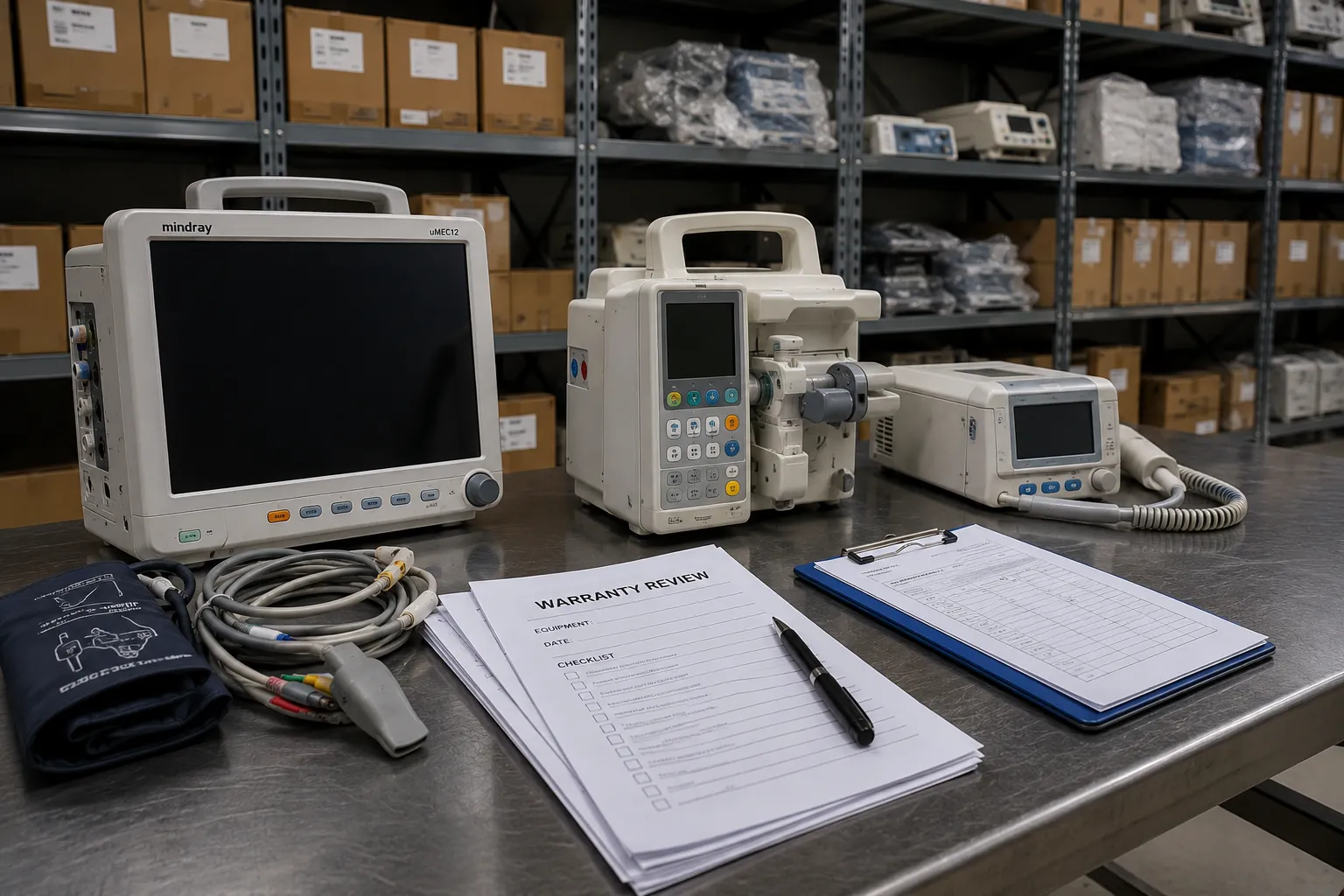
Assess warranty coverage — Warranty duration should be reviewed alongside exclusions, labour, engineer travel, spare parts, response times and preventive maintenance. A long warranty offers limited protection if technical support cannot reach the equipment.
Plan installation and training — The budget should identify who will deliver, install, test, commission and accept the device. Operator training, engineering instruction and competency documentation should also be included.
Evaluate supplier reliability — Buyers should examine product experience, response quality, references, documentation standards and after-sales capability. A low quotation should not outweigh unresolved service or compliance concerns.
Healthcare networks that manage repeat purchases may improve pricing consistency and accountability through long-term medical equipment supply partnerships. Such arrangements should include clear performance expectations, service responsibilities and periodic commercial reviews.
How Maintenance Planning Protects Equipment Service Life
Maintenance expenditure should be planned before equipment is acquired. Excluding servicing from the original budget can create unpredictable repair costs and extended clinical downtime.
Preventive maintenance schedules — Service intervals should reflect manufacturer guidance, equipment risk, utilisation and applicable local requirements. Safety-critical and high-use equipment may require more frequent inspection.
Planned servicing can identify wear before it results in equipment failure.
Calibration and performance testing — Measuring and diagnostic equipment may require scheduled calibration to maintain reliable performance. Buyers should account for technician time, external calibration services, reference equipment and certification.
Temporary replacement arrangements may also be required while equipment is unavailable.
Spare-parts planning — Batteries, seals, filters, sensors, lamps, and other wear components should be forecast-based on expected workload. Buyers should verify how long the manufacturer or supplier intends to provide replacement parts.
Equipment with discontinued components may require earlier replacement even when the main system remains functional.
Storage and environmental protection — Dust, humidity, heat, and improper charging practices can shorten equipment lifespan. Protective storage, controlled cleaning and routine inspections should form part of operational planning.
Maintenance records — Service reports help facilities identify repeated failures, rising costs and reduced reliability. These records should inform future replacement budgets.
In markets where local service support is limited, engineer travel, international freight and prolonged downtime may cost more than the repair itself. A higher initial price can therefore be justified where it includes accessible technical support, remote diagnostics and dependable parts supply.
Managing International Sourcing Costs and Budget Risk
International sourcing can expand equipment choice, but it also introduces freight, customs, currency, documentation and delivery risks. These costs should remain visible in the approved budget.
Freight and import expenditure — Buyers should calculate shipping, insurance, customs charges, taxes, inspection fees, storage and local delivery separately from the equipment price. Commercial terms must clearly show which party is responsible for each cost.
Unexpected port charges or delayed customs clearance can affect both project expenditure and implementation timing.
Currency exposure — Exchange-rate movements between quotation, approval and payment may alter the final cost. Buythroughmanthis validity period quotation purchasing, periods, and documented contingency allowances.
Export and import documentation — International purchases may require invoices, packing lists, certificates of origin, evidence of conformity, and destination-specific permits. Missing documentation can delay shipment or prevent equipment clearance.
Lead-time planning — Buyers should distinguish between estimated availability, dispatch time, transit time and final delivery. Manufacturing, refurbishment, documentation and customs processes can each affect the schedule.
New and refurbished equipment — New equipment may offer longer support life and stronger warranty coverage. Professionally refurbished equipment may reduce acquisition expenditure but requires careful review of condition, service history, software status and remaining parts support.
Specialist procurement assistance — Healthcare facilities managing volume orders, international shipping or multi-category projects can contact the Medigear.uk team for supply support. A detailed enquiry should include the destination, equipment type, quantity, preferred condition and required delivery period.
International equipment budgets should separate confirmed expenditure from provisional estimates. This allows procurement teams to update assumptions as supplier, shipping or regulatory conditions change.
Final thoughts
Medical equipment budget planning should connect clinical necessity with financial sustainability. The lowest quotation may not represent the lowest ownership cost once installation, consumables, servicing, downtime and replacement are considered.
Strong budgets begin with a clinical needs assessment, use consistent specifications and compare suppliers on total delivered and supported cost. They also recognise that healthcare settings differ. A teaching hospital, community clinic, diagnostic centre and mobile healthcare programme will not have the same infrastructure, workload or technical support.
Disclaimer
Medigear.uk is a global medical equipment supplier, exporter, and distributor. The content published on this site is intended for educational and product awareness purposes only. Nothing on this page constitutes medical advice, clinical guidance, or treatment recommendations. All healthcare procurement and clinical decisions should be made by qualified medical professionals and compliant procurement teams operating within the regulatory frameworks of their respective countries.