Medical equipment tenders can fail to produce comparable bids when requirements are unclear, evaluation criteria are introduced too late or essential service costs are omitted. Suppliers may respond with different configurations, accessories and warranty terms, leaving buyers unable to determine which offer provides suitable clinical and financial value.
For medical equipment buyers and professionals worldwide, a tender must translate clinical needs into measurable technical, commercial and service requirements. It should invite fair competition without allowing unsuitable equipment to advance through the evaluation process.
Weak tender preparation can result in incomplete submissions, disputed awards, delayed projects or equipment that cannot be supported after installation. Clear documents reduce these risks by giving every bidder the same scope, deadlines and evaluation rules.
This guide explains how medical buyers can define tender requirements, assess supplier submissions, manage compliance and prepare an award process suited to different healthcare settings.
Why Tender Documents Must Begin with Clinical Requirements
A medical equipment tender should begin with a documented clinical need rather than an existing product brochure. The purpose is to purchase an appropriate clinical solution, not to recreate one supplier’s catalogue description.
Defined service requirement — Buyers should explain the clinical service, expected patient workload and intended users. This helps bidders propose equipment with suitable capacity, accessories and workflow compatibility.
In practice, procurement teams often find that clearly documented workload assumptions reduce unnecessary specification upgrades and make supplier responses easier to compare.
Multidisciplinary input — Clinical users should describe care requirements, while biomedical engineers assess technical suitability and serviceability. Procurement, finance, facilities, infection control and digital teams may also need to review the scope.
Early involvement reduces the likelihood that important requirements will be added after bids have been received.
Existing equipment environment — The tender should identify systems, accessories, networks or infrastructure with which the equipment must work. Buyers should clarify whether compatibility is mandatory or whether alternative solutions will be considered.
Integration requirements may affect software licences, interface development, cybersecurity controls and implementation costs.
Expected operational outcomes — Tender documents should describe what the equipment must achieve in practice. Required throughput, accuracy, portability, uptime or response time should be measurable wherever possible.
Approved procurement strategy — Buyers should decide whether the requirement will be tendered as a single package, in several lots, or through a phased procurement. Grouping unrelated equipment can simplify administration, but may limit participation from specialist suppliers.
A strong tender scope gives bidders enough detail to prepare complete submissions while preserving appropriate competition.
How Tender Requirements Differ Across Healthcare Settings
Tender preparation must reflect the environment in which the equipment will be installed. Clinical workload, infrastructure, staffing and technical support vary considerably between facilities.
Large hospitals and teaching facilities — Major hospitals may tender complex imaging, surgical, laboratory and critical care systems. These projects often require detailed integration, installation, training and performance acceptance requirements.
Tender teams should identify dependencies between equipment, construction work and digital systems before publishing the opportunity.
District and regional hospitals — Regional facilities may prioritise durability, accessible servicing and straightforward operation. Buyers reviewing verified global medical equipment suppliers should confirm whether bidders can provide genuine parts, remote assistance and qualified technical support in the destination market.
Experienced clinical supply managers typically evaluate realistic service response arrangements rather than accepting a general statement that support is available.
Community clinics and outpatient centres — Smaller facilities may require compact equipment with limited utility demands. Tender specifications should avoid costly functions that do not support the planned service.
The tender should still cover training, preventive maintenance and essential accessories.
Diagnostic and laboratory facilities — Laboratory and diagnostic tenders may involve reagents, quality controls, software and recurring consumables. Buyers should request cost-per-test data where it provides a meaningful comparison.
Instrument price alone may not show the long-term financial commitment.
Mobile and remote healthcare services — Portable equipment tenders should address battery duration, transport protection, environmental tolerance and connectivity. Weight and packed dimensions may be as important as clinical performance.
Multi-facility healthcare networks — Healthcare groups may seek to standardise equipment across several locations. The tender should distinguish universal requirements from site-specific quantities, infrastructure and delivery schedules.
Each deployment environment, therefore, needs a tender scope grounded in real operating conditions.
Writing Technical Specifications That Support Fair Evaluation
Technical specifications should be precise enough to exclude unsuitable equipment without unnecessarily directing the tender towards one manufacturer or model.
Performance-based requirements — Specifications should define the required clinical capability, output and operating range. Buyers should avoid copying distinctive catalogue language unless a specific characteristic is genuinely essential.
Performance-based wording allows suppliers to propose different solutions that meet the same operational need.
Mandatory and preferred criteria — Every requirement should be identified as mandatory, scored or optional. A bidder that fails a mandatory safety or compliance requirement should not progress because of a strong score elsewhere.
Preferred functions can be weighted according to their operational value.
Complete equipment configuration — The tender should list required accessories, probes, batteries, cables, trolleys, software modules and starter consumables. Suppliers should clearly state whether each item is included, optional, or unavailable.
This prevents low base prices from being compared with complete clinical packages.
Infrastructure compatibility — Voltage, frequency, power consumption, network access, water, ventilation, gases, shielding and room conditions should be stated where relevant. Bidders should identify any additional site requirements.
A technically suitable device may still be unaffordable if major infrastructure work is discovered after award.
Digital and cybersecurity requirements — Connected equipment may require user access controls, encryption, audit records, update processes and integration with clinical systems. Buyers should specify data ownership, remote access conditions, and software support expectations.
Compliance evidence — The tender should request conformity documents relevant to the destination market, including standards such as CE, FDA or regional equivalents where applicable. Suppliers should also identify the legal manufacturer and any authorised distribution arrangements.
Clear specifications give evaluators measurable evidence rather than relying on broad marketing claims.
Structuring Commercial Terms and Supplier Evaluation
Tender documents should clearly explain how submissions will be assessed. Publishing the evaluation method supports consistency, accountability and a defensible award decision.
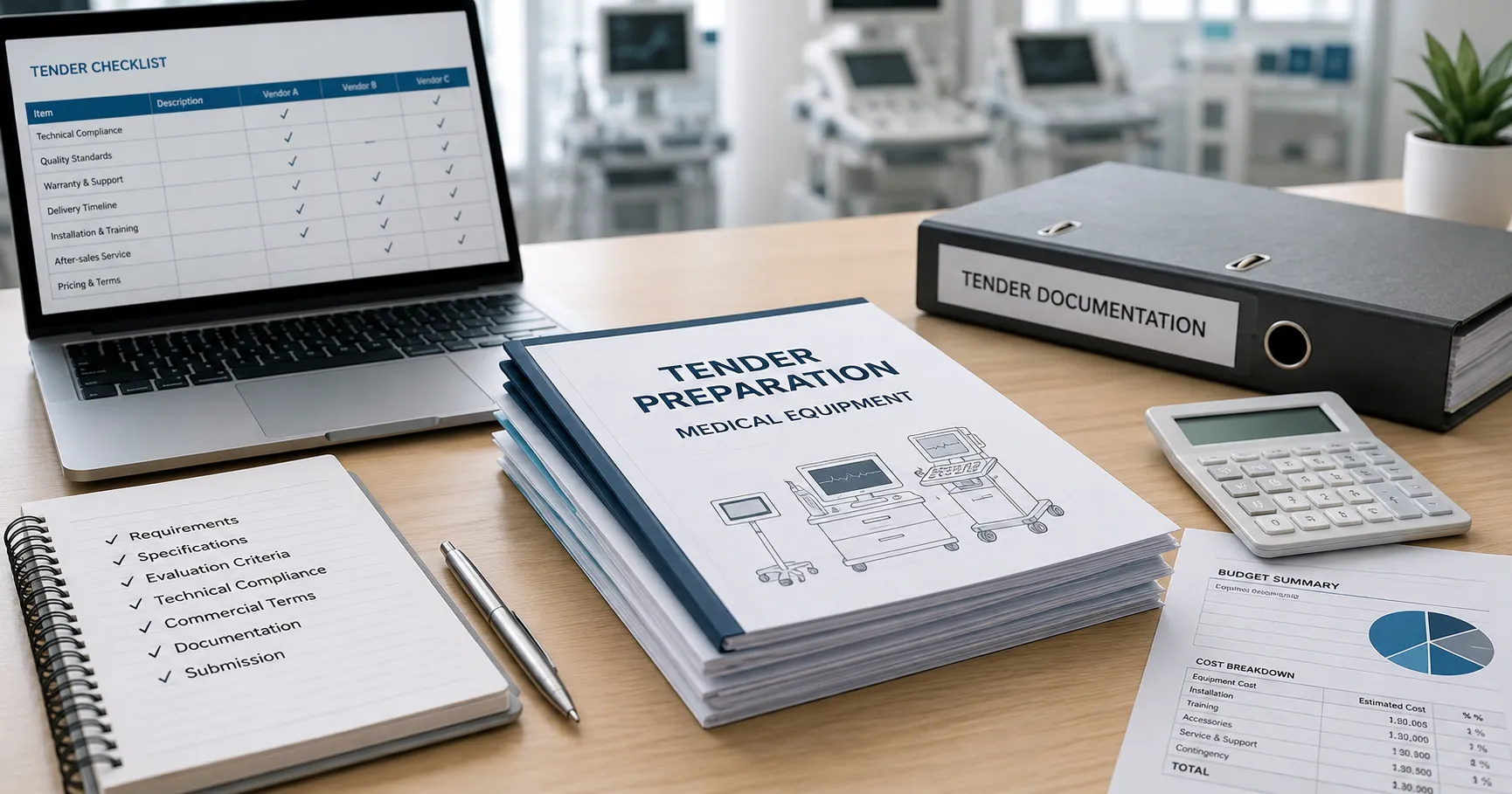
Standard pricing schedule — Buyers should provide a common format that covers equipment, accessories, freight, installation, training, warranty, software, maintenance, and consumables. Taxes and customs responsibilities should be stated separately.
This allows the evaluation team to identify excluded costs and calculate total delivered value.
Lifecycle cost assessment — Purchase price should be considered alongside maintenance, spare parts, software, consumables and expected replacement requirements. The evaluation period should match the equipment’s anticipated service life.
A lower initial bid may prove more expensive once recurring expenses are included.
Transparent supplier information — Suppliers and manufacturers advertising to global healthcare buyers should provide accurate product descriptions, configuration details, evidence of compliance, nd service terms. Tender evaluators should verify these claims against the submitted technical documents.
Supplier qualification — Buyers should review relevant experience, financial capacity, references, manufacturer authorisation and quality management arrangements. Qualification requirements should be proportionate to the contract risk.
Weighted evaluation method — Clinical suitability, technical compliance, pricing, delivery and after-sales support can be scored separately. Weightings should be approved before bids are opened and applied consistently.
Clarification controls — Clarifications may resolve ambiguity, but should not allow a bidder to redesign a non-compliant submission after the deadline. All questions and responses should be documented.
Healthcare groups running repeated tenders may benefit from formal international supply chain partnerships that preserve transparent pricing, defined service levels,s and appropriate procurement oversight.
Building Warranty and Maintenance Requirements into the Tender
Service requirements should be written into the tender rather than negotiated only after a preferred supplier has been identified. Maintenance quality can directly affect equipment availability and total ownership cost.
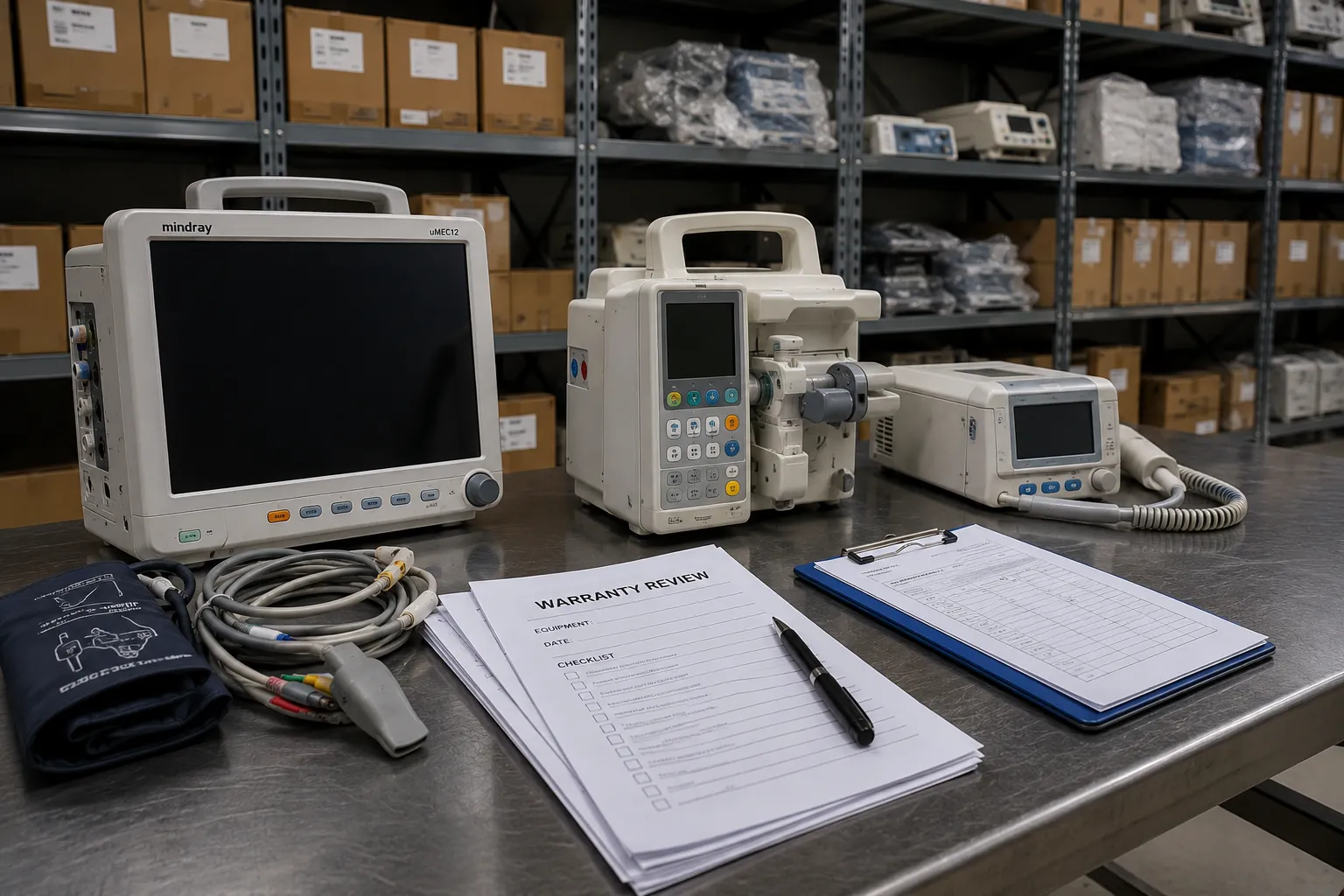
Warranty scope — The tender should define the required warranty period and require bidders to specify any exclusions. Labour, travel, replacement parts, software and preventive maintenance should be addressed separately.
A lengthy warranty offers limited value when travel or essential parts remain chargeable.
Preventive maintenance — Suppliers should provide recommended service intervals, task lists and resource requirements. Buyers should ask whether local engineers can perform maintenance and whether training is available.
Response and repair times — Critical equipment may require defined acknowledgement, attendance and restoration targets. Suppliers should explain how support will be delivered across the intended locations.
Spare-parts availability — Bidders should state expected parts support, typical lead times and any components recommended for local stock. This is particularly important where international shipping can extend downtime.
Training and technical transfer — Operator instruction should be distinguished from biomedical engineering training. The tender should specify participant numbers, training location, materials, assessments and refresher requirements.
Facilities with limited local support often find that engineer travel and extended downtime cost more than routine maintenance. Service capability should therefore carry meaningful weight during tender evaluation.
Managing International Bids, Delivery and Documentation
International tenders can improve market access, but they require clear rules for currency, shipping, documentation and destination-country compliance.
Commercial delivery terms — The tender should specify the required delivery location and the responsibilities for freight, insurance, customs, and local handling. Suppliers should use a consistent commercial basis when pricing bids.
Currency and payment structure — Buyers should define permitted currencies, quotation validity and payment milestones. Exchange-rate exposure should be considered before approval.
Export documentation — Bid requirements may include commercial invoices, packing lists, certificates of origin, conformity documents and inspection records. Suppliers should confirm their ability to provide destination-specific paperwork.
Delivery scheduling — Manufacturing, refurbishment, export preparation, transit, customs clearance and installation should be shown separately. A stated delivery date is more credible when supported by a detailed schedule.
New and refurbished offers — Where both are permitted, separate technical and documentation requirements should be provided. Refurbished equipment may require evidence of age, condition, service history, refurbishment work and remaining parts support.
Procurement assistance — Buyers preparing volume tenders or international equipment projects can contact the Medigear.uk team for supply support. A useful enquiry should include equipment categories, quantities, destination, technical requirements and the planned tender schedule.
International submissions become easier to evaluate when all bidders follow the same pricing, documentation, and delivery format.
Final thoughts
Medical equipment tender preparation should create a fair and measurable route from clinical need to contract award. Clear specifications, standard pricing schedules and published evaluation criteria help buyers compare offers without relying on headline price or promotional claims.
Strong tenders involve clinical, technical, commercial and operational stakeholders from the beginning. They define mandatory requirements carefully, include lifecycle costs and make warranty, training and service responsibilities visible before bids are submitted.
Disclaimer
Medigear.uk is a global medical equipment supplier, exporter, and distributor. The content published on this site is intended for educational and product awareness purposes only. Nothing on this page constitutes medical advice, clinical guidance, or treatment recommendations. All healthcare procurement and clinical decisions should be made by qualified medical professionals and compliant procurement teams operating within the regulatory frameworks of their respective countries.