CSSD storage solutions help healthcare facilities protect sterile medical instruments after cleaning, inspection, packaging, sterilisation, and release for clinical use. The Central Sterile Supply Department must keep sterile packs, surgical trays, procedure sets, and instrument containers organised until operating theatres, wards, emergency areas, procedure rooms, dental units, and outpatient departments require them.
For healthcare buyers' services, CSSD storage is not just about buying shelves or cabinets. It affects sterile barrier protection, instrument availability, staff workflow, case pre-casing, stock control, traceability, infection prevention, and compliance with applicable local regulatory standards. CDC guidance recommends that hospitals perform most cleaning, disinfection, and sterilisation of patient-care devices in a central processing department to more easily control quality.
How CSSD Storage Supports Sterile Supply Workflow
CSSD storage sits between sterilisation and clinical use. If this area is poorly planned, sterile packs may be crushed, misplaced, overhandled, exposed to moisture, or delayed before procedures.
Protection of Sterile Packs — Sterile instruments should remain protected until they are opened for use. CDC sterilising practice guidance notes that sterilised items should not be used if the package is wet, torn, or otherwise compromised.
Faster Case Pre-Casing — Surgical and procedure teams depend on correct trays arriving on time. A clear storage layout helps CSSD staff pick instrument sets quickly and reduces last-minute searching before theatre lists.
Controlled Clean Workflow — Sterile storage should be separated from decontamination and soiled handling areas. In practice, facilities often struggle when clean instruments, returned trays, empty containers, and dispatch trolleys move through the same tight corridor.
Better Stock Visibility — Organised storage helps teams see what is available, what is missing, and what needs reprocessing. This supports theatre planning and reduces unnecessary duplicate purchases.
Where CSSD Storage Solutions Are Used
CSSD storage solutions are used in central sterile supply departments, sterile storage rooms, theatre sterile corridors, procedure supply areas, dental sterilisation rooms, and satellite sterile supply zones. The right design depends on department size, case volume, instrument types, and delivery workflow.
Central Sterile Supply Departments — Large CSSD areas need dedicated storage zones for released sterile packs, containers, trays, wrapped sets, and procedure-specific instruments. The layout should support first-in, first-out rotation and easy picking.
Operating Theatre Supply Areas — Theatre sterile stores need quick access to trays and procedure packs. Facilities sourcing through regulated and certified equipment suppliers worldwide should confirm shelf strength, cabinet cleanability, tray compatibility, and tracking options before procurement.
Outpatient Procedure Units — Day surgery, endoscopy, dental, wound care, and minor procedure units may use smaller sterile storage cabinets. These areas still need clean, dry, protected storage and clear segregation from used instruments.
Satellite Sterile Storage Rooms — Some healthcare networks use satellite sterile stores near specialist departments. These rooms reduce transport time but require strong inventory control to ensure sterile supplies do not expire, become damaged, or disappear from the main CSSD workflow.
Core Storage Equipment Used in CSSD
CSSD storage is usually built from several types of equipment. The right combination depends on instrument weight, packaging method, available space, cleaning policy, and tracking system.
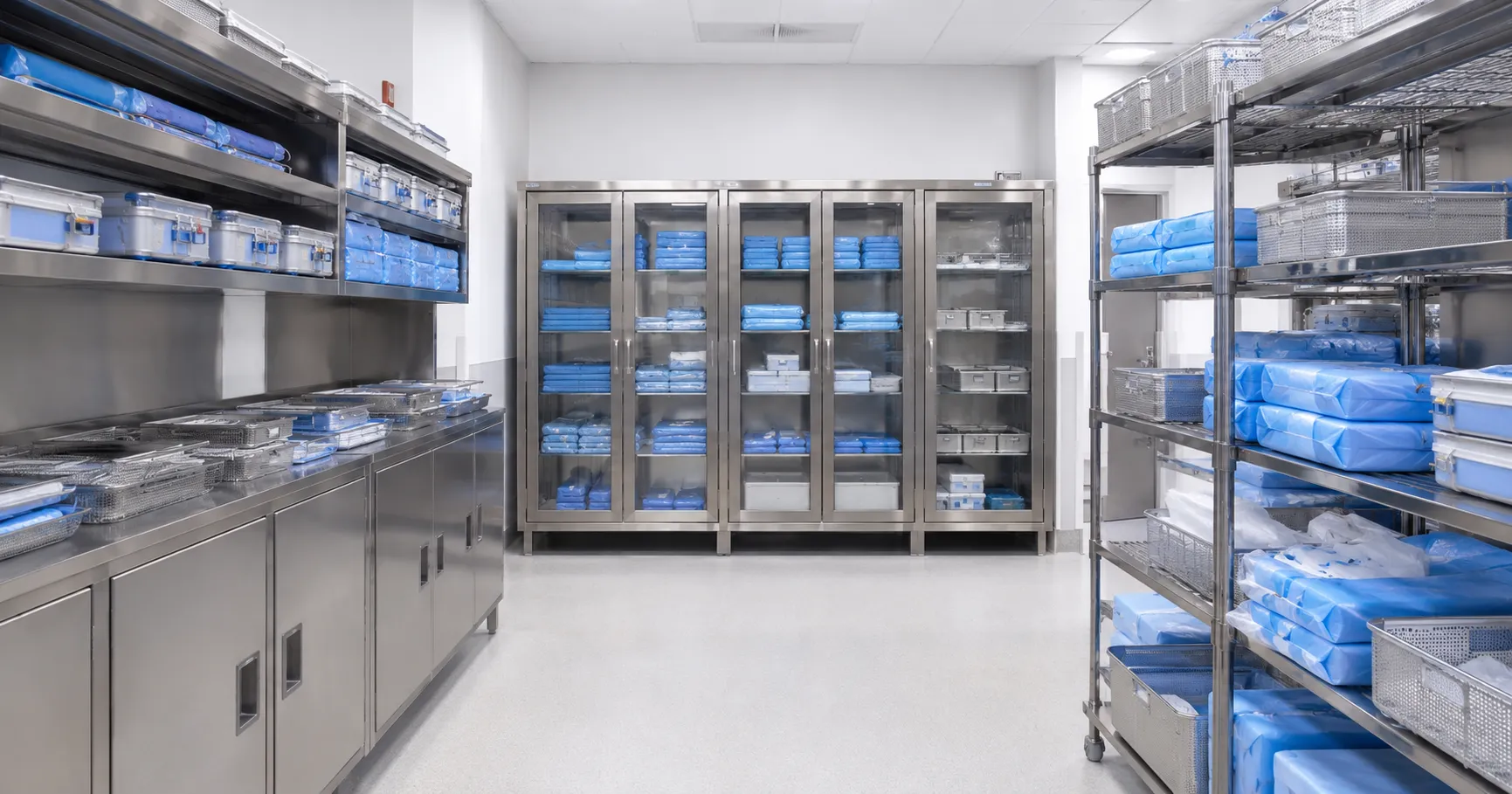
Sterile Storage Shelving — Shelving systems hold wrapped packs, trays, containers, and procedure sets. Shelves should be strong, smooth, easy to clean, and spaced to prevent crushing or overstacking.
Closed Storage Cabinets — protect sterile items from dust, unnecessary handling, and exposure to traffic. They may be useful in outpatient departments, procedure rooms, and areas where sterile items are stored outside the main CSSD.
Instrument Tray Racks — Tray racks help organise heavy surgical sets and container systems. Buyers should check the load capacity, as orthopaedic, neuro, and major theatre trays can be heavy.
Mobile Storage Trolleys — Mobile trolleys help move sterile supplies from CSSD to clinical areas. Covered trolleys can protect sterile packs during transport and reduce exposure to busy corridors.
Labelled Bins and Modular Inserts — Smaller sterile items may need bins, dividers, or modular baskets. Clear labelling helps staff pick the right item without having to overhandle multiple packs.
Storage Design Factors That Affect Sterility
Sterile storage depends on packaging quality, handling, environmental conditions, staff discipline, and storage design. A sterile pack can be compromised even after successful sterilisation if it is stored poorly.
Moisture Control — Sterile packs should be stored away from wet areas, sinks, leaking ceilings, or any risk of condensation. Moisture can compromise packaging and necessitate reprocessing.
Dust and Traffic Protection — High-traffic areas increase handling and exposure. Sterile storage should be located where movement is controlled and where items are not brushed, bumped, or repeatedly touched.
Event-Related Sterility Awareness — Many sterile processing frameworks use event-related thinking, where a pack remains usable until an event compromises its sterility barrier, such as wetness, tearing, contamination, or excessive handling. Facilities may still set local shelf-life rules based on packaging type and policy.
Correct Shelf Spacing — Packs should not be packed tightly against walls, floors, or ceilings. Adequate spacing supports cleaning, airflow, inspection, and easier handling.
Handling Reduction — The more often staff move a sterile pack, the higher the chance of damage. Storage should allow staff to find items quickly without having to move several packs to reach a single tray.
Planning CSSD Storage Layout
A CSSD storage layout should support clean movement from sterilisation release to storage, picking, dispatch, and clinical delivery. It should not force sterile items to cross soiled workflows.
Clean-to-Sterile Direction — The workflow should move from inspection and packing to sterilisation, cooling, release, storage, and dispatch. WHO guidance on decontamination and reprocessing highlights quality control procedures at each step of the medical device reprocessing process.
Separate Storage Zones — Facilities may divide storage into surgical trays, procedure packs, emergency sets, loaner sets, sterile consumables, and department-specific supplies. This reduces picking errors and improves accountability.
Clear Dispatch Points — Storage should connect logically to dispatch trolleys or case cart assembly areas. If dispatch is poorly placed, staff may park trolleys in aisles and block access.
Room for Growth — CSSD demand usually increases as procedure volume grows. Experienced clinical supply managers often plan spare storage capacity because adding shelves later can disrupt workflow.
Visibility and Labelling — Labels should be easy to read. Colour coding, barcodes, RFID tags, and shelf maps can help staff find sterile items quickly.
Procurement Guidance for CSSD Storage Solutions
CSSD storage procurement should involve sterile services managers, infection prevention teams, operating theatre leaders, biomedical engineers, facility planners, and supply chain staff. Storage decisions affect many departments, so a workflow review should inform procurement.
Total Cost of Ownership — Buyers should include the cost of shelving, cabinets, racks, trays, baskets, labels, tracking systems, transport trolleys, cleaning products, spare parts, installation, and future expansion. A low-cost storage system may become expensive if it bends under heavy trays or cannot be cleaned properly.
Load Capacity and Build Quality — CSSD shelves and racks must safely support instrument trays. Heavy surgical sets need strong frames, stable feet, corrosion-resistant surfaces, and reliable joints.
Supplier Transparency — Suppliers and manufacturers advertising to global healthcare buyers should provide clear information on load rating, material grade, shelf dimensions, cleaning compatibility, modular options, trolley compatibility, warranty terms, and spare part availability. Healthcare buyers should avoid vague listings that do not confirm suitability for sterile storage.
Compliance and Documentation — Procurement teams should request product specifications, material information, cleaning guidance, load ratings, installation instructions, warranty terms, and conformity documents. Compliance should be checked against applicable local regulatory standards, such as CE, FDA, ISO, or their regional equivalents, where relevant.
Healthcare groups managing several hospitals, surgical centres, or specialist clinics may benefit from structured distribution and reseller partnership arrangements. Standardising shelves, cabinets, tray racks, labels, and transport trolleys can reduce training needs and simplify replacement planning.
Tracking and Inventory Control in Sterile Storage
CSSD storage should support traceability. Staff need to know which instruments are available, which trays are waiting for use, which sets are missing, and which packs require reprocessing.
Manual Tracking Systems — Smaller facilities may use registers, shelf labels, and dispatch logs. This can work when procedure volume is low, and staff follow the process carefully.
Barcode Tracking — Barcode systems can help record sterilisation batches, tray identities, storage locations, and dispatch movements. They reduce manual writing and help audit instrument flow.
RFID Instrument Tracking — Larger hospitals may use RFID systems to monitor tray movement and reduce lost sets. RFID can support faster inventory checks, but it requires investment, staff training, and system maintenance.
Expiry and Event Checks — Staff should inspect packaging before issue. Wet packs, torn wrappers, opened seals, damaged containers, or unclear labels should be removed from the sterile supply.
Loaner and Consignment Set Control — Orthopaedic and speciality cases often use loaner sets. These require clear storage, tracking, and return processes to avoid interfering with routine CSSD inventory.
Infection Prevention and Environmental Control
Sterile storage must stay clean, organised, and protected. The environment should support sterile barrier integrity and reduce unnecessary exposure.
Clean Storage Conditions — Sterile items should be kept in clean, dry storage areas. Shelves, cabinets, and carts should be cleaned according to facility policy.
Controlled Access — Sterile storage areas should not be used as general supply rooms. Limiting access reduces unnecessary handling and helps maintain accountability.
Packaging Integrity Checks — Staff should check sterile packs for tears, dampness, dust, broken seals, or crushed areas. Any compromised item should be reprocessed in accordance with facility policy.
Traffic Flow Management — Soiled instruments, waste, personal items, and cleaning equipment should not pass through sterile storage areas. APSIC guidance describes CSSD functions as hospital-wide disinfection and sterilisation support, including training and reporting of recall events, thereby reinforcing the need for controlled processes.
Cleaning Responsibility — Facilities should define who cleans shelves, cabinets, handles, wheels, bins, and storage rooms. Clean equipment can become neglected if responsibility is unclear.
Equipment Maintenance and Service Life
CSSD storage systems need regular maintenance because they hold valuable sterile instruments and heavy surgical sets—a damaged shelf or trolley can compromise safety and the continuity of sterile supply.
Shelf and Rack Inspection — Staff should check for bending, corrosion, loose bolts, sharp edges, unstable legs, and damaged shelf surfaces. Damaged storage should be repaired or removed from use.
Cabinet Door and Seal Checks — Inspect cabinet hinges, handles, locks, and seals. Poorly closing doors can expose sterile items to dust and handling.
Trolley Wheel and Brake Maintenance — Mobile storage trolleys need smooth wheels and reliable brakes. Weak brakes or damaged casters can create handling problems and increase the risk of pack damage during transport.
Label and Tracking Maintenance — Labels, barcodes, RFID tags, and shelf maps should remain readable and up to date. A strong tracking system fails if location labels become inaccurate.
Cleaning Compatibility — Storage equipment should be compatible with approved cleaning products. Some coatings, plastics, wheels, and labels may degrade when repeatedly exposed to harsh chemicals.
Storage Solutions for Different Facility Sizes
CSSD storage needs vary between large hospitals, district hospitals, ambulatory surgery centres, dental facilities, and small procedure clinics.
Large Teaching Hospitals — These facilities may require high-capacity shelving, automated tracking, case-cart systems, and dedicated sterile-dispatch zones. Storage must handle high tray volume and multiple surgical specialities.
District Hospitals — District hospitals may need durable shelving, covered trolleys, and clear manual tracking. The system should be simple enough for mixed teams to manage reliably.
Specialist Surgical Centres — Orthopaedic, ophthalmology, ENT, and dental surgical centres may need procedure-specific trays and compact sterile storage. The layout should match the scheduled procedure lists and instrument turnover.
Mobile and Outreach Care — Mobile procedure units and outreach clinics may need compact sterile containers, secure cabinets, and transport-friendly storage. Sterile pack protection during movement becomes especially important.
Private Clinics and Day Surgery Units — These settings may prefer closed cabinets, modular shelving, and easy visibility into stock. The system should support quick turnover without creating clutter.
International Sourcing Considerations
CSSD storage solutions can be sourced internationally when buyers clearly define instrument volume, tray weight, room size, cabinet type, shelving dimensions, trolley needs, tracking method, cleaning requirements, documentation, packaging, warranty, and spare part support. This is especially important for new hospital projects, CSSD upgrades, and surgical centre expansions.
Buyers should confirm whether they need sterile storage shelving, closed cabinets, tray racks, modular bins, covered trolleys, case cart systems, barcode labels, RFID tracking, or full sterile storage room planning. For project-based sourcing, buyers can contact the Medigear.uk team for supply support to discuss availability, documentation, export needs, and procurement requirements.
How CSSD Storage Improves Hospital Efficiency
CSSD storage solutions help facilities avoid delays, searching, stock confusion, pack damage, and unnecessary reprocessing. A good system improves both sterile services workflow and clinical readiness.
Faster Instrument Picking — Staff can quickly find trays and packs when shelves are clearly labelled and organised by procedure type or department.
Reduced Pack Damage — Strong shelves, correct spacing, and fewer handling steps help protect sterile barriers.
Improved Theatre Readiness — Operating rooms depend on the correct instruments arriving on time. Reliable storage supports smoother case preparation.
Better Inventory Planning — Tracking stock movement helps procurement teams understand usage patterns, shortages, duplicate stock, and replacement needs.
Clearer Staff Accountability — When storage zones, labels, and responsibilities are clear, staff can follow the process more consistently.
Final Thoughts
CSSD storage solutions protect sterile medical instruments and support efficient sterile supply workflows. They help hospitals and clinics organise trays, packs, containers, and procedure sets while reducing damage, searching, and stock confusion.
The right system should match instrument volume, tray weight, room layout, sterile barrier requirements, tracking needs, cleaning policy, and local compliance standards. Buyers should review technical documentation, workflow fit, maintenance needs, spare parts, and supplier support before ordering.
Disclaimer
Medigear.uk is a global medical equipment supplier, exporter, and distributor. The content published on this site is intended for educational and product awareness purposes only. Nothing on this page constitutes medical advice, clinical guidance, or treatment recommendations. All healthcare procurement and clinical decisions should be made by qualified medical professionals and compliant procurement teams operating within the regulatory frameworks of their respective countries.