
EpiCom CBD Trial Findings Ease TAND Behavior in TSC Patients
Adding cannabidiol (CBD; Epidiolex) to standard care eased the behavioral burden in patients with tuberous sclerosis complex (TSC). That is the result of the first trial to track treatment for TSC-associated neuropsychiatric disorders (TAND).
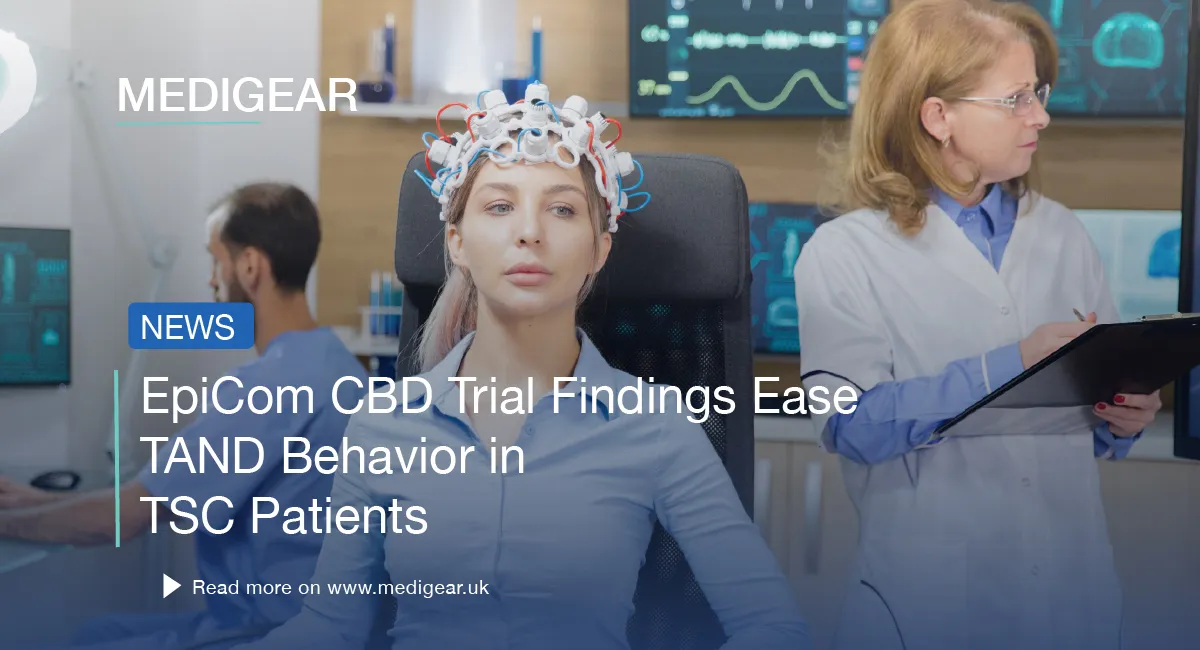
Adding cannabidiol (CBD; Epidiolex) to standard care eased the behavioural burden in patients with tuberous sclerosis complex (TSC). That is the result of the first trial to track treatment for TSC-associated neuropsychiatric disorders (TAND).
The EpiCom CBD trial findings were presented on April 20 at the American Academy of Neurology (AAN) 2026 Annual Meeting in Chicago. They mark the first signal that CBD may help with TSC psychiatric and cognitive issues.
What the EpiCom trial measured
EpiCom is an ongoing open-label phase 3b/4 study. It tracks TAND outcomes after CBD oral solution is added to standard care in patients aged 1 to 65 years with TSC-related seizures.
The 6-month interim covered 79 participants. About 79% were pediatric, with a mean age of 18.5 years, 58% male. All had moderate or severe behavioural problems at baseline, including aggression, temper tantrums, and self-injury.
Each received up to 25 mg/kg/d of CBD plus usual care. Treatment ran 26 weeks.
Outcome scales were the most problematic behaviour, the numerical rating scale, and the TAND Self-Report Quantified Checklist (TAND-SQ). The team also used the Aberrant Behavioural Checklist (ABC) and the Caregiver- and Clinician-reported Global Impression of Severity scales. All ran at baseline, weeks 13 and 26.
Behavioral results
The most problematic behaviour score fell by 2.0 points (95% CI, -3.0 to -1.0) from baseline to week 26.
On the TAND-SQ, the largest improvements were in overactive/impulsive behaviours (-1.3) and eating/sleeping problems (-2.0). On the ABC, irritability dropped by 8.0 points (-8.0) and hyperactive noncompliance by 7.0 points (-7.0).
Clinician-rated severity dropped sharply. At baseline, 47% rated behaviour as severe; that fell to 10% at week 13 and 0% at week 26. Very severe ratings went from 10% at baseline to 0% at both later points.
Caregivers saw the same trend. Severe ratings fell from 38% at baseline to 14%, then 13%. Very severe ratings moved from 18% at baseline to 4%, then 13%.
Bonus seizure reductions
The EpiCom CBD trial findings also showed strong seizure cuts. Among those with baseline seizures, 60% reached at least a 50% drop in total seizure count by week 13. By week 26, 36% held that mark. For a smaller cut, 67% and 55% reached at least 25%.
David C. Spencer, MD, called the dual gain a "double win" for patients with TSC. Spencer is a professor of neurology at Oregon Health & Science University, Portland, and director of its Comprehensive Epilepsy Centre.
In the epilepsy field, "we sometimes get a bit narrowly focused on seizures, but what also needs to be addressed are the comorbidities that go along with that," Spencer told Medscape Medical News.
Spencer said he wants more detailed data on whether seizure cuts drove the behavioural gains or whether the two ran on separate tracks.
Safety and what comes next
Treatment-emergent adverse events affected 62% of participants. The most common were diarrhoea (19), infections (18), and psychiatric disorders (13). Common infections were influenza and upper respiratory tract infections. Common psychiatric events were abnormal behaviour and aggression.
There were six serious adverse events. Four were deemed treatment-related. All resolved.
"The safety profile was consistent with previous CBD studies," said study investigator Elizabeth A. Thiele, MD, PhD, of the Carol and James Herscot Centre for Tuberous Sclerosis Complex at Massachusetts General Hospital, Boston.
Thiele told Medscape Medical News that this is the first trial to look at TAND. Treatment will run through 52 weeks. Final EpiCom CBD trial findings are expected by year-end.
Why TAND matters
TSC is a rare genetic disorder affecting roughly 1 in 6000 people. It can trigger benign tumours across the brain, eyes, heart, and other organs, often with seizures.
The FDA approved CBD for TSC-related seizures in 2020 for patients aged 1 year and older.
TAND covers behavioural, psychiatric, intellectual, and psychosocial difficulties. It affects up to 90% of TSC patients. A 2023 international consensus urges annual TAND screening. Treatment options remain thin.
The EpiCom CBD trial findings push CBD beyond seizure control. The study was funded by Jazz Pharmaceuticals.
The EpiCom CBD trial findings could reshape TSC care. Coverage on Medigear.uk shows why hospital teams must follow how these EpiCom CBD trial findings reshape TSC care.
Source: Originating coverage based on Medscape Medical News reporting on the EpiCom phase 3b/4 trial findings presented on April 20 at the American Academy of Neurology (AAN) 2026 Annual Meeting in Chicago — Elizabeth A. Thiele, MD, PhD, Massachusetts General Hospital, with commentary from David C. Spencer, MD, Oregon Health & Science University. Funded by Jazz Pharmaceuticals.
Sourcing medical equipment?
Tell us the model and destination — our sourcing team will respond within one business day.

As a Product Catalogue Specialist at MediGear, I manage product listings, specifications, images and categories to ensure all information is accurate, consistent and professionally presented for hospitals, clinics, distributors and healthcare buyers.
View all articles
MiniMed Smart MDI System: 8.1pp TIR Lift at EASD 2026
Type 1 diabetes patients who responded to more MiniMed Smart MDI alerts hit better glucose numbers i…
Corcym Memo 4D Curve Mitral Ring: First-in-Human US Implant
The Corcym Memo 4D Curve mitral repair ring has landed its first-in-human implant. The news comes so…
Myrava 3D-Printed Bolus Wins FDA 510(k) for Radiotherapy
The Myrava 3D-printed bolus has cleared the US Food and Drug Administration (FDA). The 510(k) nod co…
Medical device news, once a week.
Approvals, trials, recalls and market moves — the essentials for procurement and clinical teams.