
Psilocybin Dementia Case: Striking Symptom Reversal in 80-Year-Old
A new psilocybin dementia case from Brazil describes major symptom relief in an 80-year-old woman with advanced Alzheimer's after magic mushrooms. The paper, in Frontiers in Neuroscience, is drawing attention. But outside experts urge caution.
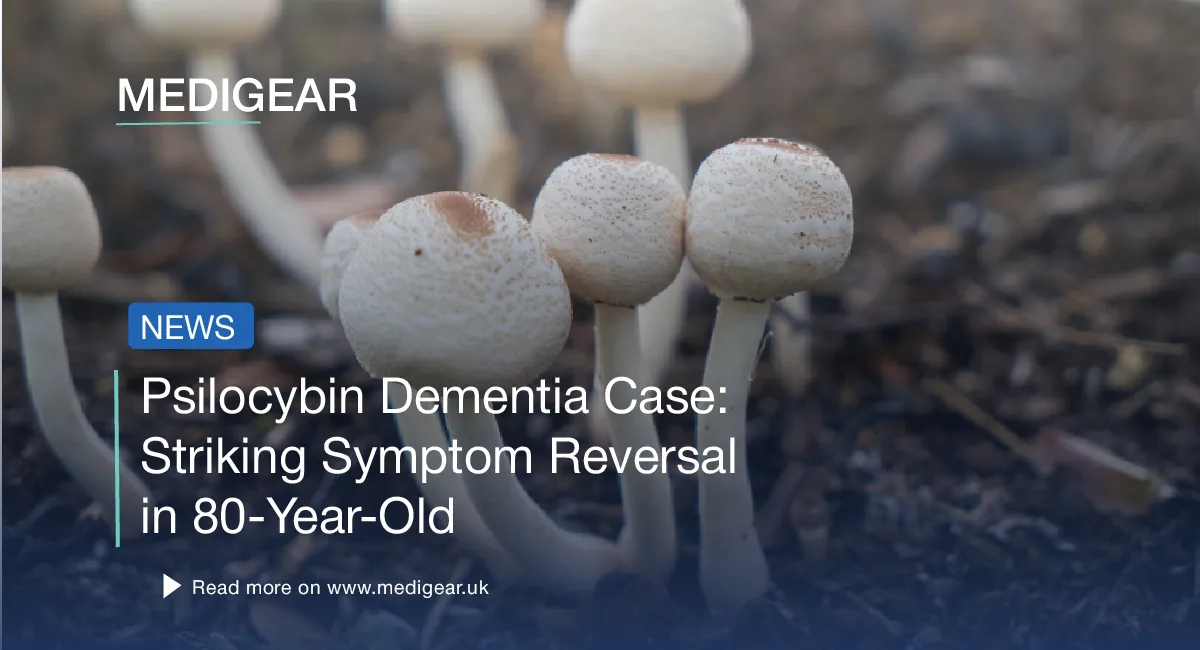
A new psilocybin dementia case from Brazil describes major symptom relief in an 80-year-old woman with advanced Alzheimer's after magic mushrooms. The paper, in Frontiers in Neuroscience, is drawing attention. But outside experts urge caution.
The psilocybin dementia case centres on a patient who had carried her diagnosis for 10 years. She was incontinent, spoke only in single syllables, and could not dress herself. She needed help walking and eating. She was emotionally unresponsive. Guardians consented to enrollment.
What the psilocybin dementia case showed
At the first session, the patient received 5 grams (g) of psilocybin-containing mushrooms. That is a high dose. Recreational use runs 1–2 g.
After the dose, she appeared to overheat and entered a long sleep-like state. About 19 hours later, she spoke spontaneously: "[a]pproximately 19 [hours] after administration, the patient spontaneously initiated autobiographical conversation lasting several hours."
Over the following weeks, the patient stopped being incontinent. She moved more easily and engaged socially. Within days of the session, she could walk unaided and dress herself.
One month later, she received a smaller 3 g dose. She was verbally expressive throughout. The authors said she showed more facial expressions and humour with "emotional reciprocity."
Why dementia treatments often disappoint
Alzheimer's disease is the most common form of dementia. Decades of work have produced treatments that only slow progression and ease symptoms. Many trial drugs target the misfolded proteins that mark the disease. That approach has largely failed.
Researchers are widening the search. Psychedelics sit on that wider list. This psilocybin dementia case adds urgency.
How psilocybin might affect the brain
Once swallowed, psilocybin converts to psilocin. The molecule binds the 5-HT2A serotonin receptor. Activating this receptor may:
- Boost neural plasticity, which lets the brain rewire. People with Alzheimer's have fewer synapses, so a boost in plasticity may help build new pathways.
- Cut brain inflammation, a known factor in dementia.
- Improve creativity and cognitive flexibility.
Earlier work also shows that 5-HT2A receptor density drops in Alzheimer's patients.
Dustin Hines, PhD, associate professor of psychology at the University of Nevada, Las Vegas, offered a possible mechanism. He was not part of the work: "In Alzheimer's, some neural circuits may be impaired but not completely destroyed. Psilocybin may transiently increase network flexibility enough for residual circuits involved in memory, emotion, movement, continence, and social behaviour to come back online."
Hines stressed the psilocybin dementia case mechanism remains a hypothesis, "not established fact."
A second possible mechanism
Tim Spector, OBE, FMedSci, of King's College London in the United Kingdom, raised a separate possibility. Spector is a professor of epidemiology. The "trippy" effect of psilocybin partly reflects shifts in the brain's default mode network (DMN), he said.
The DMN runs when the brain is at rest. It handles self-focused thinking, autobiographical memory, and mind-wandering. Psilocybin cuts connectivity within the DMN and boosts connectivity between the DMN and other regions. The effect can outlast the acute trip.
"Although this is entirely hypothetical, we also know that the DMN is altered in people with Alzheimer's, so 'rebooting' it might, theoretically, play some part in relieving symptoms," Spector suggested.
What this psilocybin dementia case does not show
The psilocybin dementia case report has clear limits. It is a single patient. The diagnosis was not confirmed with scans. Dementia symptoms can fluctuate. Improvements may have coincided with the dosing.
The study's ethics note also gave little reassurance. The paper states that "Ethical approval was not required for this single case report conducted in routine private clinical practice, in accordance with local legislation and institutional requirements," it reads.
Hines pointed to an ethics precedent. "There is already a substantial safety record for high-dose psilocybin in clinical research," he explained. Much of that base came from Roland Griffiths' work in advanced cancer patients.
Strong warning against home use
Hines was direct about risk: "Do not try this at home on yourself or a loved one with dementia. This case involved a very high mushroom dose in a medically fragile older adult, with suspected hyperthermia, sweating, autonomic activation, and prolonged altered consciousness."
Older adults with dementia face a higher risk of falls, aspiration, delirium, cardiovascular complications, and limited ability to consent.
For geriatric and neurology teams, the case is a striking signal but not proof. Coverage on Medigear.uk tracks how this psilocybin dementia case shapes research.
Source: Originating coverage based on Medical News Today reporting on a case study published in Frontiers in Neuroscience describing psilocybin in an 80-year-old patient with advanced Alzheimer's disease in Brazil, with outside commentary from Dustin Hines, PhD, University of Nevada, Las Vegas, and Tim Spector, OBE, FMedSci, King's College London, United Kingdom.
Sourcing medical equipment?
Tell us the model and destination — our sourcing team will respond within one business day.

As a Product Catalogue Specialist at MediGear, I manage product listings, specifications, images and categories to ensure all information is accurate, consistent and professionally presented for hospitals, clinics, distributors and healthcare buyers.
View all articles
MiniMed Smart MDI System: 8.1pp TIR Lift at EASD 2026
Type 1 diabetes patients who responded to more MiniMed Smart MDI alerts hit better glucose numbers i…
Corcym Memo 4D Curve Mitral Ring: First-in-Human US Implant
The Corcym Memo 4D Curve mitral repair ring has landed its first-in-human implant. The news comes so…
Myrava 3D-Printed Bolus Wins FDA 510(k) for Radiotherapy
The Myrava 3D-printed bolus has cleared the US Food and Drug Administration (FDA). The 510(k) nod co…
Medical device news, once a week.
Approvals, trials, recalls and market moves — the essentials for procurement and clinical teams.