
Hantavirus Cruise Ship Outbreak: MV Hondius Andes Virus Update
Hantavirus cruise ship update: MV Hondius outbreak reaches 13 cases and 3 deaths; Andes virus confirmed; WHO calls global risk low — Medigear.uk news.
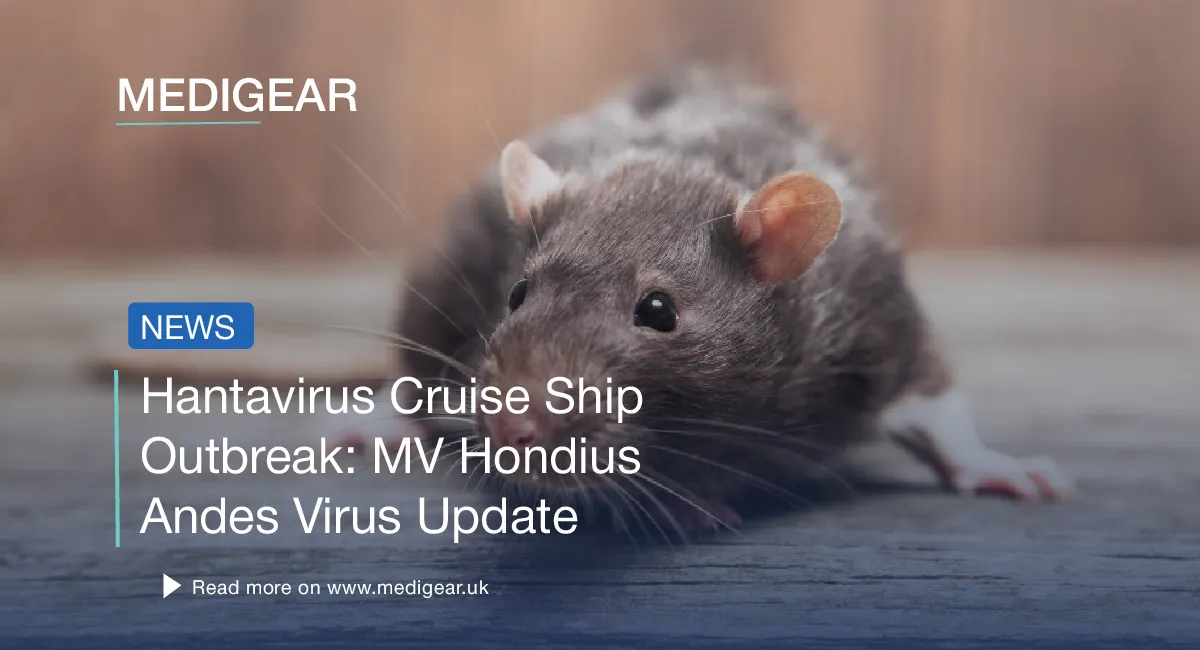
A new hantavirus cruise ship outbreak on the MV Hondius has hit 13 cases and 3 deaths as of May 27, 2026. Labs confirmed 11 cases of Andes virus (ANDV) and 2 probable. The hantavirus cruise ship, operated by Oceanwide Expeditions, sailed from Ushuaia, Argentina, with 147 people aboard. The WHO has labelled the global risk "low."
The index case was a 70-year-old Dutch male onboard. He started experiencing symptoms on April 6, five days after departure, and died on April 11, 2026. The ship notified the WHO on May 2. Labs in South Africa confirmed hantavirus. The ship was first held off Cape Verde, then docked at Granadilla, Tenerife, Canary Islands on May 10.
Passengers and crew remain at high risk regardless of symptoms. Medical evacuations run on non-commercial flights. Cases surfaced in Canada, the Netherlands, and Spain. Care reached France, South Africa, Switzerland, Singapore, and Spain.
What hantavirus is and how it spreads
Hantaviruses are zoonotic viruses carried by rodents. They spread via rodent saliva, urine, and faeces. Most strains do not pass person to person. Andes is the exception.
William Schaffner, MD, of Vanderbilt University Medical Centre, explained the rodent route. He is a professor of preventive medicine.
"Hantavirus lives in small rodents in certain parts of the world, usually where the climate is rather dry. The virus is shed in the urine and faeces of the rodents. People usually become infected when they stir up dried dust that contains the virus, causing an aerosol which is inhaled, thus initiating the infection," he told MNT.
"In this cruise ship incident, the passengers boarded in Argentina. This is relevant because a hantavirus variant, the Andes strain, occurs there, and, different from other hantaviruses, the Andes strain can be spread from person to person," he said.
Justin Chan, MD, of NYU Langone Health and Bellevue Hospital Centre, weighed in on the hantavirus cruise ship spread. Andes hantavirus needs close, prolonged contact with body fluids, Chan told MNT.
Why the Andes strain matters
The Andes strain (ANDV) was first identified in Argentina in 1995. It is most common in Argentina and Chile. Hantavirus cardiopulmonary syndrome (HCPS) has a case fatality rate up to 50%. Initial hantavirus cruise ship passengers were likely exposed to rodents.
Monica Gandhi, MD, MPH, of the University of California, San Francisco, described the lung syndrome. "The Andes strain causes lung symptoms and is found in South America generally. This syndrome is hallmarked by fever, shortness of breath, fluid in the lungs and shock. The patient can proceed to severe oxygen deprivation, bleeding, renal failure and require intubation and strong supportive care," she added.
Symptoms and incubation
Per WHO and CDC, incubation runs from a few days to 1-8 weeks. Initial symptoms are often missed.
"Hantaviruses cause stealth infections. The initial phase of the illness seems rather mild, with fever, headache, feeling poorly, some muscle aches – it does not alarm the patient," Schaffner said.
After 2 to 4 days, the patient crashes into HCPS. Breathing turns difficult, blood pressure falls, and severe weakness sets in.
Public health response
The European Centre for Disease Prevention and Control (ECDC) activated the Early Warning and Response System (EWRS) for European authorities. The ECDC issued MV Hondius guidance on May 9.
Symptomatic passengers should get tested and seek care. They can isolate in Tenerife or fly home on medical flights. Test-negative passengers should still quarantine for up to 6 weeks. Asymptomatic passengers remain high-risk contacts. Staff should wear gloves, FFP2 masks, and eye protection.
There are no vaccines or antivirals for the hantavirus cruise ship strain. Treatment is supportive care, often in intensive care.
Outlook on the hantavirus cruise ship outbreak
Schaffner said the cruise ship outbreak appears well confined. "The risk of substantial spread is very low; this should not be the start of another COVID-like epidemic," he added.
Chan added that despite high mortality, human-to-human spread is uncommon and the overall risk to the general public is deemed low.
"Everyone who has disembarked should be isolating at home for up to 6-8 weeks to monitor for symptoms and contact public health immediately if there are symptoms so they can be tested," Gandhi said.
For infectious disease and travel medicine teams, the hantavirus cruise ship case shows the value of WHO and ECDC coordination. Coverage on Medigear.uk tracks the outbreak.
Source: Originating coverage based on Medical News Today reporting on the Andes hantavirus outbreak on the Dutch-flagged cruise ship MV Hondius, operated by Oceanwide Expeditions, with WHO and ECDC updates and expert commentary from William Schaffner, MD, Vanderbilt University Medical Center; Justin Chan, MD, NYU Langone Health and Bellevue Hospital Center; and Monica Gandhi, MD, MPH, University of California, San Francisco.
Sourcing medical equipment?
Tell us the model and destination — our sourcing team will respond within one business day.

As a Product Catalogue Specialist at MediGear, I manage product listings, specifications, images and categories to ensure all information is accurate, consistent and professionally presented for hospitals, clinics, distributors and healthcare buyers.
View all articles
MiniMed Smart MDI System: 8.1pp TIR Lift at EASD 2026
Type 1 diabetes patients who responded to more MiniMed Smart MDI alerts hit better glucose numbers i…
Corcym Memo 4D Curve Mitral Ring: First-in-Human US Implant
The Corcym Memo 4D Curve mitral repair ring has landed its first-in-human implant. The news comes so…
Myrava 3D-Printed Bolus Wins FDA 510(k) for Radiotherapy
The Myrava 3D-printed bolus has cleared the US Food and Drug Administration (FDA). The 510(k) nod co…
Medical device news, once a week.
Approvals, trials, recalls and market moves — the essentials for procurement and clinical teams.