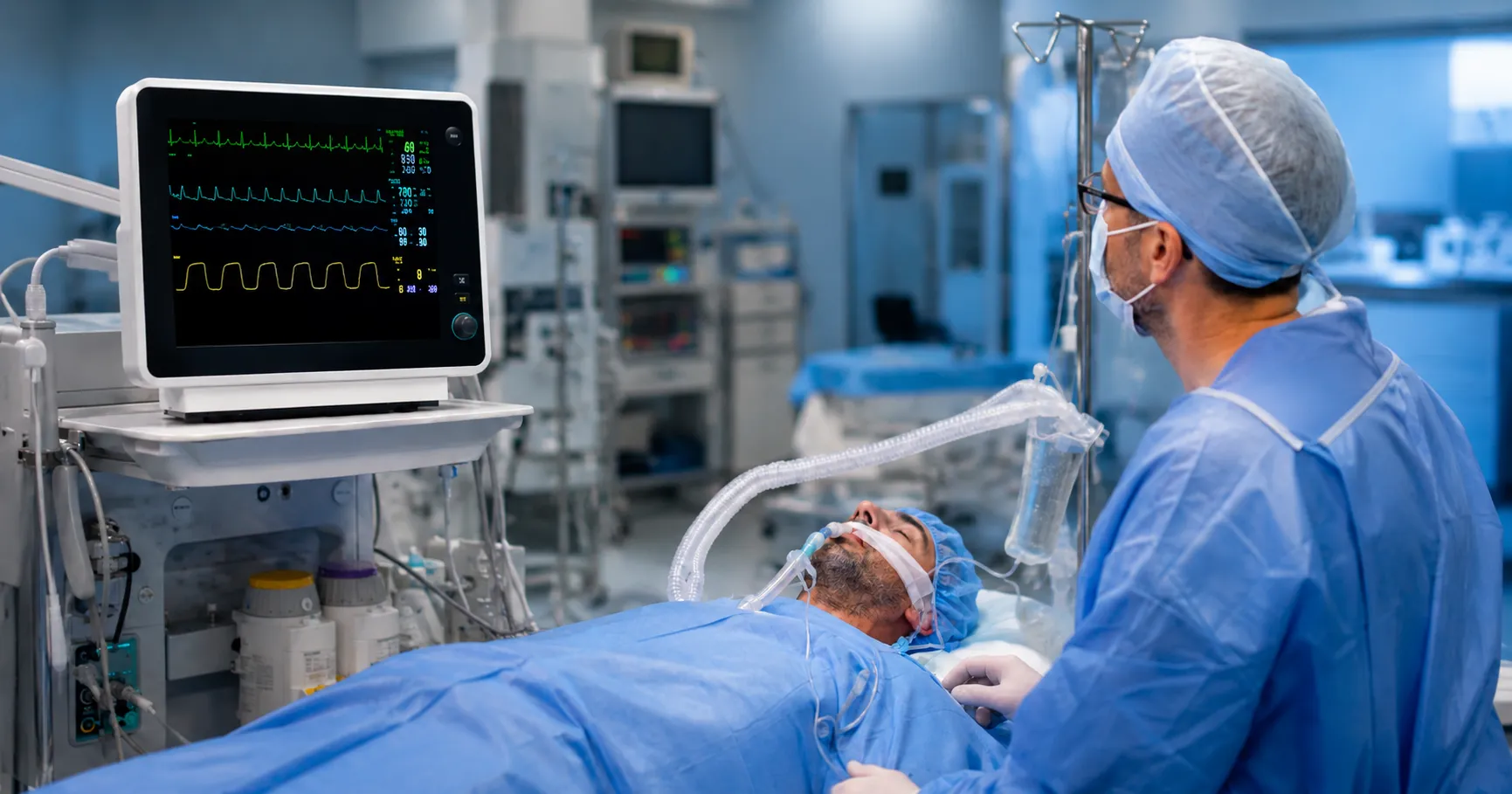
What is the number on the monitor showing CO2 at the end of every breath? Why do anaesthetists and intensive care teams treat it as one of the most important numbers in the room? Capnography. Continuous CO2 measurement. Not a test ordered and waited for. A live waveform. A number updated every breath. In real time. Flat when no breath comes. Climbs when CO2 is retained. Drops to zero when the tube is displaced. Seconds. No other monitor tells this story in real time.
He was forty-one. Appendicectomy. Routine procedure. Induced under general anaesthesia. Intubated. Monitor attached. EtCO2 thirty-eight. Normal square waveform. At twenty-two minutes — waveform peaked, then flattened. End-tidal CO2 dropped to zero. The anaesthetist acted. Tube displaced. Reintubated within ninety seconds. SpO2 never fell below ninety-four. The patient woke up. Home the next day. No harm done. Without capnography, displacement was found only when SpO2 fell. By that point, hypoxic injury had a window. With capnography — displacement found. Before oxygen levels moved.
This guide covers what capnography is and why it is used. Honest detail. For anaesthetists, anaesthetic nurses, and procurement teams. Medigear supplies certified capnography monitors and respiratory monitoring equipment. To NHS theatres, private hospitals, and intensive care units across the UK. Theatres sourcing certified capnography equipment can explore the Medigear buyers portal for pricing, availability, and procurement built for anaesthetic monitoring purchasing.
What Capnography Measures
The monitor measures CO2 in exhaled air. CO2 rises during exhalation as alveolar gas is expelled. Peak at end of exhalation — EtCO2. In normal lungs, this approximates arterial CO2. Normal EtCO2 — thirty-five to forty-five millimetres of mercury. Above — hypercapnia. Below — hypocarbia. Both matter. In lung disease, EtCO2 may underestimate arterial CO2. Trend and waveform remain valuable. Even when the absolute number is less reliable.
The Waveform
The waveform has a characteristic shape. Phase one — baseline. Dead space. No CO2. Flat. Phase two — rapid rise. Dead space giving way to alveolar gas. Steep upstroke. Phase three — alveolar plateau. EtCO2 read here. Flat or gently rising. Phase four — rapid fall. Baseline. Next breath begins. Shape reveals mechanics. Airway patency. Completeness of exhalation. Normal square waveform — reassuring. Abnormal — act. Capnography monitor manufacturers wanting to list mainstream, sidestream, and portable units where theatres and intensive care units are searching can reach buyers through the Medigear advertising platform.
Mandatory Use
Mandatory in the UK. Every patient is under general anaesthesia. The Association mandates it. On a tube or on a supraglottic device — continuous monitoring required. No other monitor is as reliable. SpO2 reflects oxygen levels. Downstream from breathing. By the time it falls after displacement, reserves are depleted. Capnography reflects breathing directly. Waveform disappears. The moment breathing stops. Reach out to our team for guidance on capnography monitoring for your theatre or anaesthetic department.
Tube Placement Confirmation
Confirming tube placement. Most critical single-use. Tube in the oesophagus — no waveform. None. Definitive confirmation. Tube not in the airway. Nothing else provides this. Chest rise. Auscultation. Tube fogging. All used. All can mislead. The capnogram does not mislead. Sustained square waveform over six or more breaths. Tracheal placement confirmed. No bedside test matches this.
Mainstream vs Sidestream
Mainstream monitoring — sensor directly in the breathing circuit at the airway. Sensor in the gas flow. Analyses as it passes. No aspiration. Fast response. No water trap needed. Used in ventilated patients in the theatre and the ICU. Closed circuit. Sensor easy to access. Sidestream aspirates a small gas sample constantly. From the circuit or a sampling line. Including nasal cannula samplers for non-intubated patients. Slower than mainstream. Needs a water trap. Prevents condensation from blocking the line. Suitable for spontaneously breathing patients. Sedated patients. Any setting without a closed circuit. Our guide to surgical suction devices covers the aspiration equipment used in theatre settings — the same clinical environment where sidestream capnography aspiration lines must work reliably alongside suction without interference.
CPR Monitoring
Capnography is used during CPR to assess compression quality and detect return of circulation. EtCO2 during CPR reflects cardiac output. CO2 in the lungs depends on how much blood is being compressed. Low EtCO2 — poor compressions. Rising — output improving. Sudden rise — circulation has returned. Shows the return of circulation before the pulse is felt. The first sign in some patients that resuscitation worked. Our guide to electrosurgical units covers the electrical monitoring standards used across theatre environments — the same theatre monitoring discipline that mandates capnography during general anaesthesia also governs the safe use of electrosurgical equipment alongside active monitoring devices.
Pulmonary Embolism Detection
Capnography detects pulmonary embolism. Sudden fall in EtCO2 with no change in breathing. Less CO2 despite the same gas volume. Sudden drop in lung perfusion. Dead space increased. Blood not reaching the lungs. No CO2. Pulmonary embolism in surgery. Fat embolism in orthopaedic work. Air embolism in neurosurgery — sitting position. Each produces the sudden EtCO2 fall. The monitor catches it. Before blood flow collapse makes the diagnosis apparent.
Sedation Monitoring
Sedation monitoring, too. Not only anaesthesia. Sedated patient breathing too shallowly. EtCO2 rises before SpO2 falls. Rising EtCO2 — the team is warned. Sedation has crossed into respiratory compromise. Reduce sedation. Stimulate. Oxygen. Jaw thrust. Before hypoxia. Strongly recommended. Procedural sedation. Anaesthetic and emergency bodies. Suppliers of mainstream, sidestream, and portable monitors can register through the Medigear supplier portal to connect with NHS theatres, private hospitals, and intensive care units investing in capnography capability.
Audit
Does your department audit capnography use during all sedation procedures? Not just general anaesthesia. Benchmark it against national guidance. The audit reveals the gap. Before a patient is harmed. Before hypoventilation goes uncaught. One audit changes the protocol. Interventional radiology. Ketamine in the emergency department. Bronchoscopy under conscious sedation. Each one was sedated. Each one monitored. Using capnography only for intubated patients. Sedated patient unmonitored. For the warning sign that arrives first. Each breathes too shallowly before they desaturate. Each can be caught. Before desaturation. Companies seeking long-term collaboration on supply, servicing, and theatre monitoring programmes can explore the Medigear partnership programme for ongoing opportunities beyond a single order.
Case Debrief
Does your anaesthetic team debrief after every case where the capnography waveform produced an unexpected finding? Every unexpected event. The intubation was avoided. The pulmonary embolism was detected early. The sedated patient whose EtCO2 rose prompted intervention. These cases teach the team. Document the clinical value. In ways that procurement discussions alone cannot. The team that debriefs builds expertise faster. Than the one that moves straight to the next case.
Waveform Recognition
Can your theatre team explain the difference between a normal capnogram and the shark fin pattern? The one that indicates bronchospasm. Shark fin — alveolar plateau slopes upward. Bronchospasm. Incomplete exhalation. Upstroke normal. Plateau rises instead of holding. Recognising the abnormal waveform is a skill. It turns the monitor from a number into a diagnostic tool. Normal — flat alveolar plateau. COPD — gently rising as emptying is uneven. Bronchospasm — shark fin. Plateau slopes sharply upward. Three waveforms. Three meanings. Three different clinical responses.
Absent Trace
What does your team do when the capnography trace is absent at the start of a case? Before the case begins. Check the connection. Check the sample line. Check the water trap. Reconnect. Retest. Then retest again. No trace — consider whether the tube is in the right place. Do not proceed without a confirmed waveform. Under any anaesthetic. Monitor is absent at the start. Risk is present throughout.
Low EtCO2 in Theatre
What does your team do when EtCO2 is low — below twenty-five millimetres — in a patient breathing normally? Low EtCO2 with normal breathing. Dead space has increased. Consider pulmonary embolism. Air embolism. A dramatic drop in output from any cause. The capnography number starts the thought. Clinical assessment makes the diagnosis.
Why Choose Medigear
Medigear supplies certified mainstream, sidestream, and portable capnography units to NHS theatres, private hospitals, and intensive care units across the UK. Whether equipping a new anaesthetic room, adding capnography to a sedation suite, or building a sedation pathway — our team matches the right monitor to your need and patient population. Reach out to our team for guidance built around the waveform that confirms the airway — and the number that confirms the patient is breathing.
Conclusion
What is the number on the monitor updated with every breath? Capnography. Forty-one. Appendicectomy. Waveform peaked, then flat. EtCO2 zero. Reintubated in ninety seconds. SpO2 never fell below ninety-four. No harm done. Without capnography — found when SpO2 fell. With it — found before oxygen moved. Measures CO2 in exhaled air. EtCO2 at the alveolar plateau. Mandatory in the UK for every patient under general anaesthesia. No bedside test confirms the tube as reliably. Mainstream for closed circuits. Sidestream for sedated patients and nasal cannula samplers. CPR — shows ROSC before the pulse. Pulmonary embolism — sudden EtCO2 fall catches it first. Sedation — EtCO2 rises before SpO2 falls. Normal waveform reassures. Shark fin indicates bronchospasm. Absent trace — do not proceed. Low EtCO2 with normal breathing — investigate perfusion. Debrief every unexpected finding. Medigear stands alongside anaesthetic and theatre teams with certified capnography monitors from mainstream to portable. Speak to our team today — because the waveform that confirms the airway is open must be present, readable, and interpreted by a team that knows exactly what it means.
⚠️ This post is for general information only. We do not sell medications or provide prescriptions — Medigear.uk is a medical equipment supplier only.