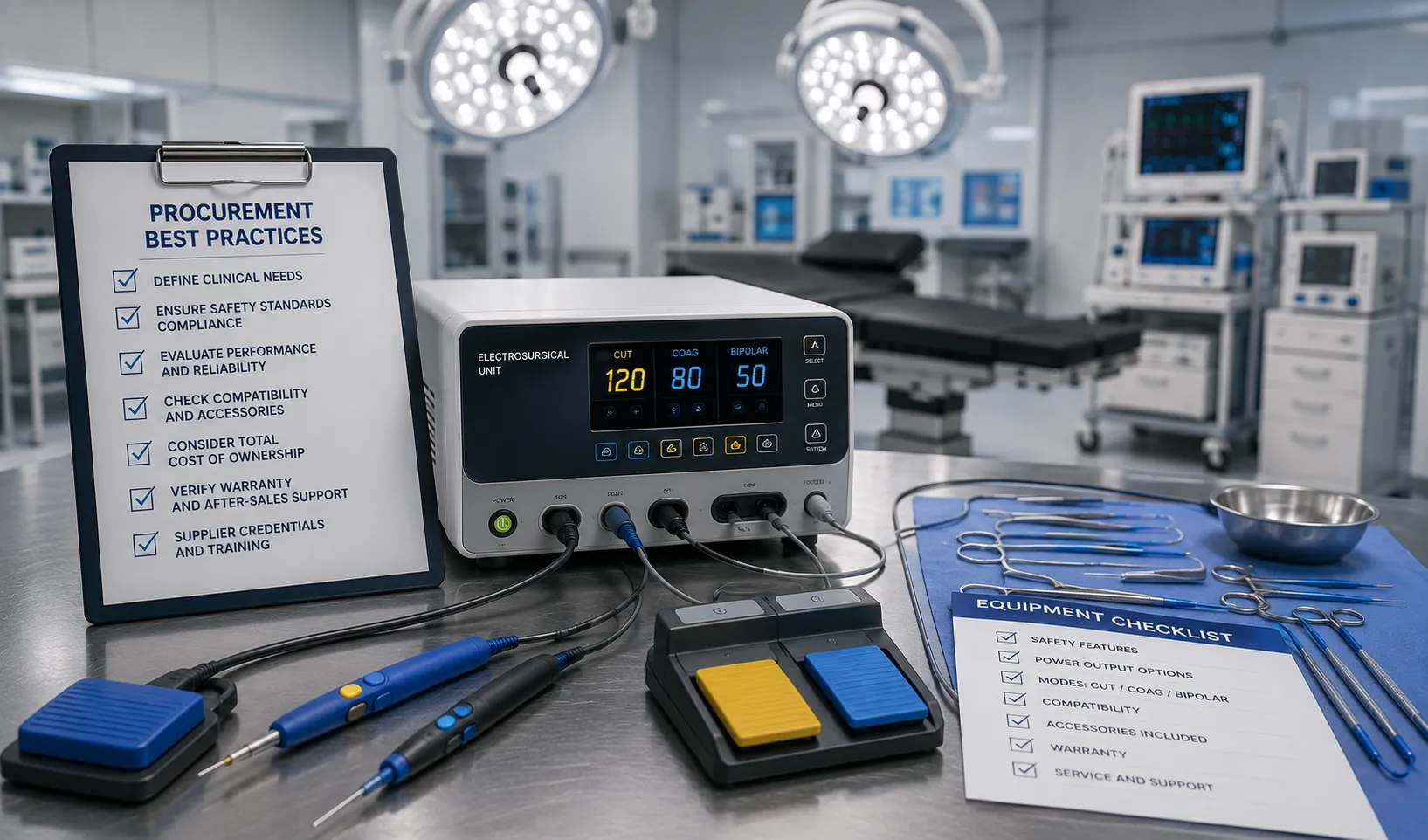
Electrosurgical equipment is central to many operating theatres and procedure rooms, but selecting a suitable system involves far more than comparing generator output or purchase price. Procurement teams must consider the intended procedures, operating modes, accessories, compatibility, maintenance support, staff training, smoke management, documentation, and long-term availability of consumables.
Electrosurgical systems use high-frequency electrical current to cut tissue or to control bleeding. Depending on the equipment and procedure, energy may be delivered through monopolar, bipolar, vessel-sealing, or other specialised configurations. The FDA describes general-surgery electrosurgical devices as systems designed to cut or remove tissue and control bleeding using high-frequency electrical current.
A strong procurement process should therefore begin with clinical and operational requirements rather than a product catalogue. The objective is to purchase a complete, supportable system that can be integrated safely into the facility’s existing surgical workflow.
Define the Procedures the System Must Support
The first step is to establish where and how the equipment will be used.
Procurement teams should consult surgeons, theatre managers, biomedical engineers, infection-control teams, and technical staff to clarify:
-
Surgical specialities using the system
-
Expected daily case volume
-
Monopolar and bipolar requirements
-
Vessel-sealing needs
-
Required power ranges
-
Open or minimally invasive procedures
-
Reusable and single-use accessory preferences
-
Existing operating-theatre infrastructure
-
Future departmental expansion
A basic generator may be suitable for routine cutting and coagulation. At the same time,e a higher-volume surgical department may require multiple energy modes, advanced tissue-response technology, integrated vessel sealing, or specialised laparoscopic accessories.
Avoid purchasing unused capability – An advanced system may offer features the department does not require.
Allow for realistic growth – A system that meets only current demand may become restrictive if surgical services expand.
Separate essential and optional requirements – This helps suppliers provide quotations that are easier to compare.
Healthcare organisations reviewing equipment options can explore buyer services.
Understand Monopolar and Bipolar Requirements
Most procurement discussions begin with the required electrosurgical configurations.
Monopolar electrosurgery generally uses an active electrode at the surgical site and a patient return electrode to complete the electrical circuit. FDA device information describes return electrodes as components used to complete the circuit between the generator, active electrode, and patient.
Bipolar electrosurgery passes current between two electrodes positioned within the same instrument. It is commonly selected where more localised energy delivery is required.
Procurement teams should confirm:
-
Which modes are available
-
Whether simultaneous outputs are supported
-
Whether the system includes return-electrode monitoring
-
Which handpieces and forceps are compatible
-
Whether specialised vessel-sealing instruments are required
-
Whether accessories are reusable, disposable, or mixed
The generator, cables, electrodes, handpieces, footswitches, return pads, and surgical instruments should be evaluated as one system rather than as unrelated products.
Verify the Required Output and Operating Modes
High maximum power should not be treated as the main sign of equipment quality. The more important question is whether the system can deliver appropriate, stable, and controllable energy for the procedures being performed.
Common functions may include:
-
Pure cut
-
Blend modes
-
Forced coagulation
-
Soft coagulation
-
Spray coagulation
-
Bipolar coagulation
-
Precise low-power modes
-
Vessel-sealing functions
Procurement documents should request a clear explanation of each mode rather than accepting a list of marketing names. Buyers should understand the intended use, power range, compatible accessories, and control method for each function.
The relevant IEC particular standard covers the basic safety and essential performance of high-frequency surgical equipment and associated accessories.
Treat Accessories as Part of the Procurement Decision
A generator cannot operate effectively without compatible accessories. Missing or unsuitable accessories can delay implementation, even when the main unit arrives on time.
The quotation should clearly identify:
-
Active electrode handles
-
Electrode tips
-
Bipolar forceps
-
Laparoscopic instruments
-
Return electrodes
-
Reusable and disposable cables
-
Footswitches
-
Adapters
-
Trolleys or mounting systems
-
Cleaning accessories
-
Storage solutions
Confirm the initial accessory pack – Specify quantities rather than accepting “standard accessories.”
Check replacement availability – Consumables and electrodes should remain accessible throughout the expected equipment life.
Review cross-compatibility carefully – A connector that physically fits may not necessarily be approved or suitable for the generator.
Calculate usage costs – Single-use accessories can significantly influence the total cost per procedure.
Suppliers interested in presenting equipment and compatible accessory portfolios to healthcare buyers can explore the business supplier program.
Evaluate Patient Return-Electrode Monitoring
Where monopolar electrosurgery is used, patient return-electrode monitoring should be included in the procurement assessment.
Buyers should ask:
-
Does the generator monitor contact quality?
-
What happens if contact becomes inadequate?
-
Are audible and visual warnings provided?
-
Is power delivery interrupted automatically?
-
Which return pads are compatible?
-
Are adult and paediatric options available where required?
-
Are return pads included in the initial quotation?
The purpose of the procurement review is not merely to confirm that the generator has an alarm. Buyers should understand how the monitoring feature operates and which accessories are required for it to function correctly.
Include Surgical Smoke Management
Electrosurgical procedures can generate surgical smoke. Smoke management should therefore be considered during theatre planning and equipment purchasing rather than left as a later accessory decision.
A complete assessment may include:
-
Smoke evacuator availability
-
Suction capacity
-
Filter type
-
Filter replacement cost
-
Tubing and handpiece compatibility
-
Noise levels
-
Automatic activation options
-
Theatre-space requirements
-
Portable or integrated design
The procurement team should calculate the continuing cost of filters, tubing, and other consumables. A low-cost smoke evacuator may become expensive if proprietary filters require frequent replacement.
Review Safety and Technical Standards
Electrosurgical equipment is medical electrical equipment, so buyers should request evidence of compliance with applicable safety and performance requirements.
IEC 60601-2-2 specifically addresses high-frequency surgical equipment and accessories, while the general IEC 60601 framework covers the safety and essential performance of medical electrical equipment.
Documentation should be assessed according to the destination market and may include:
-
Applicable conformity information
-
Electrical safety documentation
-
Electromagnetic compatibility information
-
Manufacturer details
-
Intended-use statement
-
Technical specifications
-
User instructions
-
Accessory compatibility lists
-
Cleaning and reprocessing instructions
-
Service documentation
Reusable accessories may require validated reprocessing information where applicable. FDA classification information notes that reusable electrosurgical devices with relevant design features may require validated reprocessing instructions and supporting validation data.
Regulatory requirements differ by market, so procurement teams should verify the destination-country obligations before placing an order.
Check Compatibility with the Operating Theatre
The system should fit the physical and technical environment in which it will be used.
Review:
-
Available electrical supply
-
Plug and voltage compatibility
-
Earthing requirements
-
Space on equipment towers
-
Trolley dimensions
-
Footswitch placement
-
Cable routing
-
Integration with operating tables
-
Compatibility with laparoscopic towers
-
Proximity to smoke evacuation and suction
-
Cleaning access
The equipment should also be evaluated for stability and ease of movement. Trolleys should provide secure generator placement, cable organisation, and lockable castors where required.
Assess the User Interface
An intuitive control layout can reduce confusion during busy procedures.
Before purchasing, users should review:
-
Display visibility
-
Control labelling
-
Power-adjustment method
-
Mode selection
-
Alarm indicators
-
Footswitch design
-
Port identification
-
Startup checks
-
Preset availability
-
Language options
A demonstration can reveal practical issues that may not be visible in the brochure. Surgeons and theatre staff should be able to evaluate the system under realistic workflow conditions wherever possible.
Plan Staff Training Before Commissioning
Training should form part of the purchase agreement, not an informal promise made after delivery.
Training may need to cover:
-
Generator setup
-
Monopolar and bipolar modes
-
Accessory connection
-
Return-electrode monitoring
-
Alarm interpretation
-
Footswitch operation
-
Cleaning and inspection
-
Routine pre-use checks
-
Basic fault reporting
-
Safe equipment shutdown
The training plan should identify the number of sessions, participant groups, training materials, and arrangements for new staff joining later.
For complex systems, procurement teams should also ask whether advanced clinical application support is available.
Examine Cleaning and Reprocessing Requirements
Electrosurgical generators, cables, handpieces, forceps, and reusable electrodes may have different cleaning or reprocessing requirements.
Buyers should obtain written instructions covering:
-
Approved cleaning agents
-
Surface-disinfection methods
-
Reusable accessory processing
-
Autoclave compatibility, where applicable
-
Maximum reuse cycles
-
Cable inspection
-
Drying requirements
-
Storage conditions
-
Damaged-accessory disposal
Do not assume that every reusable accessory can be processed using the same cycle. Incorrect reprocessing may shorten product life or damage insulation and connectors.
Confirm Preventive Maintenance and Testing Needs
Electrosurgical equipment should be included in the facility’s biomedical maintenance programme.
Before purchase, confirm:
-
Recommended inspection intervals
-
Electrical safety testing requirements
-
Output testing procedures
-
Required test equipment
-
Calibration needs
-
Software or firmware support
-
Service manual availability
-
Engineer training options
-
Expected spare parts availability
Maintenance planning should include accessories. Damaged cables, worn insulation, loose connectors, and compromised instruments can affect system reliability even when the generator itself functions correctly.
Review Service and Spare-Parts Support
The long-term value of an electrosurgical system depends heavily on service support.
Ask suppliers:
-
Where are service engineers located?
-
What response time is available?
-
Which repairs can be completed locally?
-
Are loan units available?
-
How long will parts remain supported?
-
Are circuit boards, sockets, fans, displays, and footswitches replaceable?
-
Is remote technical support available?
-
What is included in the warranty?
-
Are preventive maintenance contracts offered?
A generator with a lower purchase price can become costly if it must be shipped internationally for routine repairs.
Healthcare organisations seeking long-term commercial collaboration can review potential business partners.
Calculate Total Cost of Ownership
A fair comparison should include the full cost of operating the system, not only the purchase price.
Total ownership costs may include:
-
Generator
-
Trolley
-
Handpieces
-
Electrodes
-
Return pads
-
Bipolar forceps
-
Vessel-sealing instruments
-
Smoke-management filters
-
Footswitches
-
Reusable accessory replacement
-
Preventive maintenance
-
Repairs
-
Staff training
-
Shipping
-
Installation
-
Testing
Consumable-dependent systems may appear affordable initially but entail substantial ongoing expenditure. Procurement teams should estimate costs using expected case volume.
Compare Quotations Using a Standard Format
Supplier quotations should be placed into a common evaluation structure.
Suggested comparison points include:
-
Exact model
-
Available modes
-
Maximum and minimum output
-
Monopolar capability
-
Bipolar capability
-
Vessel-sealing capability
-
Return-electrode monitoring
-
Included accessories
-
Consumable pricing
-
Warranty
-
Training
-
Delivery time
-
Installation
-
Preventive maintenance
-
Spare-parts support
-
Total landed cost
A structured comparison prevents procurement decisions from being influenced by incomplete or differently formatted quotations.
Conduct Acceptance Checks at Delivery
Equipment should be inspected before clinical deployment.
The receiving and commissioning process may include:
-
Packaging inspection
-
Model verification
-
Serial-number recording
-
Accessory count
-
Physical-condition check
-
Electrical safety testing
-
Output verification
-
Alarm testing
-
Footswitch testing
-
Return-electrode monitoring check
-
User-interface review
-
Documentation confirmation
Any missing components or transit damage should be documented immediately.
Create a Replacement and Standardisation Strategy
Facilities operating several electrosurgical systems may benefit from standardising equipment where clinically appropriate.
Standardisation can simplify:
-
User training
-
Accessory stocking
-
Return-pad procurement
-
Maintenance
-
Spare-parts management
-
Engineer familiarity
-
Equipment rotation
However, standardisation should not restrict specialist departments that require different energy capabilities.
Replacement planning should consider equipment age, repair history, parts availability, accessory cost, service support, and changing clinical requirements.
Procurement Questions to Ask Suppliers
Before confirming an order, ask:
-
Which procedures are the system designed to support?
-
Which monopolar and bipolar modes are included?
-
Does it support return-electrode monitoring?
-
Which accessories are included?
-
Which components are single-use?
-
Are reusable accessories validated for reprocessing?
-
What smoke-management options are available?
-
Which safety standards apply?
-
What training is included?
-
Where will servicing be performed?
-
How long are parts expected to remain available?
-
What is the estimated cost per procedure?
-
What is the total delivered and installed price
Clearly written answers help reduce misunderstandings later.
Businesses offering relevant surgical technologies or support services can explore business Advertise opportunities.
Final Thoughts
Electrosurgical equipment procurement should focus on the complete operating system, including the generator, accessories, consumables, smoke management, training, maintenance, and service support. A generator with impressive technical specifications may still be a poor investment if compatible accessories are expensive, local servicing is unavailable, or staff cannot use it confidently.
The strongest procurement decisions combine clinical input with technical evaluation and lifecycle costing. This approach helps healthcare organisations select equipment appropriate for current surgical needs while ensuring it remains supportable throughout its expected working life.
For product enquiries, sourcing support, or procurement assistance, organisations can contact Team.
Disclaimer
Medigear.uk is a medical equipment supplier and distributor. We do not provide medical, surgical, legal, regulatory, or clinical advice. This article is intended for general educational and product-awareness purposes only. Electrosurgical equipment selection, operation, maintenance, and clinical use should be assessed by qualified surgeons, biomedical engineers, procurement professionals, manufacturers, and relevant regulatory authorities.