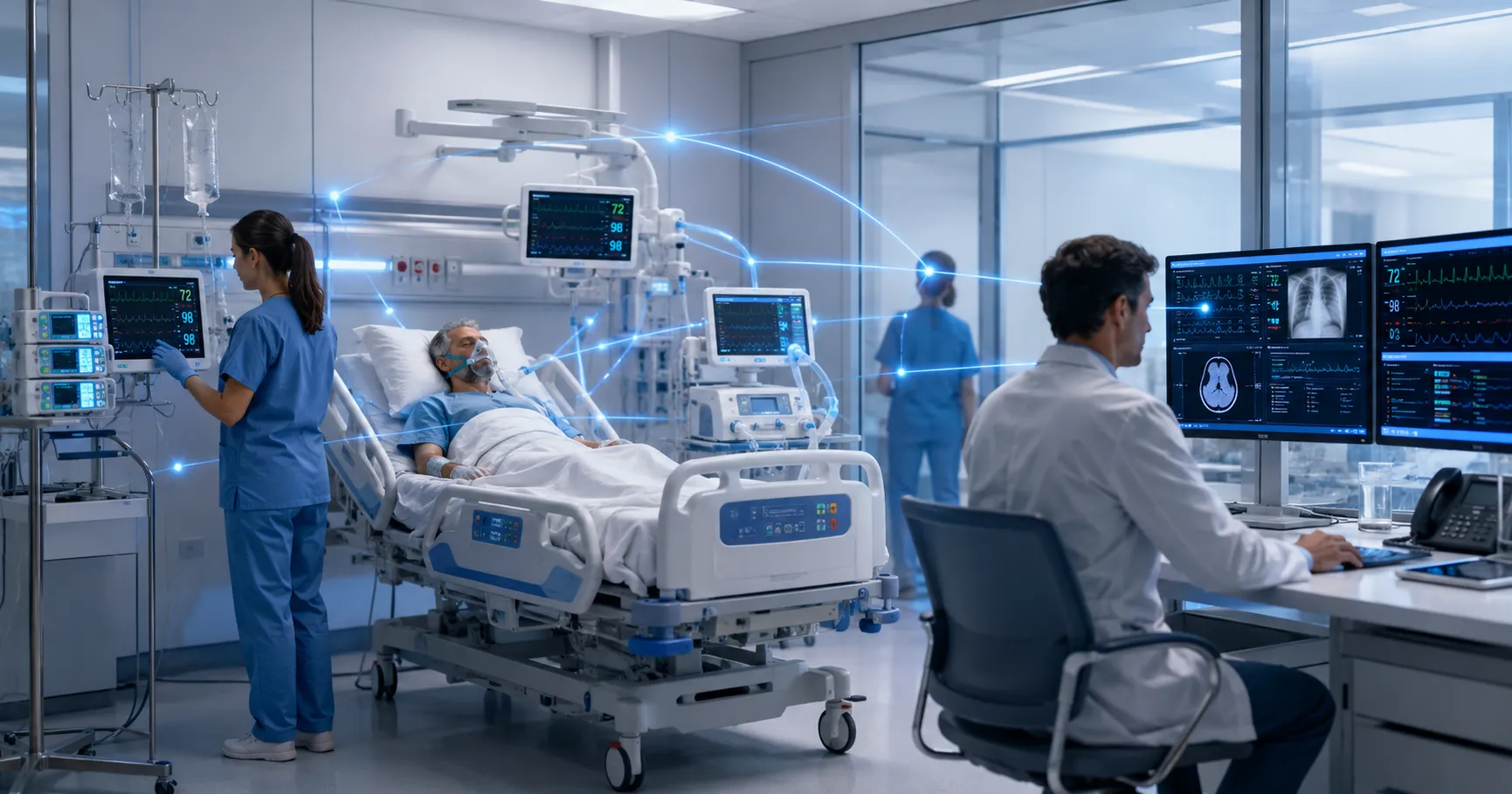
Connected healthcare equipment helps hospitals link medical devices, patient data, clinical systems, biomedical teams, and operational dashboards. These systems may include connected patient monitors, smart infusion pumps, digital imaging devices, laboratory analysers, networked ventilators, wireless sensors, smart hospital beds, remote monitoring tools, asset tracking tags, and connected maintenance platforms.
For healthcare buyers, connected healthcare equipment should not be treated as normal equipment with Wi-Fi added. Buyers need to review clinical value, interoperability, cybersecurity, data privacy, software updates, network requirements, user training, biomedical support, supplier documentation, and compliance with applicable local regulatory standards. The FDA explains medical device interoperability as the ability to safely, securely, and effectively exchange and use information among devices, products, technologies, or systems.
How Connected Healthcare Equipment Supports Hospitals
Connected healthcare equipment supports hospitals by improving the flow of information among devices, staff, systems, and departments. The aim is not only to collect more data. The real value comes when connected equipment helps teams act faster, reduce manual work, improve visibility, and manage devices more efficiently.
Patient Data Connectivity — Connected monitors and devices can send readings to central stations, dashboards, electronic systems, or remote review platforms. This can reduce repeated manual entry and help staff review patient trends more clearly.
Improved Clinical Coordination — When devices are properly connected, doctors, nurses, technicians, and biomedical teams can see relevant updates more quickly. This supports smoother coordination during ward rounds, critical care review, diagnostics, and department handovers.
Better Equipment Visibility — Connected systems can show whether equipment is active, idle, under maintenance, misplaced, or due for service. This helps hospitals reduce searching time and improve asset utilisation.
Support for Digital Health Strategy — WHO states that digital health technologies can strengthen health systems when implemented with appropriate governance, infrastructure, and planning. Connected equipment is one part of that wider digital health environment.
Where Connected Healthcare Equipment Is Used
Connected healthcare equipment can be used across almost every hospital department. The correct device mix depends on the clinical setting, patient risk level, department workload, IT infrastructure, and maintenance capacity.
Intensive Care Units (ICUs) may use connected patient monitors, ventilators, infusion pumps, central monitoring stations, alarm systems, and digital documentation tools. These systems help teams review patient data from multiple sources.
Emergency Departments — Emergency teams may use connected triage monitors, mobile diagnostic devices, smart beds, portable ultrasound units, and patient-tracking systems. Fast data movement can support better patient flow when workflows are planned well.
Operating Rooms and Procedure Areas — Connected anaesthesia workstations, surgical lights, imaging systems, procedure room dashboards, and digital documentation tools can support procedure planning and room coordination.
Diagnostic and Laboratory Departments — Imaging systems, laboratory analysers, pathology platforms, and reporting systems often depend on digital connectivity. Facilities sourcing through regulated and certified equipment suppliers worldwide should confirm system compatibility, software support, cybersecurity documentation, and integration requirements before procurement.
Wards and Outpatient Areas — Connected vital-signs devices, smart beds, nurse call systems, remote-monitoring tools, and mobile workstations can support routine care. Devices should be simple enough for staff to use during busy clinical shifts.
Common Types of Connected Healthcare Equipment
Connected healthcare equipment can be simple or advanced, local or cloud-based, wired or wireless. Buyers should understand what the equipment connects to and whether that connection improves workflow.
Connected Patient Monitors — These devices collect vital signs and may send readings to central stations, electronic systems, or clinical dashboards. Buyers should check alarm settings, waveform quality, integration support, and data export options.
Smart Infusion Systems — Connected infusion systems may support drug libraries, dose alerts, pump status monitoring, and usage reporting. These systems need careful training, cybersecurity planning, and maintenance support.
Networked Imaging Equipment — Imaging devices may connect to PACS, reporting systems, worklists, cloud platforms, or AI tools. Buyers should review image transfer speed, storage needs, software licences, and support arrangements.
Connected Laboratory Devices — Laboratory analysers may connect with laboratory information systems for orders, results, quality control, and reporting. Integration reduces manual entry but requires strong data validation.
Smart Hospital Beds — Some hospital beds integrate with nurse call systems, patient safety alerts, weight scales, bed-exit alerts, or ward dashboards. Buyers should confirm which features are clinically useful.
Wearable and Wireless Sensors — Wearable sensors can collect selected readings such as heart rate, oxygen saturation, movement, temperature, or ECG data. IoT healthcare literature identifies patient monitoring, tracking devices, hospital management, medication management, and telemedicine as common connected healthcare applications.
Asset Tracking Systems — Tracking tags and location systems help hospitals find wheelchairs, infusion pumps, beds, monitors, trolleys, and emergency equipment. This can reduce wasted time and improve equipment allocation.
Benefits of Connected Equipment in Hospital Workflow
Connected equipment can improve hospital workflow when it is matched to real operational needs. The strongest results usually come from systems that reduce manual work, improve visibility, or support faster decisions.
Reduced Manual Documentation — Connected devices can reduce repeated writing or typing of readings. This may improve staff efficiency if data flows accurately into the right system.
Faster Response to Alerts — Connected alerts can help teams identify patient changes, device faults, or equipment needs more quickly. Alert settings must be managed carefully to avoid an unnecessary burden of alarms.
Improved Equipment Utilisation — Hospitals often have underused equipment hidden in departments or unavailable when needed. Connected asset systems can help teams see where devices are and how often they are used.
Better Maintenance Planning — Connected devices may send service data, usage hours, error logs, or performance alerts. Biomedical teams can use this information to plan preventive maintenance more effectively.
Stronger Procurement Decisions — Usage data can help procurement teams decide whether to buy more equipment, replace older models, standardise devices, or reduce excess stock.
Interoperability Planning
Interoperability is one of the most important aspects of planning connected healthcare equipment. A device that cannot exchange useful data with hospital systems may create additional work rather than reducing it.
System Compatibility — Buyers should confirm whether the device connects with EMR, HIS, LIS, PACS, nurse call systems, monitoring stations, asset platforms, or biomedical maintenance systems.
Data Format and Standards — The supplier should explain how data is exported, stored, displayed, and transferred. If data is within a single vendor's platform, the hospital may face long-term limitations.
Safe Data Use — FDA notes that interoperable information may be displayed, stored, interpreted, analysed, or used to automatically act on another product. This shows why hospitals must understand exactly how connected data is used before deployment.
Downtime Workflow — Connected equipment should still support safe care if the network fails. Staff must know how to use devices manually or follow backup procedures during downtime.
Vendor Collaboration — Multi-device connectivity often requires cooperation between equipment vendors, IT teams, software providers, and biomedical engineers. Procurement teams should confirm responsibilities before purchase.
Cybersecurity and Data Security Risks
Connected healthcare equipment creates new cybersecurity and data protection responsibilities. A connected device may support a better workflow, but it may also pose a risk if its security is weak.
Cybersecurity Documentation — FDA cybersecurity guidance provides recommendations on device design, labelling, and premarket documentation for devices with cybersecurity risk, showing why buyers should request security information before procurement.
Access Control — Hospitals should define who can access device settings, patient data, dashboards, software updates, and remote support features.
Secure Transmission — Buyers should ask whether data is encrypted during transfer and storage. The supplier should provide clear answers, not vague statements.
Remote Access Rules — Suppliers may need remote access for service, updates, or troubleshooting. Hospitals should control how remote access is approved, logged, and limited.
Software Patch Management — Connected devices may need security updates and firmware patches. The update process should be documented and coordinated with clinical teams.
Known Device Vulnerability Risk — An FDA safety communication has identified cybersecurity vulnerabilities in certain patient monitors, underscoring the need for hospitals to evaluate connected device security before deployment.
Procurement Guidance for Connected Healthcare Equipment
Connected healthcare equipment procurement should include clinical users, biomedical engineers, IT teams, cybersecurity teams, data protection officers, finance staff, legal teams, and supply chain managers. A connected device must meet both clinical needs and digital infrastructure requirements.
Total Cost of Ownership — Buyers should include device cost, software licences, cloud fees, integration costs, network upgrades, cybersecurity review, training, accessories, maintenance, spare parts, updates, service contracts, and downtime planning.
Clinical Need First — The connected feature should solve a real hospital problem. Buyers should avoid purchasing connected equipment only because it appears advanced.
Supplier Transparency — Suppliers and manufacturers advertising to global healthcare buyers should provide clear information on device specifications, connectivity, supported platforms, cybersecurity, software updates, data storage, service support, and documentation.
Hidden IT Cost Review — ECRI has warned that procuring networked devices entails hidden IT-related costs, such as integration and support needs that may strain budgets or delay projects if not planned early.
Compliance and Documentation — Procurement teams should request product specifications, intended use, conformity documents, software version details, cybersecurity documents, user manuals, cleaning instructions, warranty terms, and service policies. Compliance should be checked against applicable local regulatory standards, as well as CE, FDA, IEC, ISO, or their regional equivalents, where relevant.
Healthcare groups managing several hospitals or clinics may benefit from structured distribution and reseller partnership arrangements. Standardising connected devices, dashboards, service plans, and training can reduce confusion across sites.
Questions Buyers Should Ask Suppliers
Connected equipment requires a deeper supplier review than standalone devices. Buyers should ask clear questions before placing an order.
What systems can the device connect with? — The supplier should identify supported platforms, data standards, ports, APIs, and integration options.
What happens during network failure? — The device should support safe fallback workflows when connectivity is interrupted.
How is patient data protected? — The supplier should explain encryption, access control, data storage, audit logs, and remote access rules.
Who handles software updates? — Buyers should know whether updates are automatic, scheduled, approved, tested, or manually installed.
What are the recurring costs? — Software licences, cloud subscriptions, support fees, data storage, and service plans should be included in the cost review.
Is training included? — Connected equipment may require user training, biomedical training, IT training, and cybersecurity awareness.
How long is software supported? — A device may become difficult to use if software support ends before the hardware reaches the end of life.
Implementation Planning in Hospitals
Connected healthcare equipment should be deployed carefully. Poor implementation can create confusion, data gaps, alert overload, and staff resistance.
Workflow Mapping — Hospitals should map how the device will be used before, during, and after clinical care. This includes who reviews data, who responds to alerts, and where information is recorded.
Pilot Testing — A small pilot can reveal issues with connectivity, dashboard layout, staff workflow, alarms, data accuracy, and patient safety processes.
Staff Training — Nurses, doctors, technicians, biomedical teams, and IT staff should understand how to use the devices, manage data flow, handle alerts, troubleshoot issues, and follow escalation steps.
Clinical Governance — Hospitals should define how connected data is used in clinical decision-making. Staff should know whether a dashboard is only informational or part of formal care documentation.
Performance Review — After implementation, hospitals should review alert volume, downtime, user feedback, data accuracy, service tickets, and workflow impact.
Maintenance and Lifecycle Management
Connected healthcare equipment needs both hardware maintenance and digital lifecycle management. Biomedical and IT teams should work together from procurement through retirement.
Hardware Checks — Screens, cables, batteries, sensors, chargers, mounts, wheels, connectors, and accessories should be inspected regularly.
Software Version Control — Hospitals should record software and firmware versions. Updates should be tested and documented where facility policy requires it.
Cybersecurity Patch Planning — Security patches should be applied in accordance with the supplier's guidance and the hospital's IT policy. Delayed updates can create avoidable risk.
Calibration and Accuracy Checks — Devices that measure clinical parameters may need scheduled verification or calibration. Buyers should confirm these requirements before purchase.
Service Contract Review — Service contracts should include physical repair, software support, update assistance, cybersecurity response, and replacement terms.
End-of-Life Planning — Connected devices may become unsupported when software, operating systems, or cloud platforms change. Buyers should ask about the expected support life before purchase.
International Sourcing Considerations
Connected healthcare equipment can be sourced internationally when buyers clearly define clinical use, connectivity requirements, software support, language needs, power specifications, data policy, cybersecurity expectations, integration requirements, documentation, warranty, and spare part support. This is especially important for itlhospitals purchasing connected monitoring systems, smart beds, digital diagnostics, and and AI-enabled equipment-tracking platforms.
Buyers should confirm whether they need connected patient monitors, smart infusion systems, networked imaging equipment, connected laboratory systems, smart beds, wearable asset tracking, remote monitoring platforms, and smart hospital packages. For project-based sourcing, buyers can contact the Medigear.uk team for supply support to discuss availability, documentation, export needs, and procurement requirements.
Future Role of Connected Equipment in Hospitals
Connected healthcare equipment will continue to shape hospital workflow, but successful adoption depends on planning. Hospitals should focus on systems that improve patient care, staff efficiency, equipment visibility, maintenance planning, and data quality.
The future of connected hospitals will depend on interoperability, cybersecurity, clinical governance, staff training, and total cost control. Equipment should be selected because it solves a clear problem, not because it carries a smart or connected label.
Healthcare leaders should build connected equipment strategies around real workflows, reliable suppliers, secure systems, and long-term maintenance plans. When this happens, connected healthcare equipment can support better visibility, faster coordination, and stronger operational control.
Final Thoughts
Connected healthcare equipment helps hospitals link patient data, device status, clinical alerts, equipment tracking, maintenance information, and digital workflows. It can support better coordination, greater visibility, and more efficient equipment management, and can be selected carefully.
The right connected equipment aligns with the match client's needs, network infrastructure, interoperability requirements, cybersecurity policies, staff training, maintenance capacity, and local compliance standards. Buyers should review documentation, total cost of ownership, software lifecycle, supplier support, and integration needs before ordering.
Disclaimer
Medigear.uk is a global medical equipment supplier, exporter, and distributor. The content published on this site is intended for educational and product awareness purposes only. Nothing on this page constitutes medical advice, clinical guidance, cybersecurity advice, data protection advice, legal advice, or treatment recommendations. All healthcare procurement, technology, data, legal, and clinical decisions should be made by qualified professionals and compliant procurement teams operating within the regulatory frameworks of their respective countries.