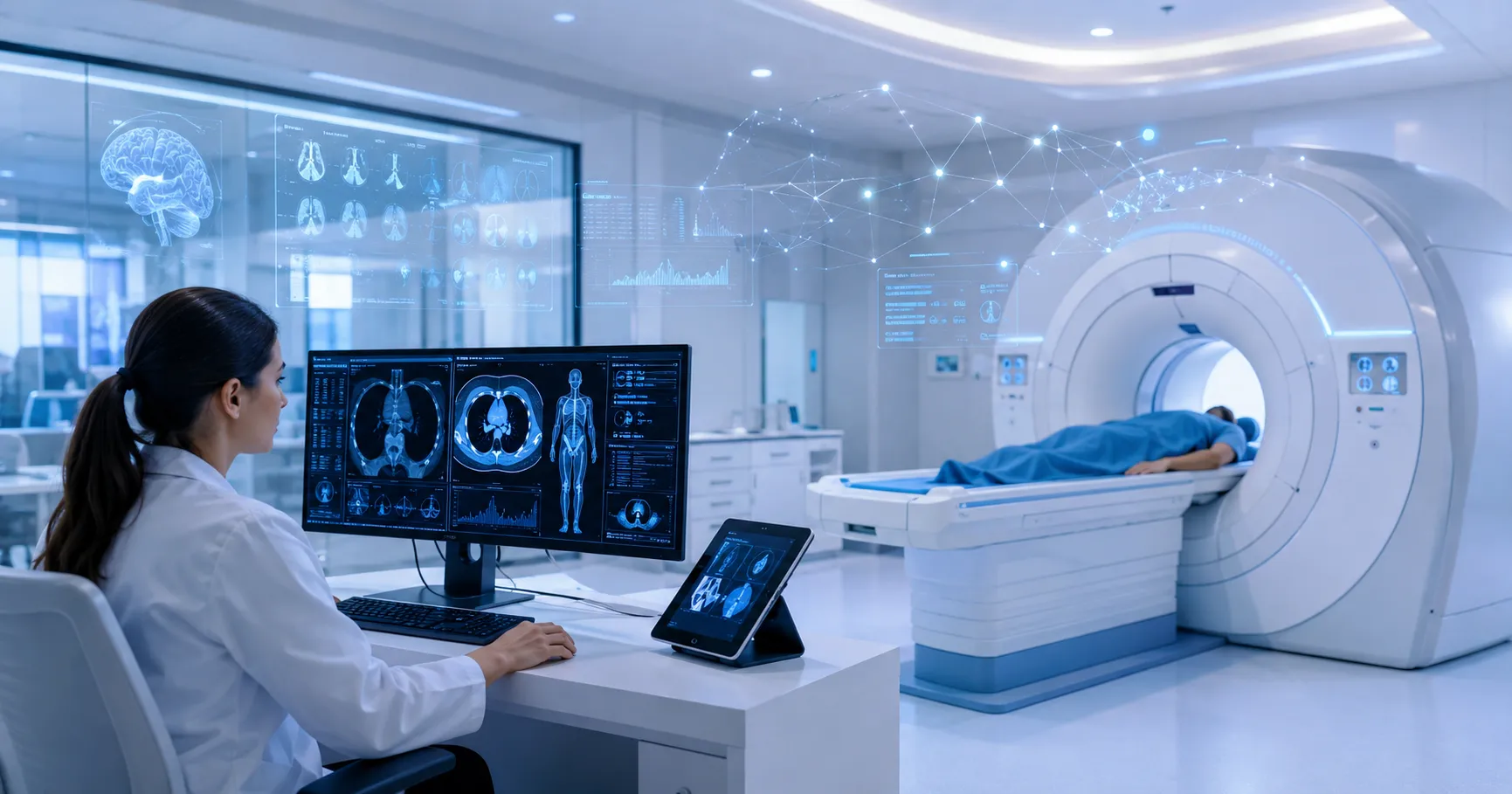
AI-powered imaging equipment is becoming an important part of diagnostic centre planning. These systems combine medical imaging hardware, software, machine learning algorithms, digital workflows, and connected reporting platforms to support image capture, image enhancement, case prioritisation, quality review, measurement support, and diagnostic workflow efficiency.
For healthcare buyers, AI-powered imaging equipment should not be selected solely because it includes AI. Buyers need to review clinical purpose, intended use, image quality, regulatory documents, algorithm limitations, cybersecurity, interoperability, software updates, service support, user training, and long-term maintenance. The FDA describes AI and machine learning medical device technologies as tools that can derive insights from healthcare data and notes that these technologies require careful management throughout the medical product lifecycle.
What AI-Powered Imaging Equipment Means
AI-powered imaging equipment refers to imaging systems or imaging-related software that use artificial intelligence or machine learning to support diagnostic imaging workflows. These systems may be built into X-ray, CT, MRI, ultrasound, mammography, C-arm, dental imaging, ophthalmic imaging, or radiology reporting platforms.
The AI feature may support image reconstruction, image enhancement, abnormality detection, triage prioritisation, measurement automation, segmentation, noise reduction, scan protocol optimisation, or workflow routing. Some AI tools are part of the imaging equipment itself, while others work as separate software connected to PACS, cloud platforms, or reporting systems.
FDA maintains an AI-enabled medical device list to identify devices authorised for marketing in the United States, including many radiology-related devices. This is useful for understanding how strongly AI is already represented in diagnostic imaging technology.
Why Diagnostic Centres Are Adopting AI Imaging Tools
Diagnostic centres handle large volumes of scans, reports, patient appointments, and image review tasks. AI-powered imaging equipment can support this workload when implemented correctly.
Faster Image Review Support — AI tools may help flag cases for review, highlight specific image areas, or assist with measurement tasks. This can help imaging teams manage busy reporting workflows.
Improved Image Quality Workflow — Some systems support image reconstruction, noise reduction, positioning feedback, or quality checks. This may help diagnostic teams reduce repeat scans when workflow is properly managed.
Better Case Prioritisation — AI tools may assist in routing urgent or abnormal cases for faster review, depending on the system's intended use and validation.
More Consistent Measurements — Some imaging tools can support automated measurements, segmentation, or comparison across images. These features may help reduce repetitive manual work.
Operational Efficiency — Diagnostic centres can use AI-supported dashboards, worklists, and connected systems to improve workflow visibility and manage scan volumes more efficiently.
Where AI-Powered Imaging Equipment Is Used
AI-powered imaging equipment can be used across several diagnostic departments. The right system depends on clinical service type, patient volume, reporting model, infrastructure, and staff capability.
Radiology Centres — Radiology centres may use AI-supported X-ray, CT, MRI, ultrasound, mammography, and image review platforms for workflow support and image analysis.
Hospitals — Hospitals may use AI imaging tools in emergency departments, ICUs, operating rooms, radiology departments, outpatient imaging units, and specialist clinics.
Diagnostic Chains — Multi-site diagnostic groups may use AI-supported platforms to standardise reporting workflows, image transfer, case prioritisation, and quality review across locations.
Specialist Clinics — Ophthalmology, cardiology, orthopaedic, dental, urology, oncology, and women’s health clinics may use imaging tools with AI-supported measurement or review features.
Remote Reporting Networks — AI-supported imaging systems may help organise worklists, case triage, image quality checks, and reporting coordination where remote radiologists or specialists review scans.
Facilities sourcing through regulated and certified equipment suppliers worldwide should confirm intended use, regulatory documentation, system compatibility, software support, training needs, and after-sales service before procurement.
Common Types of AI-Powered Imaging Equipment
AI-powered imaging can appear in different product categories. Buyers should determine whether AI is part of the scanner, image-processing software, reporting platform, or workflow management system.
AI-Supported X-Ray Systems — These may support image enhancement, positioning checks, abnormality flagging, workflow triage, or image quality review.
AI-Enabled CT Systems — CT platforms may use AI or machine learning for image reconstruction, noise reduction, protocol support, segmentation, or workflow tools.
AI-Supported MRI Systems — MRI systems may use AI features for reconstruction, scan acceleration, image quality support, or workflow efficiency.
AI Ultrasound Systems — Ultrasound systems may include automated measurements, anatomy recognition support, image optimisation, or workflow guidance.
AI Mammography Systems — Mammography AI tools may support image review, case prioritisation, density assessment, or lesion detection support where authorised and clinically appropriate.
AI C-Arm and Surgical Imaging Systems — Some systems support image guidance, positioning, navigation, or workflow assistance during procedures.
AI Radiology Reporting Platforms — These platforms may help route cases, pre-fill measurements, support structured reporting, or flag selected image findings.
AI Image Analysis Software — Separate software tools may connect with PACS or imaging workstations to support image review, segmentation, measurements, or worklist prioritisation.
Benefits for Diagnostic Centre Workflow
AI-powered imaging equipment can help diagnostic centres improve their operational workflows when carefully selected
Reduced Manual Repetition — Automated measurements, image quality checks, and case routing may reduce repeated manual steps for radiology teams.
Improved Worklist Management — AI-supported platforms may help organise cases by urgency, modality, department, or reporting queue.
Faster Communication — Connected imaging tools can enable faster transfer of images and reports among technicians, radiologists, referring doctors, and clinical teams.
Quality Control Support — AI tools may help identify image-quality problems, incomplete views, positioning issues, or inconsistent acquisition patterns.
Better Use of Equipment Capacity — Workflow dashboards may help diagnostic centres review scan volume, machine usage, reporting delays, and appointment bottlenecks.
Support for Multi-Site Operations — Diagnostic networks can use connected platforms to standardise image transfer, worklists, reporting templates, and quality review.
Clinical Safety and Human Oversight
AI-powered imaging equipment should support trained healthcare professionals. It should not replace qualified radiologists, clinicians, sonographers, radiographers, or diagnostic specialists.
AI results may be affected by image quality, patient population, scan protocol, device settings, algorithm training data, and local workflow. WHO regulatory considerations for AI in health highlight the importance of risk-benefit assessment, performance evaluation, monitoring, and stakeholder responsibility for AI systems used in healthcare.
Diagnostic centres should define how AI outputs are reviewed, documented, and escalated. Staff should understand when the AI tool is giving a measurement, a probability, a prioritisation flag, an image enhancement, or a workflow suggestion.
Accuracy, Validation and Intended Use
Before purchasing AI-powered imaging equipment, buyers should confirm what the AI feature is approved or intended to do.
Intended Use — The supplier should clearly explain whether the AI tool supports detection, measurement, image reconstruction, workflow prioritisation, quality review, or reporting assistance.
Validation Evidence — Buyers should request performance evidence, limitations, study population details, modality details, and image conditions used for validation.
Clinical Setting Fit — A tool validated in one environment may not perform the same way in another. Diagnostic centres should review whether the system fits their patient population, scanner type, image protocol, and reporting workflow.
False Positive and False Negative Risk — AI tools may flag normal images or miss abnormal findings. Staff should be trained to interpret outputs appropriately.
Version Control — AI software may change through updates. Diagnostic centres should record software versions, update history, and any workflow changes following updates.
FDA explains that AI and machine learning medical devices may need review through appropriate premarket pathways and that modifications may require review depending on their significance and risk.
Interoperability and Imaging Data Flow
AI-powered imaging equipment is most valuable when it fits safely into diagnostic centre systems. The FDA defines medical device interoperability as the ability to safely, securely, and effectively exchange and use information among devices, products, technologies, or systems.
PACS Compatibility — Imaging equipment should connect smoothly with PACS for image storage, review, retrieval, and reporting.
DICOM Support — Diagnostic imaging systems commonly depend on DICOM workflows. Buyers should confirm image transfer, metadata handling, worklist support, and viewing compatibility.
RIS and HIS Integration — Diagnostic centres may need integration with radiology information systems, hospital information systems, appointment platforms, billing systems, or referral workflows.
Cloud Platform Review — If AI analysis is cloud-based, buyers should review data hosting, upload speed, access controls, downtime plans, and data retention.
Report Transfer — AI-generated measurements or findings should be incorporated into reports only through controlled, clinically reviewed workflows.
Downtime Planning — Facilities should define how imaging work continues if AI software, cloud access, PACS connectivity, or network services are unavailable.
Cybersecurity and Data Protection
AI-powered imaging equipment may connect to hospital networks, PACS, cloud platforms, vendor portals, remote service tools, or reporting systems. This makes a cybersecurity review essential.
Access Control — Facilities should define who can access images, AI outputs, software settings, dashboards, and administrative tools.
Secure Data Transfer — Diagnostic images and patient information should be protected during transfer and storage.
Remote Service Management — Supplier remote access should be approved, logged, time-limited, and controlled in accordance with facility policy.
Software Updates — AI imaging platforms may require updates to software, firmware, models, or cloud services. Updates should be documented and reviewed before routine use.
Cybersecurity Documentation — FDA cybersecurity guidance provides recommendations on cybersecurity device design, labelling, and documentation for devices with cybersecurity risk. This supports a cybersecurity review before purchasing connected imaging equipment.
Procurement Guidance for AI-Powered Imaging Equipment
Procurement of AI-powered imaging equipment should include radiologists, radiographers, imaging technicians, biomedical engineers, IT teams, cybersecurity staff, finance teams, compliance staff, and procurement teams.
Clinical Requirement Review — The diagnostic centre should define the imaging modality, patient volume, reporting workflow, clinical use case, room requirements, and expected productivity benefit.
Total Cost of Ownership — Buyers should include device price, software licence, AI module fee, cloud fee, PACS integration, workstation cost, accessories, training, maintenance, cybersecurity review, service contract, spare parts, and upgrade cost.
Supplier Transparency — Suppliers and manufacturers advertising to global healthcare buyers should provide clear details on intended use, AI function, validation evidence, connectivity, cybersecurity controls, software lifecycle, warranty, training, and service support.
Regulatory Documentation — Buyers should request conformity documents, product registrations where relevant, software version details, user manuals, service manuals, cybersecurity information, warranty terms, and training materials.
Pilot Testing — Diagnostic centres should test the system in real workflow before large-scale adoption. A pilot can reveal reporting delays, false alerts, connectivity issues, user confusion, integration gaps, and hidden costs.
The Good Machine Learning Practice principles promoted by international regulators focus on safe, effective, and high-quality AI and machine learning medical devices while considering the total product lifecycle.
Key Questions Buyers Should Ask Suppliers
AI-powered imaging equipment requires a deeper supplier review than standard imaging equipment.
What exactly does the AI feature do?
The supplier should explain whether AI supports image quality, reconstruction, detection, measurement, triage, reporting, or workflow.
Is the AI feature part of the medical device claim?
Buyers should understand whether AI is regulated as part of the device or offered as workflow support.
What evidence supports performance?
Suppliers should provide validation evidence, limitations, applicable patient group, and supported imaging conditions.
Can the system connect with existing PACS and reporting tools?
Integration should be checked before purchase.
How are AI updates managed?
Buyers should know whether updates are automatic, controlled, approved, documented, and reversible.
Who owns and controls the imaging data?
Facilities should understand data storage, retention, export, access, and supplier rights.
What happens if AI is unavailable?
The diagnostic centre should still be able to perform imaging and reporting through safe fallback workflows.
Maintenance and Biomedical Engineering Planning
AI-powered imaging equipment needs both physical maintenance and software lifecycle management.
Preventive Maintenance — Imaging systems should follow manufacturer-recommended maintenance schedules, safety checks, calibration, and performance verification.
Software Version Control — AI modules, scanner software, workstation software, and cloud tools should have documented version records.
Image Quality Checks — Diagnostic centres should monitor image quality, artefacts, reconstruction performance, and repeated scan issues.
Hardware Support — Detectors, probes, coils, tubes, workstations, monitors, cables, cooling systems, and power systems may require planned service.
Calibration and Quality Assurance — Imaging equipment may require regular quality assurance checks according to modality, manufacturer guidance, and local requirements.
Service Records — Maintenance reports, calibration results, downtime logs, AI update records, fault reports, and warranty claims should be stored for audit readiness.
Healthcare groups managing several diagnostic centres may benefit from structured distribution and reseller partnership arrangements. Standardising equipment models, reporting workflows, AI modules, training, service contracts, and maintenance records can reduce variation across sites.
Staff Training and Workflow Adoption
AI-powered imaging equipment can only deliver value when users understand how to operate it and interpret its outputs.
Radiologist Training — Radiologists should understand AI outputs, limitations, false alert risk, workflow roles, and reporting responsibilities.
Technician Training — Radiographers and imaging technicians should understand acquisition protocols, positioning guidance, image quality prompts, and troubleshooting.
Biomedical Training — Biomedical teams should understand maintenance requirements, service logs, software updates, and supplier escalation.
IT Training — IT teams should understand network requirements, PACS integration, access control, cybersecurity, and data flow.
Administrative Training — Diagnostic centre managers should understand reporting dashboards, workflow metrics, scheduling impact, and service performance indicators.
Common Mistakes to Avoid
Diagnostic centres should avoid buying AI imaging equipment without a clear implementation plan.
Buying AI Without a Workflow Goal — AI should solve a real problem,m such as reporting backlog, image-quality variation, scalability, measurement workload, or case prioritisation.
Ignoring False Alerts — AI outputs require clinical review and should not be treated as definitive decisions.
Skipping Integration Checks — A system that does not connect with PACS, DICOM workflows, or reporting tools may create extra manual work.
Forgetting Software Costs — AI modules may include subscriptions, cloud fees, updates, user licences, or workstation requirements.
Weak Cybersecurity Review — Imaging data can contain sensitive patient information and should be protected carefully.
No Version Control — AI performance and software behaviour may change after updates. Updates should be tracked.
Poor Staff Training — Staff must know how to use AI features safely and when to rely on standard review processes.
International Sourcing Considerations
AI-powered imaging equipment can be sourced internationally when buyers clearly define modality, clinical purpose, patient volume, AI feature requirements, image quality expectations, software support, PACS compatibility, power specifications, room requirements, documentation, warranty, service access, cybersecurity expectations, and compliance needs.
Buyers should confirm whether they need AI-supported X-ray systems, CT systems, MRI systems, ultrasound equipment, mammography systems, C-arm imaging, dental imaging, ophthalmic imaging, PACS-connected AI tools, or full diagnostic centre imaging packages. For project-based sourcing, buyers can contact the Medigear.uk team for supply support to discuss availability, documentation, export needs, and procurement requirements.
Future Role of AI-Powered Imaging Equipment
AI-powered imaging equipment will continue to influence diagnostic centre workflow, but successful adoption depends on careful planning. The most useful systems will support real clinical and operational needs rather than simply adding AI branding.
Diagnostic centres should focus on equipment that improves image workflow, supports consistent quality, integrates with reporting systems, protects data, and remains serviceable over time. AI tools should support professionals, not replace professional review.
The future of AI imaging will depend on validation, transparency, interoperability, cybersecurity, training, maintenance, and responsible lifecycle management. When these areas are well planned, AI-powered imaging equipment can help diagnostic centres improve efficiency, reporting coordination, and equipment utilisation.
Final Thoughts
AI-powered imaging equipment can help diagnostic centres improve image workflow, case prioritisation, image quality review, reporting coordination, and operational efficiency. These systems are valuable when they solve real problems at diagnostic centres and fit safely into existing clinical workflows.
The right AI imaging solution should match clinical purpose, modality needs, patient volume, PACS compatibility, cybersecurity policy, maintenance capacity, staff training, software lifecycle, and local compliance standards. Buyers should review documentation, validation evidence, total cost of ownership, supplier support, and long-term service planning before ordering.
Disclaimer
Medigear.uk is a global medical equipment supplier, exporter, and distributor. The content published on this site is intended for educational and product awareness purposes only. Nothing on this page constitutes medical advice, clinical guidance, cybersecurity advice, legal advice, data protection advice, or treatment recommendations. All healthcare procurement, technology, legal, data, and clinical decisions should be made by qualified professionals and compliant procurement teams operating within the regulatory frameworks of their respective countries.