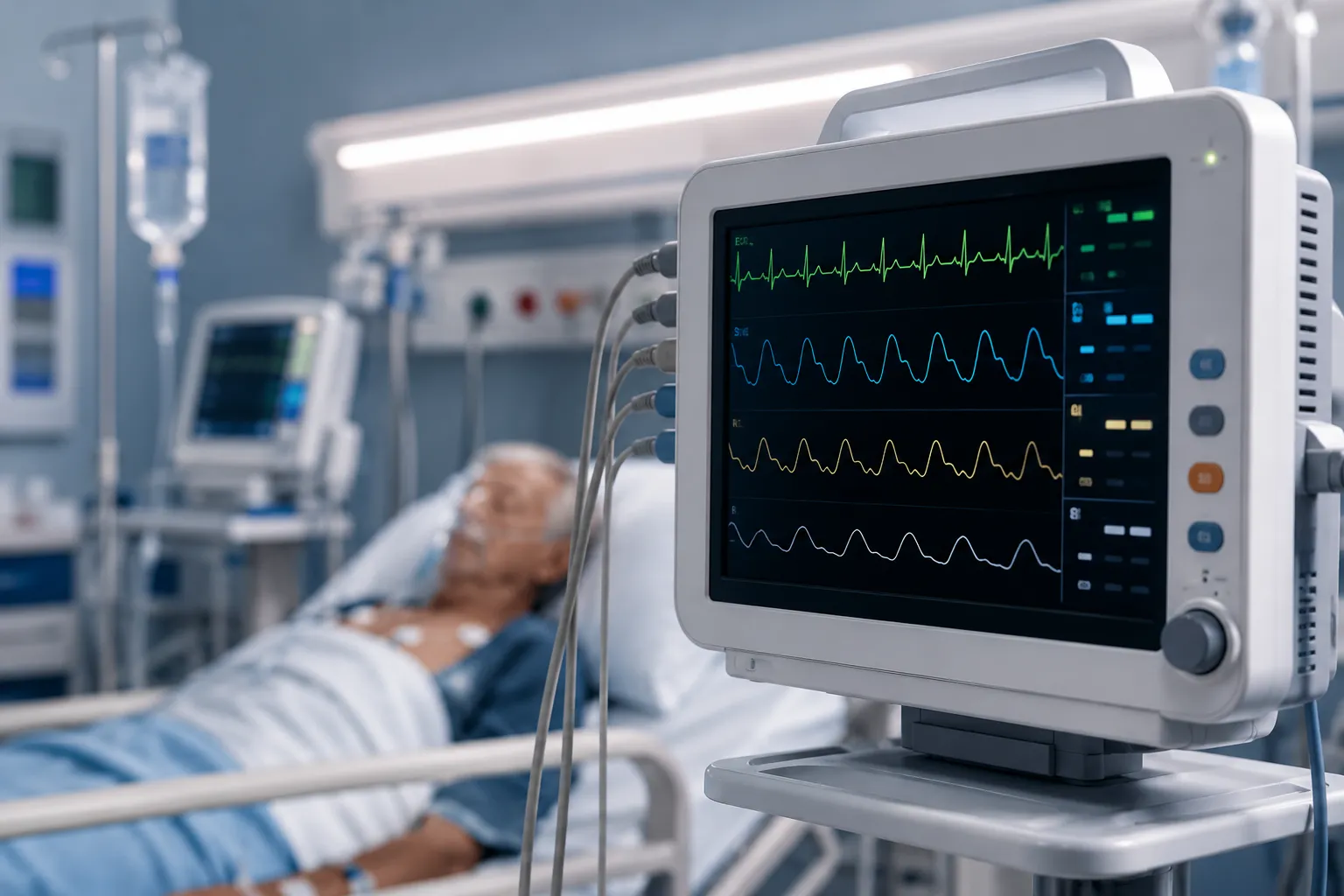
What is the ECG machine actually doing when those electrodes go on the chest, and the paper starts printing? It is not measuring the heartbeat. It measures the electrical activity that causes the heartbeat. Every contraction of the heart begins with an electrical impulse. That impulse spreads through the heart muscle in a predictable pattern. The ECG machine records that pattern — the voltage changes at the skin surface that reflect the electrical events happening inside the heart. What comes out is a waveform. A line that rises and falls in a signature shape that tells the clinician whether the heart is beating normally, whether a chamber is enlarged, whether a vessel is blocked, whether the rhythm is dangerous, and whether the patient is about to die without intervention.
She was fifty-three. Came to the GP with chest tightness on exertion. No history. No risk factors documented. ECG was performed during the surgery. The GP saw ST changes in leads V4-V6. Called an ambulance. The patient reached the cath lab within ninety minutes. A significant LAD stenosis was found. Stented. She survived a heart attack, which the ECG machine found before she had it. The ambulance crew took the ECG. The cath lab read it before she arrived. The ECG machine did not diagnose the heart attack. It showed the clinician where to look — and the clinician did the rest.
This guide covers what an ECG machine is and how it works with the honest detail that GPs, nurses, paramedics, and procurement teams need. Medigear supplies certified ECG machines to hospitals, GP surgeries, and clinics across the UK, and every point here comes from real clinical use. Clinics sourcing certified ECG machines can explore the Medigear buyers portal for pricing, availability, and procurement built for cardiac purchasing.
The Electrical System
The heart has its own electrical system. The sinoatrial node (SA node) in the right atrium fires a spontaneous electrical impulse. That impulse spreads across the atria, causing them to contract. It reaches the atrioventricular node — the AV node — which delays it briefly before passing it to the bundle of His, the bundle branches, and the Purkinje fibres. These conduct the impulse to the ventricular muscle, which contracts. One cycle. One heartbeat. The ECG machine records every stage of this electrical journey — every depolarisation, every repolarisation — as a waveform on paper or a screen.
The Waveform
The waveform has named components. The P wave represents atrial depolarisation — the electrical activation of the atria. The PR interval is the time from atrial activation to ventricular activation — a delay at the AV node. The QRS complex represents ventricular depolarisation — the electrical activation of the ventricles, the main pumping chambers. The T wave represents ventricular repolarisation — the electrical reset of the ventricles before the next beat. The ST segment sits between the QRS and the T wave. When the ST segment elevates — STEMI — it signals acute myocardial infarction. When it depresses, it signals ischaemia or subendocardial injury. The waveform is the language the ECG machine speaks. Read it fluently, and the heart tells its story.
12 Leads
The standard 12-lead ECG uses ten electrodes — four on the limbs and six on the chest — to create twelve different views of the heart's electrical activity. Each lead looks at the heart from a different angle. Leads I, II, and III look from the limbs. aVR, aVL, and aVF are augmented limb leads. V1-V6 are the precordial leads. Each view shows a slightly different picture. Together, they give a three-dimensional electrical map of the heart. The inferior leads — II, III, aVF — show the bottom of the heart. The lateral leads — I, aVL, V5, V6 — show the side. The anterior leads — V1 to V4 — show the front. A heart attack in the right coronary artery shows changes in different leads than one in the left anterior descending. The ECG machine does not know which artery is blocked. The leads show which territory is affected. The clinician works out which artery from there. ECG machine manufacturers wanting to list cardiac monitoring and 12-lead systems where hospitals and GP surgeries are searching can reach buyers through the Medigear advertising platform.
Types of ECG Machine
Types of ECG machine suit different clinical settings. The resting 12-lead ECG machine is the standard. Placed on the patient at rest. Records ten seconds of activity. Prints or displays the 12-lead output. Used in GP surgeries, cardiology clinics, A&E, and wards. The exercise ECG — stress test — records during a treadmill or bike protocol. Shows how the heart responds to increasing demand. Used to detect exertional ischaemia. The Holter monitor records continuously for twenty-four to forty-eight hours. The patient wears it home. Normal activity. Sleep. Exercise. Every rhythm event is captured. Used to detect paroxysmal arrhythmias. The event monitor records only when triggered by the patient or by the device sensing an arrhythmia. Used for infrequent episodes. The 3-lead portable ECG records a simplified view for rapid rhythm assessment — ambulance, bedside, remote. Reach out to our team for guidance on matching ECG machine type to your clinical setting and patient population.
Electrode Placement
Electrode placement determines output quality. The wrong electrode position produces a misleading trace. The right arm electrode is placed on the left arm inverts the limb leads. A chest electrode placed too high or too low shifts the precordial picture. Consistent electrode placement produces consistent, comparable traces over time. Only as accurate as the placement of the electrodes. Training on placement is not optional. It determines whether the trace means what the clinician thinks it means.
Paper Speed and Gain
Paper speed and gain must be set correctly. Standard paper speed is twenty-five millimetres per second. Standard gain is ten millimetres per millivolt. Changing either changes the appearance of the waveform without changing the heart. A fast paper speed stretches the waveform. A slow speed compresses it. A high gain makes everything look bigger. A low gain makes it look smaller. Read an ECG without knowing the paper speed and gain? May misinterpret what is there. Our guide to Creutzfeldt-Jakob disease covers the EEG monitoring used in neurological diagnosis — the same waveform-reading principles that apply when interpreting ECG traces apply across every bioelectrical recording the clinician encounters.
Artefact
Artefact is the enemy of interpretation. Electrical artefacts from patient movement, poor skin contact, loose electrodes, nearby electrical equipment, or poor cable positioning can produce an abnormal trace when the heart is not. Mistake artefact for AF — start treatment; the patient does not need it. Recognise artefact — repeat with better technique. Motion artefact in an ambulance. Electrical artefact near a diathermy machine. Muscle artefact in a shivering patient. The ECG machine records everything. Including what the heart is not doing. Our guide to essential eye screening devices covers the calibration and quality standards that clinical diagnostic tools must meet — the same standards apply when an ECG machine must produce a trace accurate enough to drive an emergency clinical decision.
Digital Transmission
Digital ECG machines transmit traces instantly. A paramedic attaches electrodes at the patient's home. The trace is transmitted to the receiving hospital. Cardiologist reads before the ambulance arrives. Cath lab activated. The patient goes straight to the table. Not a luxury. Saves the thirty minutes between arrival and decision. Suppliers of ECG machines, Holter monitors, and cardiac monitoring accessories can register through the Medigear supplier portal to connect with hospitals and clinics building or upgrading their cardiac diagnostic capability.
Pre-Hospital Transmission
Can your GP surgery perform a 12-lead ECG and transmit it to the receiving hospital before the ambulance arrives? Trace reaches the cardiologist first. Preparation before the patient arrives. Companies seeking long-term collaboration on ECG machine supply, servicing, and cardiac monitoring packages can explore the Medigear partnership programme for ongoing opportunities beyond a single order.
ECG Interpretation
Does your clinical team know how to recognise STEMI, AF, complete heart block, and VT on the ECG trace — or just that the trace looks abnormal? The ECG machine produces the data. The clinician must interpret it. Training. Regular exposure. Supervised reading. The team that reads acts confidently. The team that defers every trace waits for a decision that the machine has already made.
Trace Log
Does your practice maintain a log of every ECG performed — with the patient, the date, the operator, and the outcome? The ECG that was performed but not stored cannot be compared with the next one. The baseline trace taken before the chest pain started is the most valuable ECG the clinician has when the chest pain begins. Store every trace. Date it. Attach it to the patient record.
Daily Check
Can your team calibrate and check the ECG machine before use each morning? Signal quality. Paper or printer function. Lead integrity. Battery or mains power confirmed. The ECG machine that fails mid-trace during a suspected STEMI loses the thirty seconds it takes to restart. The one checked before the clinic opens does not.
Borderline Trace
What does your GP surgery do when the ECG machine shows a result that could be a STEMI but the patient looks clinically stable? Do not treat the appearance alone. Do not ignore it either. Call for ambulance support. Send the trace. Let the cardiologist confirm. The GP who acts on a high-quality trace and a consistent clinical picture saves the patient the one who waits for clarity that never comes before the arrhythmia does.
Why Choose Medigear
Medigear supplies certified ECG machines, Holter monitors, and cardiac monitoring accessories to GP surgeries, hospitals, and clinics across the UK. Whether you are equipping a new clinic, upgrading to digital transmission, or adding Holter capability, our team matches the right ECG machine to your patients and your practice. Reach out to our team for guidance built around the device that records the heart's electrical story — and the clinicians who must read it correctly every time.
Conclusion
What is the ECG machine doing? Recording the electrical activity that causes the heartbeat. Every depolarisation. Every repolarisation. Mapped into a waveform that tells the clinician what the heart is doing — and what it is about to do. She came in with chest tightness. The ECG machine showed ST changes. She reached the cath lab within ninety minutes. Survived a heart attack it found before she had it. Twelve leads. Twelve views. P wave. QRS. ST segment. The waveform is the language. Read it fluently. Resting, stress, Holter, event, portable — each type for each setting. Electrode placement must be correct. Paper speed set. Gain standard. Artefact recognised. Digital transmission saves thirty minutes. Medigear stands alongside clinical teams with certified ECG machines and the honest support that cardiac diagnostics demand. Speak to our team today — because the device that records the heart's electrical story must do it right every single time.