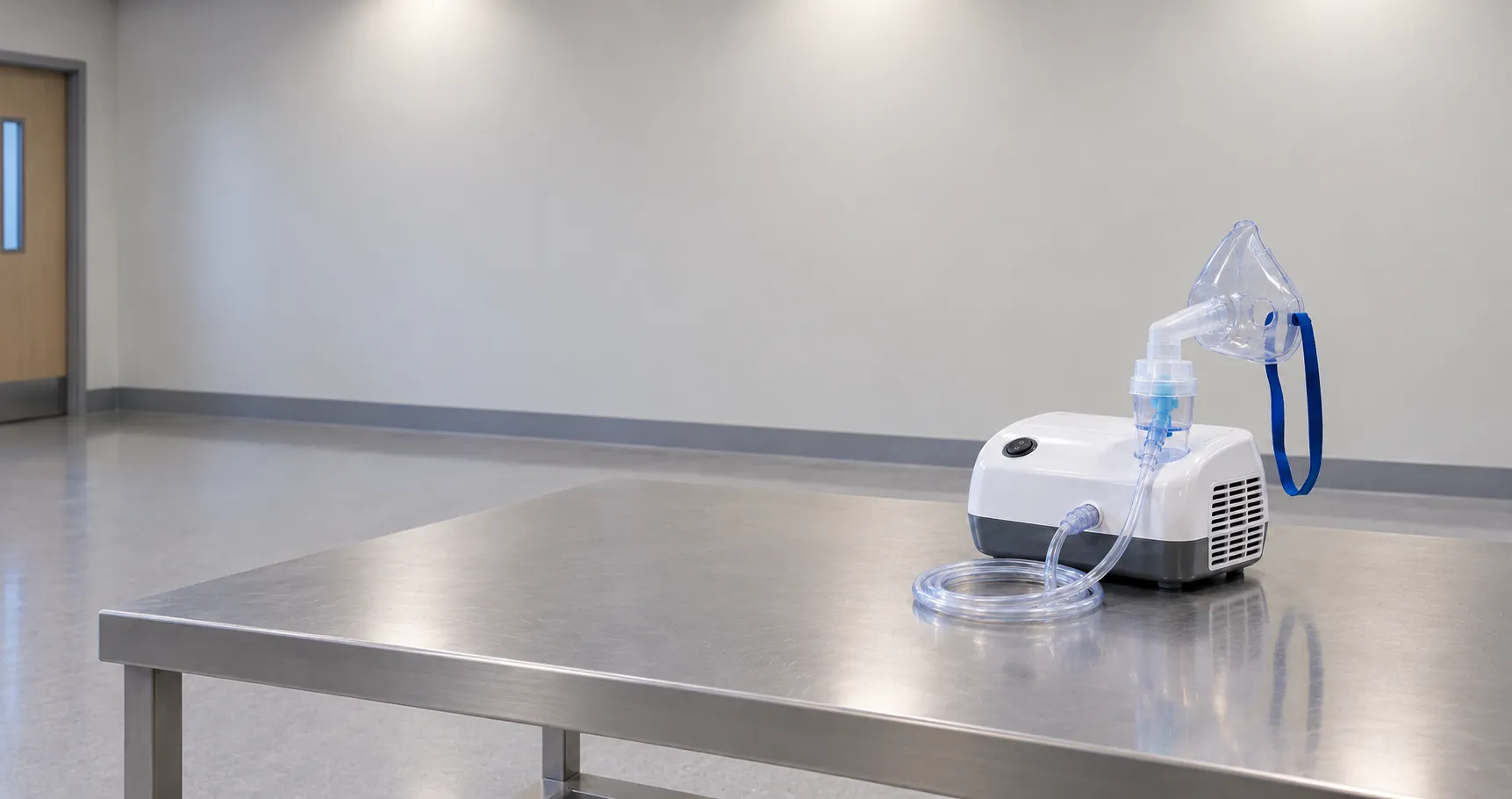
Nebuliser machines deliver liquid medication as a fine mist that patients inhale through a mouthpiece or mask. They are commonly used in respiratory care for patients who may have difficulty using handheld inhalers, including children, elderly patients, and acutely unwell patients,
well patients, or people who need supervised aerosol therapy in clinical settings.
For healthcare buyers, buying nebuliser machines is not only about selecting a compact device. Buyers must review nebuliser type, medication compatibility, output performance, noise level, portability, cleaning requirements, accessories, spare parts, and compliance with applicable local regulatory standards. FDA guidance identifies nebulisers as prescription devices in its device review context, underscoring why healthcare buyers should request clear product documentation before procurement.
How Nebuliser Machines Support Respiratory Care
Nebuliser machines help patients inhale aerosolised medicine by breathing normally. Respiratory therapists, nurses, doctors, emergency teams, paediatric teams, and home care providers use them under appropriate clinical direction.
Aerosol Medication Delivery — A nebuliser changes liquid medicine into a mist that can be inhaled into the airways. MedlinePlus describes nebulisers as devices that turn asthma medicine into a mist that can be inhaled through a mask or mouthpiece.
Support for Patients Who Struggle With Inhalers — Some patients cannot coordinate inhaler timing properly. Nebulisers can help when a patient needs medication delivered with relaxed breathing rather than a quick-acting inhaler technique.
Clinical Use Across Age Groups — Nebulisers may be used in adult, paediatric, emergency, outpatient, and home care settings. In practice, mask fit, treatment time, noise level, and ease of cleaning often affect daily use as much as device power.
Medication and Device Matching — Not every nebuliser suits every medicine. Buyers should check medicine compatibility, particle output, cup design, and manufacturer instructions before standardising a model across departments.
Where Nebuliser Machines Are Used
Nebuliser machines are used in many healthcare environments. Their design should match the care setting, patient group, treatment frequency, and cleaning capacity.
Hospital Wards — General wards may use nebulisers for supervised respiratory treatments. Devices should be easy to clean, stable on bedside surfaces, and simple for staff to assemble.
Emergency and Critical Care Areas — Emergency departments and urgent care areas need reliable nebulisers that can be prepared quickly. Facilities sourcing through regulated and certified equipment suppliers worldwide should confirm the device type, accessories, medication cup availability, tubing compatibility, and spare parts availability before procurement.
Paediatric and Outpatient Clinics — Children may need masks, quieter devices, and shorter treatment workflows. A loud compressor or poorly fitting mask can make treatment harder for younger patients.
Home Healthcare Programmes — Portable nebulisers may be useful for home oxygen and respiratory care programmes. Buyers should consider battery life, cleaning instructions, replacement parts, and patient training materials.
Common Types of Nebuliser Machines
Nebuliser machines are available in different designs. The right choice depends on medication type, treatment setting, portability needs, and maintenance capability.
Compressor Nebulisers — Compressor or jet nebulisers use compressed air to produce a mist of medication. They are widely used because they are familiar, durable, and suitable for many routine respiratory care settings.
Mesh Nebulisers — Mesh nebulisers use a vibrating mesh to produce aerosol particles. They are often compact, quiet, and portable, but they may require careful cleaning and may cost more than basic compressor models.
Ultrasonic Nebulisers — Ultrasonic nebulisers use high-frequency vibration to create mist. They can be quieter, but buyers should confirm medication compatibility, as some medications may not be compatible with ultrasonic aerosol generation.
Portable Nebulisers — Portable models may run on batteries or rechargeable power. They are useful for home care, mobile clinics, travel support, and outpatient respiratory programmes.
Paediatric Nebuliser Setups — Paediatric use often requires child-sized masks, softer materials, lower noise levels, and simple assembly. The machine itself may be similar, but accessories and user experience matter strongly.
Selection Points for Healthcare Buyers
Select nebuliser machines for clinical suitability and service reliability. A low-cost device may become expensive if accessories are unavailable or cleaning is difficult.
Medication Compatibility — Buyers should check whether the nebuliser is suitable for the medicines the facility uses. Confirm this through manufacturer instructions and local clinical policy.
Aerosol Output and Treatment Time — Output performance affects how quickly the device delivers medication. A device that takes too long may reduce patient comfort and slow clinical workflow during busy sessions.
Noise Level — Compressor nebulisers can be noisy. In paediatric wards, outpatient clinics, or home care, quieter operation may improve patient cooperation and staff acceptance.
Accessory Availability — Masks, mouthpieces, tubing, filters, medicine cups, batteries, chargers, and replacement mesh parts should be readily available. Missing accessories can make a working machine unusable.
Cleaning Requirements — Nebuliser parts must be easy to clean and dry. MedlinePlus advises washing the medicine cup and mouthpiece after each use and air-drying parts before storage.
Procurement Guidance for Nebuliser Machines
Nebuliser procurement should include clinical, biomedical, infection prevention, and supply chain review. Evaluate the machine, accessories, medicine cup, tubing, filters, and cleaning process together.
Total Cost of Ownership — Buyers should include the device, reusable or disposable parts, masks, mouthpieces, tubing, filters, batteries, chargers, cleaning supplies, staff time, and replacement accessories. A cheaper device may cost more over time if consumables are expensive or hard to obtain.
Compliance and Documentation — Procurement teams should request product specifications, intended use, medication compatibility guidance, electrical safety information, cleaning instructions, warranty terms, and conformity documents. Check compliance against applicable local regulatory standards, such as CE, FDA, ISO, or regional equivalents, where relevant.
Supplier Transparency — Suppliers and manufacturers advertising to global healthcare buyers should provide clear information on nebuliser type, aerosol output, treatment rate, accessories, cleaning steps, power requirements, and spare parts. Healthcare buyers should avoid vague listings that do not identify clinical use or accessory compatibility.
Training and User Support — Staff and patients should know how to assemble, use, clean, dry, and store the nebuliser. Training should also explain when nebuliser therapy is appropriate and when clinical review is needed.
Healthcare groups managing several hospitals, clinics, or home care programmes may benefit from structured distribution and reseller partnership arrangements. Standardising nebuliser models and accessories can reduce ordering errors, simplify staff training, and improve spare part planning.
Maintenance and Infection Prevention Planning
Nebuliser machines require careful cleaning and maintenance because medication pathways and moisture can promote contamination if handled improperly. Never treat reusable parts casually.
Cleaning After Use — Clean reusable nebuliser parts according to manufacturer instructions and facility policy. Published respiratory care guidance notes that reusable nebulisers should be cleaned, disinfected, rinsed where required, and air-dried between uses.
Filter and Tubing Checks — Inspect compressor filters, tubing, medicine cups, masks, and mouthpieces regularly. Replace discoloured, cracked, blocked, or damaged parts.
Dry Storage — Nebuliser components should be stored clean and dry. Wet storage can increase the risk of contamination and may damage accessories.
Device Performance Review — Staff should report weak mist output, unusual noise, power faults, overheating, or long treatment times. These issues can indicate blocked parts, worn components, or device failure.
International Sourcing Considerations
Nebuliser machines can be sourced internationally when buyers clearly define the intended care setting, device type, power requirements, plug type, accessory needs, medication compatibility, documentation, packaging, warranty, and spare-part supply. Buyers should also confirm whether they need compressor, mesh, ultrasonic, portable, paediatric, or homecare models.
For project-based sourcing, buyers can contact the Medigear.uk team for supply support to discuss availability, documentation, export needs, and procurement requirements.
Final Thoughts
Nebuliser machines support respiratory care by helping patients inhale medication as a fine mist. They are useful across hospitals, clinics, emergency care, paediatric departments, and home healthcare programmes.
The right nebuliser should match the medication, patient group, care setting, cleaning process, accessory needs, maintenance capacity, and local compliance requirements. Buyers should review documentation, spare parts, staff training, and supplier support before ordering.
Disclaimer
Medigear.uk is a global medical equipment supplier, exporter, and distributor. The content published on this site is intended for educational and product awareness purposes only. Nothing on this page constitutes medical advice, clinical guidance, or treatment recommendations. Qualified medical professionals and compliant procurement teams should make all healthcare procurement and clinical decisions within the regulatory frameworks of their respective countries.