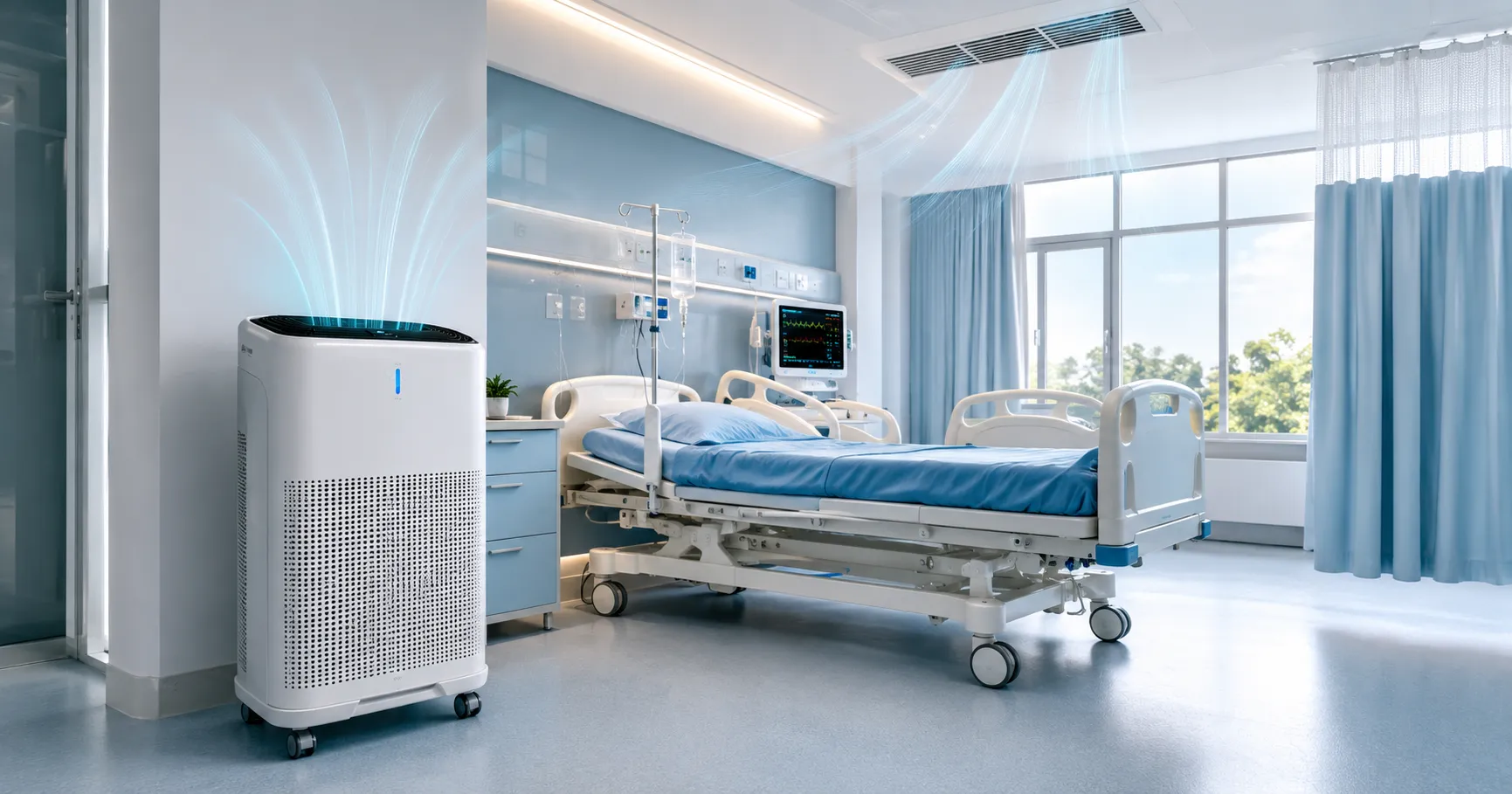
Hospital air purification systems are used to support cleaner indoor air in selected healthcare spaces. They may include portable HEPA air cleaners, HVAC filtration upgrades, UVGI systems, ceiling-mounted filtration units, or integrated air quality solutions. These systems do not replace ventilation, cleaning, hand hygiene, isolation protocols, or personal protective equipment, but they can support infection prevention and indoor air quality planning.
For healthcare buyers, air purification should be treated as part of facility engineering rather than a simple appliance purchase. Buyers need to review room size, airflow, filter efficiency, maintenance access, noise level, electrical safety, staff workflow, and compliance with applicable local regulatory standards. WHO guidance on indoor ventilation highlights the need to assess ventilation and improve indoor air quality to reduce indoor health risks.
How Hospital Air Purification Systems Support Safer Indoor Air
Hospital air purification systems help reduce airborne particles and improve air quality in targeted areas. They are often used where existing ventilation needs support or where additional filtration is needed for specific workflows.
Supplemental Air Cleaning — Portable HEPA units and fixed filtration systems can provide extra air cleaning in areas where ventilation upgrades are difficult. CDC NIOSH guidance notes that in-room HEPA air cleaners with powered fan systems are a preferred auxiliary air-cleaning option in higher-risk settings such as health clinics, vaccination areas, medical testing locations, and waiting areas.
Support for Infection Control Planning — Air purification can help lower airborne particle concentration, but it must be matched to room use and airflow patterns. In practice, a unit placed in the wrong corner or blocked by furniture may deliver poor real-world results.
Cleaner Waiting and Treatment Areas — Waiting rooms, triage spaces, outpatient clinics, dental areas, laboratories, and consultation rooms may benefit from improved air cleaning. These spaces can have fluctuating occupancy levels, which makes planning for air movement and filtration important.
UVGI as a Supplemental Measure — Some facilities use ultraviolet germicidal irradiation as part of an air cleaning strategy. CDC environmental infection control guidance describes UVGI as a supplemental air-cleaning measure that can reduce transmission of airborne bacterial and viral infections in hospitals and other settings.
Where Air Purification Systems Are Used
Hospital air purification systems are used across different clinical and support environments. The correct system depends on the room's purpose, occupancy, patient risk, existing HVAC performance, and maintenance capacity.
Waiting and Reception Areas — These areas may have high patient and visitor movement. Portable or fixed air cleaning systems can support indoor air quality when matched to room size and airflow needs.
Outpatient and Diagnostic Rooms — Examination rooms, imaging preparation areas, dental clinics, and testing spaces may need additional air cleaning during busy service hours. Facilities sourcing equipment through regulated and certified suppliers worldwide should verify clean air delivery, filter type, noise level, certification documents, and spare filter availability before procurement.
Laboratories and Procedure Support Areas — Some laboratories and procedure preparation areas may require filtration support, depending on the risk assessment. Air purification should not be used as a substitute for biosafety cabinets, fume extraction, or correct ventilation where those systems are required.
Temporary and Retrofit Spaces — Portable HEPA units can be useful in older buildings, mobile clinics, temporary screening areas, and retrofit projects. CDC environmental infection control guidance has referred to portable industrial-grade HEPA filters as temporary supplemental air cleaning in specific healthcare situations, with engineering consultation for proper placement.
Selection Points for Hospital Air Purification Systems
Hospital air purification systems should be selected with room performance in mind. Product appearance or generic “clean air” claims are not enough for healthcare use.
HEPA Filter Performance — HEPA filtration is commonly used to capture airborne particles. Buyers should confirm the filter grade, replacement schedule, seal quality, and whether the unit maintains airflow as filters load over time.
Clean Air Delivery Rate — Clean air delivery rate indicates how much filtered air a unit can provide. The figure should be compared with the room size, occupancy, and intended use, rather than reviewed in isolation.
Noise and Staff Comfort — Air purification systems must be quiet enough for patient care and staff communication. A powerful unit may be ineffective if staff lower the fan speed because it is too noisy.
Maintenance Access — Filters, UV lamps, pre-filters, sensors, and grilles should be easy to inspect and replace. Hard-to-access parts increase downtime and maintenance costs.
Airflow Direction — The system should avoid blowing air from one person directly toward another. Proper placement matters because air-cleaning performance depends on how room air circulates.
Procurement Guidance for Healthcare Buyers
Buying hospital air purification systems requires technical review, clinical input, and facility planning. The system should match the room, risk level, existing ventilation, and maintenance resources.
Total Cost of Ownership — Buyers should include the unit, filters, UV lamps, sensors, installation, testing, electricity, maintenance labour, and spare parts. A budget-tier unit may become expensive if replacement filters are costly or unavailable.
Compliance and Documentation — Procurement teams should request product specifications, electrical safety details, filter certificates, installation manuals, maintenance instructions, warranty terms, and conformity documents. Compliance should be checked against applicable local regulatory standards and standards such as ASHRAE, CE, FDA, or their regional equivalents where relevant.
Supplier Transparency — Suppliers and manufacturers advertising to global healthcare buyers should provide clear information about filtration type, airflow capacity, noise level, service access, spare filters, UVGI safety controls, and intended room use. Healthcare buyers should avoid products that rely only on broad marketing claims.
Integration With Existing HVAC — Air purification should be reviewed alongside ventilation and filtration already present in the building. ASHE guidance notes that hospitals and design engineers should carefully consider filter efficiency ratings when ordering HVAC filters, as performance over time matters.
Healthcare groups managing several departments or sites may benefit from structured distribution and reseller partnership arrangements. Standardising models, filters, service schedules, and supplier responsibility can make long-term management easier.
Maintenance and Monitoring Planning
Hospital air purification systems need planned maintenance to remain effective. A system with a clogged filter, an expired UV lamp, a blocked intake, or a disabled alarm may give a false sense of protection.
Filter Replacement Schedule — Filters should be replaced according to the manufacturer's guidance and actual operating conditions. High-dust or high-traffic areas may require more frequent inspection.
UVGI Safety Checks — UVGI systems need correct shielding, lamp replacement, output checks, and safety controls. Staff should not be exposed to unsafe ultraviolet radiation during operation or servicing.
Airflow and Placement Review — Units should remain unobstructed. Furniture, curtains, storage boxes, or equipment can block intake and outlet areas.
Record Keeping — Facilities should document filter changes, lamp replacement, maintenance visits, repairs, and performance checks. Records help procurement and facility teams plan future replacement budgets.
International Sourcing Considerations
Hospital air purification systems can be sourced internationally when buyers define room size, intended use, filtration needs, airflow target, noise limits, documentation requirements, plug or voltage compatibility, spare filter needs, and lead times. Buyers should confirm whether they need portable HEPA units, HVAC filter upgrades, UVGI systems, ceiling-mounted units, or integrated air quality monitoring.
For project-based sourcing, buyers can contact the Medigear.uk team for supply support to discuss product availability, documentation, export needs, and procurement requirements.
Final Thoughts
Hospital air purification systems help maintain cleaner indoor air in select healthcare environments. They can help improve air quality when used alongside proper ventilation, cleaning, maintenance, and infection-prevention practices.
The right system should be selected based on room size, clinical use, airflow requirements, filter performance, maintenance access, noise level, compliance documentation, and supplier support. Buyers should focus on real operational performance, not only product claims.
Disclaimer
Medigear.uk is a global medical equipment supplier, exporter, and distributor. The content published on this site is intended for educational and product awareness purposes only. Nothing on this page constitutes medical advice, clinical guidance, or treatment recommendations. All healthcare procurement and clinical decisions should be made by qualified medical professionals and compliant procurement teams operating within the regulatory frameworks of their respective countries.