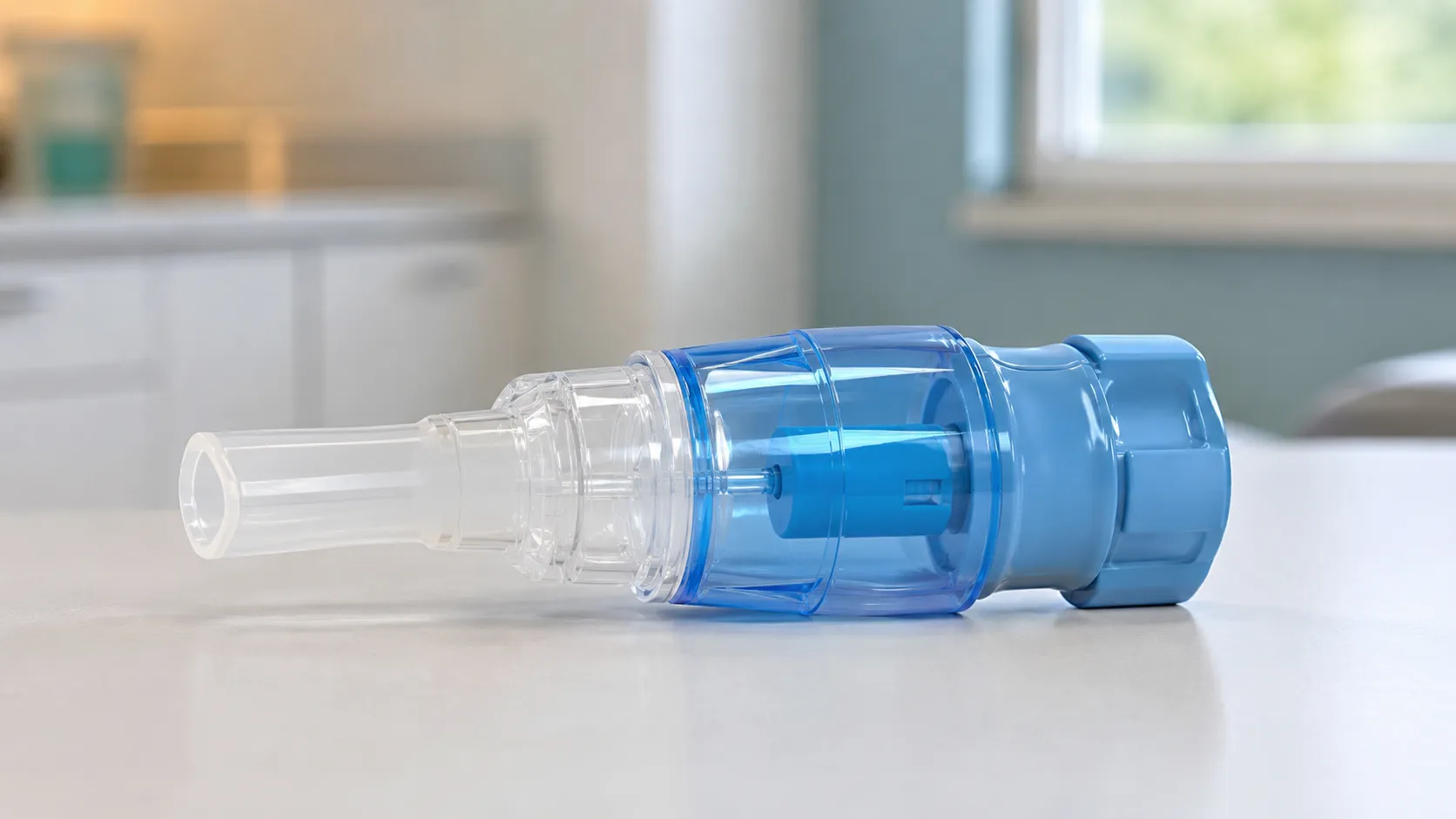
Positive expiratory pressure therapy, or PEP, is an airway-clearance technique in which a patient breathes out against a fixed resistance, generating a steady back-pressure in the airways of roughly ten to twenty centimetres of water. That pressure splints collapsible airways open and drives air behind trapped mucus through collateral channels, pushing secretions toward the larger airways and clearing them with a huff or cough. This article covers non-oscillating PEP; a separate MediGear guide deals with oscillating PEP devices, which add a vibratory element on top of the back-pressure.
This piece is for respiratory services, community teams and procurement staff choosing PEP hardware for cystic fibrosis, bronchiectasis, COPD and post-operative use. It sets out the device types, how the target pressure is set and verified, and the specifications to confirm before buying.
How Steady Back-Pressure Clears Airways
Unlike an oscillating device, non-oscillating PEP delivers a smooth, constant expiratory resistance with no vibration. The patient inhales a little above normal, then breathes out actively but not forcibly against the resistor for a series of breaths, holding the pressure in the therapeutic band before pausing to huff and clear. The steady pressure keeps unstable airways from collapsing during exhalation and promotes even filling of lung regions behind mucus plugs, so the next breaths can get air behind the secretions and shift them. The technique is repeated in cycles for a set session.
Fixed-Orifice Resistor PEP
The simplest devices generate pressure with a fixed orifice: expired air is forced through a calibrated hole, and the resistance of that hole against the patient's flow produces the back-pressure. Many use a set of interchangeable orifices of different diameters so the resistance can be matched to the patient. The important caveat is that the pressure produced depends on expiratory flow, so it varies if the patient breathes harder or more gently. That is why a manometer is used to set and check the target, and why the patient is coached to a flow that brings the pressure into the intended range.
Threshold PEP
Threshold PEP works differently. A spring-loaded or weighted one-way valve stays shut until the expiratory pressure reaches a set opening value, then allows flow while holding that pressure. The result is largely flow-independent: the device maintains pressure close to the set value regardless of how fast the patient exhales, making dosing more consistent than a fixed orifice. Threshold devices usually allow the opening pressure to be dialled or set, and are a good choice where reproducible pressure without constant coaching matters.
Bottle PEP
Bottle PEP, sometimes called bubble PEP, is the low-cost variant: the patient exhales through a length of tubing into a container holding a column of water, and blows bubbles. The depth of tubing below the water surface, measured in centimetres, sets the approximate back-pressure in centimetres of water, so eight to twelve centimetres of submersion gives roughly that pressure. It is cheap and easy to assemble, and is often used where a simple, disposable set-up is preferred. However, it needs clean water, single-patient tubing, and attention to infection control.
Setting and Verifying the Target Pressure
Whatever the mechanism, the therapeutic aim is a pressure in the region of ten to twenty centimetres of water, confirmed rather than assumed. A manometer, either built into the device or connected at a port in the mouthpiece or mask, lets the clinician read the pressure during exhalation and adjust the orifice, spring or water depth accordingly. When specifying fixed-orifice or threshold devices, confirm there is a manometer port or an integrated gauge, since setting PEP by feel alone is unreliable, particularly with flow-dependent fixed-orifice units.
Cleaning, Consumables and Care Settings
PEP devices are used repeatedly, so decontamination often drives the buying decision. Confirm whether the device is single-patient or can be dismantled, cleaned, or autoclaved for reuse, and follow the manufacturer's method and agents. Mouthpiece and mask options should suit both adults and children, and a mask matters for patients who cannot maintain a mouthpiece seal. Because these are simple, portable, non-powered devices, they move easily between hospital, clinic and home; for a home programme, confirm the patient can clean and reassemble the device correctly and that replacement mouthpieces, valves or tubing are readily available. Our buyer resources can help model that consumable line.
Matching the Device to the Patient and Setting
Choosing between the PEP types is a clinical decision, but the practical differences guide stock. Threshold devices give reproducible pressure with the least coaching, which suits community and self-managed use; fixed-orifice devices are simple and inexpensive but need a manometer and coaching to land the target; bottle PEP is the cheapest to assemble and easy to explain, at the cost of a water container and stricter hygiene. A respiratory service typically holds more than one type so a clinician can match the device to the patient's ability, the setting and the pressure the technique requires.
Total Cost and Consumable Planning
These are low-unit-cost devices, so lifetime spend sits in consumables and reprocessing labour rather than purchase price. A single-patient device avoids decontamination but is bought repeatedly; a reusable device costs more up front but is cleaned and reissued, shifting the burden to sterile-services or ward-cleaning time. Model both routes against your patient numbers, and confirm the reorder route for mouthpieces, valves, filters and, for bottle PEP, suitable tubing, so a simple therapy is never held up by a missing part.
Standards and Regulation
PEP devices are medical devices and should carry valid UKCA or CE marking and MHRA registration; even simple, non-powered products fall under the regulations, so ask for the declaration and instructions for use. Materials in the breathing-gas pathway should meet ISO 18562 biocompatibility, and any device incorporating a filter or valve should state its performance. Because these products carry no electrical parts, the IEC 60601 electrical-safety family does not apply. Still, cleaning validation and biocompatibility documentation do, and current clearance-technique guidance from bodies such as NICE informs how the devices are used within a service.
Procurement Checklist
-
Confirm UKCA or CE marking and MHRA registration for the device.
-
Decide between fixed-orifice, threshold or bottle PEP for your service.
-
Check for a manometer port or integrated gauge to set the target pressure.
-
Confirm the achievable pressure range covers roughly ten to twenty centimetres of water.
-
Verify mouthpiece and mask options suit adults and children.
-
Establish whether the device is single-patient or cleanable and autoclavable.
-
Confirm replacement mouthpieces, valves and tubing are readily available.
-
For home use, check the patient can clean and reassemble it correctly.
Distinct From Oscillating PEP
The key distinction for procurement is that non-oscillating PEP delivers only steady back-pressure, while oscillating PEP adds a fluttering vibration to that pressure and is covered in its own guide. They are not interchangeable line items: some patients are prescribed one, some the other, and a service usually stocks both. When comparing quotes, be clear about which type each product is, since the mechanism, how pressure is set, and the coaching involved all differ. Keeping the two categories separate avoids buying the wrong device against a clinician's prescription.
Conclusion
Non-oscillating PEP therapy clears airways with a simple, steady expiratory back-pressure set to a verified target, delivered through fixed-orifice, threshold or bottle designs. Specify a confirmable pressure range, a manometer port, suitable interfaces, and a clear cleaning and consumable plan, and keep it distinct from oscillating PEP on the order. To compare compliant PEP devices, manometers, and consumables, or to arrange a service quote, contact MediGear or open a buyer account.
Disclaimer
This article is for informational purposes only. It is published by MediGear (medigear.uk) for general information and procurement guidance and is not clinical, diagnostic, treatment, technical, engineering, legal, or regulatory advice, nor a product endorsement, guarantee, or substitute for professional assessment. MediGear does not provide medical consultations. Buyers should consult their clinical, biomedical, estates and regulatory contacts, and the manufacturer's documentation, and independently verify all specifications, certifications, compatibility and suitability before purchase. Specifications, certifications and availability are correct at the time of publication and may change without notice. MediGear is a medical-equipment distributor and does not sell medicines or pharmaceutical products.