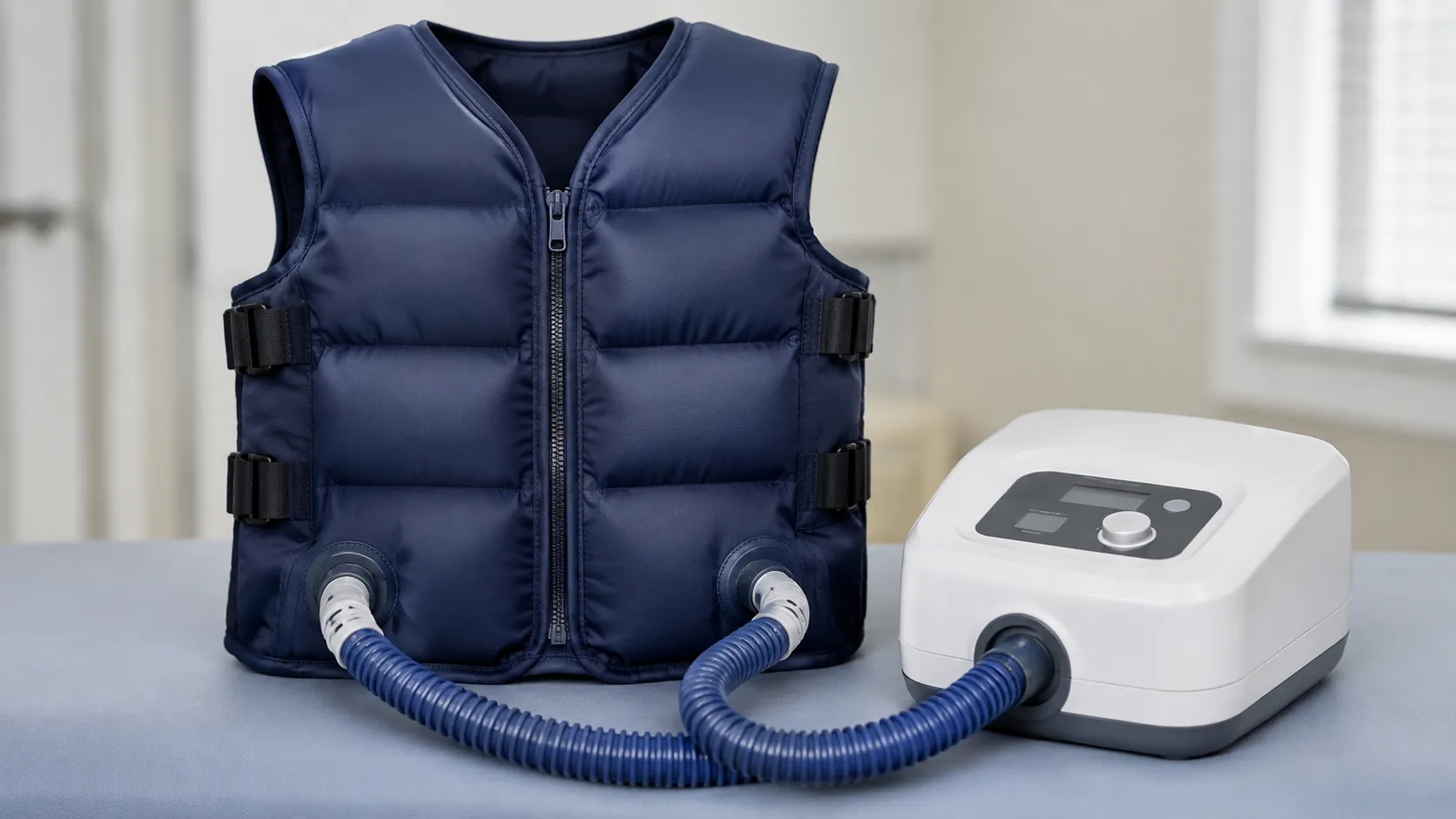
An airway clearance vest is a wearable device that mobilises thick secretions from the lungs using high-frequency chest-wall oscillation, or HFCWO. An inflatable garment worn over the torso is linked to an inflatable generator that rapidly inflates and deflates it many times a second, delivering gentle compressive pulses to the chest that shear mucus loose and move it towards the larger airways for coughing out. In cystic fibrosis, it provides a consistent, repeatable daily clearance session that does not depend on a carer's technique.
This guide is for procurement teams, home-oxygen and respiratory services and biomedical staff specifying vests for hospital and, more often, home use. It focuses specifically on the oscillating-vest system, which is distinct from handheld and breathing-based clearance aids covered elsewhere, and sets out the specifications and buying criteria that matter.
How High-Frequency Chest-Wall Oscillation Works
The generator produces rapid pressure pulses that fill and empty the vest bladders. Each pulse briefly compresses the chest and creates a small burst of expiratory airflow in the airways; repeated many times per second, these bursts loosen mucus from the airway walls and nudge it centrally, a process sometimes described as creating repeated mini-coughs. Sessions typically run for around twenty to thirty minutes, often stepping through several frequencies so that different-sized airways are addressed, with the patient pausing to huff or cough and clear the mobilised secretions.
Frequency, Pressure and Session Settings
Two adjustable parameters define the therapy: oscillation frequency, usually spanning roughly five to twenty hertz, and pressure or intensity, which sets how firmly the vest squeezes. Lower frequencies tend to mobilise secretions in larger airways and higher frequencies in smaller ones, so a session cycles through a programmed range. When comparing generators, look at the breadth of the frequency range, the granularity of pressure control, whether programmes can be preset for a patient, and whether session data can be logged to support adherence monitoring in a home programme.
Vest and Garment Options
The garment is where fit and compliance are won or lost. Systems offer a size range from small paediatric to large adult, and a choice between a full wrap-style vest and a lighter waistcoat design; correct sizing matters because a loose or oversized garment transmits the oscillation poorly. Check the available size chart against your patient population, the ease of donning for patients with limited dexterity, and whether garments are single-patient for home use or can be cleaned and reissued. Garments and hoses are the recurring consumables; their price, lifespan, and reorder route matter.
Home Use and Adherence
Most vests are prescribed for daily home use rather than kept on a ward, so practicality at home drives the decision. Weigh the generator's size, weight and noise, how simple the controls are for a patient or parent to run unaided, and whether a carry case supports travel. Because the clinical benefit depends entirely on the therapy being done consistently, features that lower the burden, quick set-up, comfortable garments, quiet operation and clear progress feedback translate into adherence directly. For a loan or home-issue scheme, a dependable spares and garment supply line is as important as the generator itself.
Programmes and the Daily Session
Adherence hinges on how easy a full session is to complete unaided, so look closely at how programmes are run. Better generators let a clinician preset a sequence of frequency and pressure steps with a total run time, so a patient can follow it rather than adjust it repeatedly. A pause or ramp function that lets the patient stop to huff and clear without losing their place is valuable, as is a clear countdown of time remaining. For children, a parent-operated interface and a garment that is quick to fasten make the difference between a session done well and one cut short.
Connections, Warranty and Home Support
The generator connects to the vest through one or two hoses, and those couplings, along with the garment zips or fasteners, are the parts that wear with daily use, so confirm they are replaceable and stocked. Because a home device in daily use cannot sit idle awaiting repair, the support arrangement is a genuine specification: ask how a fault is reported, whether a loan generator bridges a repair, and the typical turnaround for a replacement. A longer warranty on the generator and a clear garment-replacement pathway protect both the patient's therapy and the service's budget over the years these systems remain in use.
Distinct From Other Chest-Physiotherapy Devices
An oscillating vest is not the same as the handheld and breathing-based clearance devices some patients use. It applies oscillation externally to the whole chest wall through a powered garment. In contrast, oscillating-pressure devices work through the mouth and depend on the patient's own breath, and manual techniques rely on a trained carer. The vest's advantage is consistent, technique-independent whole-chest treatment for patients who need a reliable daily regime; its trade-offs are cost, size and the need for mains power. Choosing between approaches is a clinical decision, but procurement should understand that the vest is a specific powered system with its own consumables and servicing.
Standards, Regulation and Servicing
Airway clearance vests are powered medical devices and should carry valid UKCA or CE marking and be registered with the MHRA. The generator's electrical safety falls under the IEC 60601-1 family, with electromagnetic compatibility under IEC 60601-1-2, and garment materials in patient contact should meet the relevant biocompatibility requirements. Ask for the declared frequency and pressure ranges, the service interval and any calibration check for delivered oscillation, and the warranty terms; for home devices, confirm how a fault is triaged and how quickly a replacement generator can reach a patient, since a broken unit interrupts daily therapy.
Procurement Checklist
-
Confirm UKCA or CE marking and MHRA registration for the system.
-
Check the oscillation frequency range and the pressure or intensity control.
-
Verify garment sizes cover your paediatric-to-adult population and fit correctly.
-
Confirm whether garments are single-patient or cleanable for reissue.
-
Assess generator weight, noise and simplicity for unaided home use.
-
Establish garment and hose cost, lifespan and reorder route.
-
Confirm service interval, warranty and home replacement turnaround.
-
Check whether session logging supports adherence monitoring.
Use Beyond Cystic Fibrosis
Although cystic fibrosis is the archetypal indication, HFCWO vests are also used in bronchiectasis and some neuromuscular conditions where a weak cough limits secretion clearance. The buying criteria are the same: correct garment fit, adequate frequency range, home practicality, and a solid consumable and service line, but the patient mix differs—still, the size range and the balance between hospital and home issues. remain the same. Ae-equipped mixed caseload should confirm the same platform can be garment-matched across ages rather than buying separate systems.
Conclusion
An airway clearance vest delivers consistent, technique-independent daily secretion clearance through high-frequency chest-wall oscillation, which is why it is a mainstay of cystic fibrosis care. Specify the garment and sizing, frequency and pressure range, home practicality, and a dependable consumable and service line, and treat it as a distinct powered system rather than a substitute for handheld or breathing-based aids. To compare compliant vests, garments, and generators or arrange a home-to-site quote, contact MediGear or open a buyer account.
Disclaimer
This article is for informational purposes only. MediGear (publishegear.uk) publishes it for general information and procurement guidance. It is not clinical diagnostic, treatment, technical, engineering, legal, or regulatory advice, nor a product endorsement, guarantee, or substitute for professional assessment. MediGear does not provide medical consultations. Buyers should consult their clinical, regulatory, and documentation contacts and independently verify all specifications, certifications, and purchases. Specifications, certifications and availability are correct at the time of publication and may change without notice. MediGear is a medical-equipment distributor and does not sell medicines or pharmaceutical products.