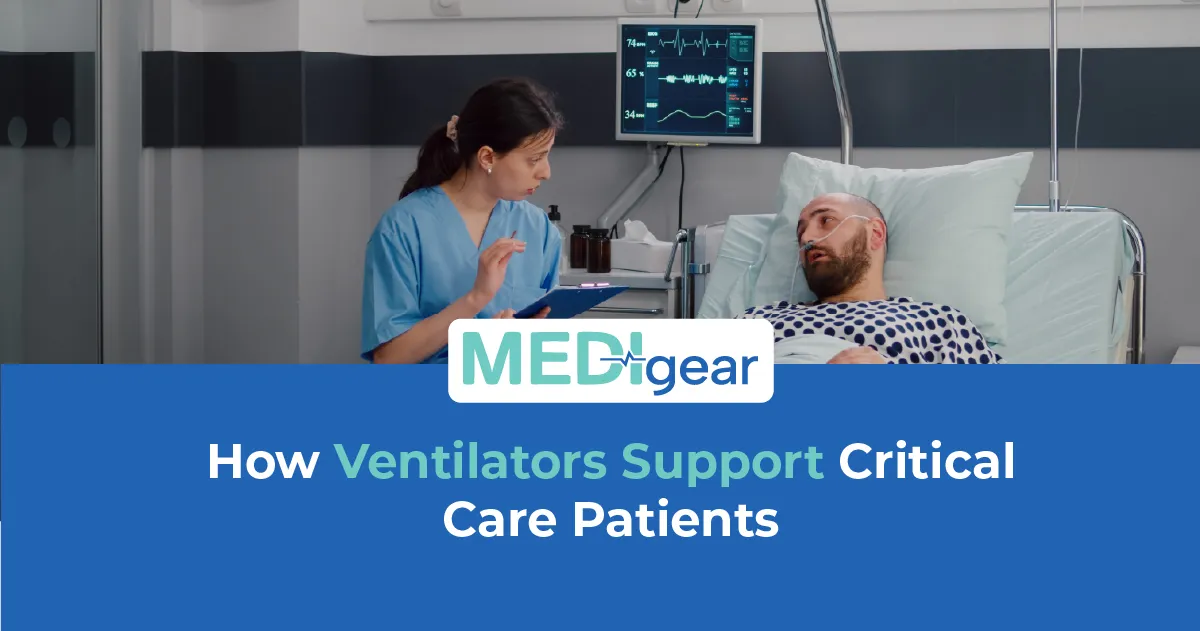
Inside critical care units, every second matters. Patients experiencing severe respiratory distress, trauma complications, neurological conditions, or post-surgical instability often require immediate breathing support to maintain oxygen delivery throughout the body. Ventilators play a central role in these environments by helping healthcare teams stabilise patients whose lungs cannot function effectively on their own.
Modern ventilators are no longer limited to basic respiratory assistance. Today's systems combine advanced monitoring, intelligent airflow control, alarm management, and digital integration to support safer and more responsive patient care across intensive care units, emergency departments, transport settings, and surgical recovery areas.
Healthcare providers planning respiratory care infrastructure frequently coordinate procurement discussions through Medigear Buyer Support Services when evaluating ventilator systems and ICU expansion requirements.
Ventilators Help Maintain Oxygen Delivery During Critical Illness
The primary purpose of a ventilator is to assist or fully support breathing when a patient cannot maintain adequate respiratory function independently.
Supporting Oxygen Exchange – Ventilators help move oxygen into the lungs while assisting with carbon dioxide removal. This becomes essential during respiratory failure or severe lung compromise.
Reducing Breathing Strain – Critically ill patients often struggle to breathe efficiently. Mechanical ventilation helps reduce the physical workload placed on weakened respiratory muscles.
Providing Controlled Airflow Management – Ventilator settings can be adjusted to match individual patient conditions, helping healthcare teams manage breathing support more precisely.
Respiratory support technology is increasingly integrated with connected ICU systems, a trend also reflected in broader healthcare infrastructure discussions, such as Essential ICU Equipment Every Hospital Needs, as critical care environments rely heavily on coordinated monitoring and device communication.
Different Ventilation Modes Support Different Patient Conditions
Not all patients require the same type of respiratory assistance. Modern ventilators offer multiple operational modes designed for varying clinical situations.
Full Respiratory Support for Critical Cases – Some patients require full respiratory support when respiratory function is severely compromised.
Partial Assistance During Recovery – Ventilators can also support patients who are beginning to breathe independently but still need controlled assistance.
Adaptive Ventilation Adjustments – Advanced systems automatically adjust airflow delivery based on patient breathing patterns and lung mechanics.
This flexibility allows healthcare professionals to tailor respiratory support according to changing patient conditions throughout treatment and recovery.
Ventilators Are Essential Across Multiple Critical Care Environments
Although ventilators are strongly associated with ICUs, their use extends far beyond traditional intensive care settings.
Emergency Department Stabilisation – Ventilators help stabilise patients experiencing trauma, severe respiratory distress, or cardiac emergencies before transfer to specialised care.
Operating Room Support – Surgical patients frequently require controlled ventilation during anaesthesia and procedural recovery.
Transport and Mobile Critical Care – Portable ventilators assist patients during ambulance transport, inter-facility transfers, and emergency response operations.
Healthcare facilities evaluating portable respiratory technologies often compare mobility-focused operational insights from Portable X-Ray Machines: Benefits and Applications, as portability and workflow flexibility are becoming important considerations across multiple medical technologies.
Modern Ventilators Include Advanced Monitoring Capabilities
Current-generation ventilators provide far more than just airflow delivery.
Continuous Respiratory Monitoring – Ventilators track breathing pressure, oxygen concentration, airflow volume, and respiratory rates in real time.
Alarm Systems for Rapid Response – Integrated alerts notify healthcare teams about pressure irregularities, disconnections, airway obstruction, or system abnormalities.
Waveform Visualisation Tools – Graphical respiratory data help clinicians evaluate patients' breathing mechanics more effectively.
These monitoring capabilities help improve patient oversight and enable faster intervention in response to sudden respiratory changes.
Infection Control and Air Quality Management Have Become Major Priorities
Ventilator design now places greater emphasis on contamination prevention and infection control.
Advanced Filtration Systems – Many ventilators include filtration technology designed to reduce airborne contamination risks during respiratory support.
Single-Patient Circuit Components – Disposable breathing circuits help minimise cross-contamination between patients.
Simplified Surface Cleaning – Smooth external designs and accessible components support faster disinfection procedures in high-turnover healthcare environments.
Healthcare suppliers that support respiratory equipment distribution frequently collaborate through the Medigear Supplier Collaboration Network to improve access to critical care technologies across healthcare facilities.
Ventilator Technology Is Becoming Smarter and More Connected
Critical care systems are increasingly integrated into digital healthcare ecosystems.
Centralised ICU Connectivity – Ventilators can connect to patient monitoring systems, electronic records, and centralised nursing stations.
Remote Monitoring Capabilities – Some healthcare environments now support remote ventilator monitoring to improve operational oversight.
AI-Assisted Respiratory Management – Emerging technologies are helping optimise ventilation settings based on patient-specific respiratory patterns.
Facilities modernising connected healthcare infrastructure often explore related innovation trends discussed in the Lathe test Innovations in Medical Imaging Technology, as SAS I integration is influencing multiple areas of healthcare technology.
Preventive Maintenance Is Critical for Ventilator Reliability
Ventilator performance depends heavily on proper servicing and maintenance.
Routine Calibration Checks – Airflow accuracy and pressure regulation should be tested regularly to maintain dependable operation.
Battery and Backup System Inspections – Portable ventilators require stable backup power performance during transport situations.
Filter Replacement and Cleaning – Airflow systems and filters must remain clean to support respiratory safety and operational stability.
Healthcare organisations introducing critical care technologies to hospitals and procurement teams often use the Medigear Healthcare Advertising Platform to improve visibility within the healthcare sector.
Buyer Considerations Before Investing in Ventilator Systems
Hospitals and healthcare facilities evaluate several factors before selecting ventilator equipment.
Scalability for Growing ICU Demand – Facilities prefer systems that can support future patient volume growth.
Ease of Staff Training – User-friendly interfaces help reduce operational complexity during high-pressure situations.
Compatibility With Existing ICU Systems – Integration with monitors, hospital networks, and electronic medical record systems improves workflow efficiency.
Service and Technical Support Availability – Reliable maintenance support remains essential for critical care equipment management.
Healthcare organisations exploring long-term infrastructure partnerships and respiratory care expansion strategies often engage through Medigear Healthcare Partnership Opportunities for broader operational planning discussions.
For assistance with ventilator procurement, technical support coordination, or respiratory care infrastructure planning, healthcare providers can contact Medigear Contact Services for additional guidance.
Disclaimer
Medigear.uk is a medical equipment supplier and distributor. We do not provide medical advice, diagnosis, or treatment recommendations. All information is for educational and product awareness purposes only. Qualified medical professionals should always make healthcare decisions.