Modern fertility care centres rely on specialised medical equipment to support the diagnosis and treatment of reproductive health conditions. From fertility assessments and assisted reproductive technologies to embryo culture and cryopreservation, advanced equipment helps clinicians deliver precise and efficient care across diverse healthcare settings.
For buyer services, selecting fertility clinic equipment requires careful consideration of clinical performance, laboratory accuracy, environmental control, maintenance requirements, and long-term operational reliability. Large fertility hospitals, specialist IVF centres, women's healthcare clinics, and reproductive medicine departments often invest in integrated equipment ecosystems to support patient care.
Why Advanced Equipment Matters in Fertility Care
Modern fertility treatment involves multiple clinical and laboratory processes that require highly controlled environments and reliable technology.
Precision throughout the treatment pathway — Fertility care depends on accurate diagnosis, careful laboratory handling, and consistent monitoring. In practice, procurement teams often prioritise equipment that supports standardised workflows.
Laboratory quality assurance — Environmental stability and equipment reliability directly influence laboratory operations and quality management systems.
Operational efficiency — Multi-functional equipment platforms can improve workflow coordination between clinical and embryology teams.
Healthcare facilities sourcing through business suppliers often benefit from documented quality systems, technical support, and compliance with applicable local regulatory standards.
Ultrasound Imaging Systems
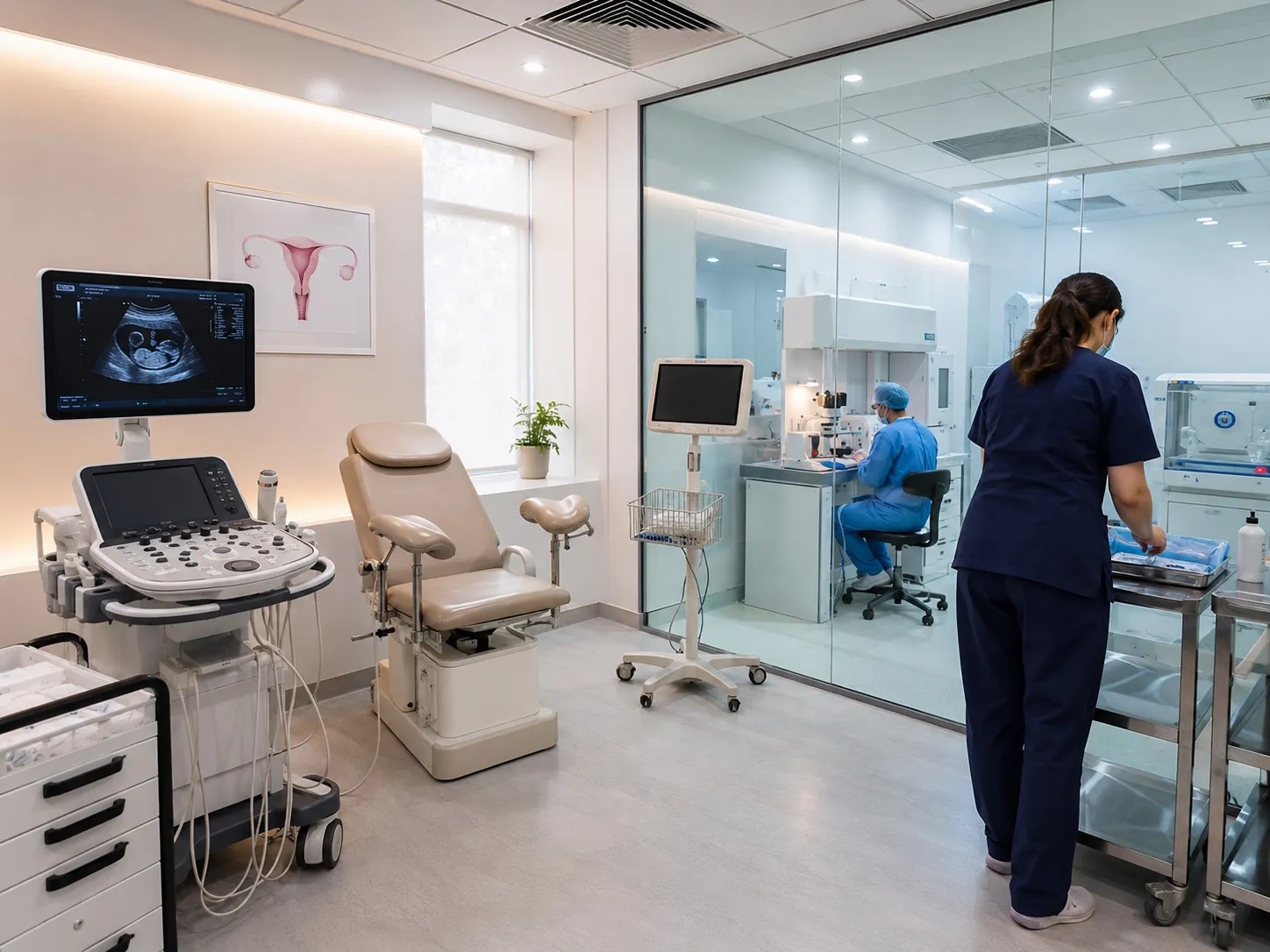
Ultrasound systems are fundamental diagnostic tools in reproductive medicine.
Real-time reproductive imaging — High-resolution imaging supports assessment of ovarian follicles, uterine anatomy, and early pregnancy monitoring.
Minimally invasive evaluation — Transvaginal ultrasound provides detailed visualisation while supporting routine fertility investigations.
Clinical versatility — Experienced procurement managers evaluate probe options, image quality, software features, and workflow integration.
Common applications include:
-
Ovarian assessment
-
Follicular monitoring
-
Uterine evaluation
-
Early pregnancy assessment
-
Guided fertility procedures
Semen Analysis Systems
Laboratory semen analysers support investigations into male fertility.
Objective assessment — Automated systems evaluate sperm concentration, motility, and morphology in accordance with laboratory protocols.
Improved workflow consistency — Digital analysis may reduce observer variation and improve laboratory efficiency.
Laboratory integration — Facilities often compare software capabilities, reporting functions, and maintenance requirements.
IVF Workstations and Laminar Flow Cabinets
Controlled laboratory environments are essential for embryo handling.
Particle-controlled workspace — Laminar airflow helps maintain clean working conditions during sensitive laboratory procedures.
Temperature stability — Workstations support controlled conditions for gamete and embryo handling.
Laboratory efficiency — One aspect that surprises first-time buyers is the importance of ergonomic design for embryologists performing prolonged procedures.
Healthcare facilities typically evaluate:
-
Airflow quality
-
Temperature control
-
Workspace configuration
-
Alarm systems
-
Service support
CO₂ Incubators
Embryo culture depends on carefully controlled environmental conditions.
Stable culture environment — Incubators regulate temperature, humidity, and gas concentrations required for laboratory protocols.
Continuous monitoring capability — Modern systems provide digital controls and environmental alarms.
Reliability considerations — Experienced clinical supply managers carefully assess recovery times following door openings and environmental stability.
Procurement factors include:
-
Chamber capacity
-
Gas regulation
-
Environmental monitoring
-
Data recording
-
Maintenance support
Micromanipulation Systems
Micromanipulation equipment supports advanced assisted reproductive procedures.
Precision laboratory procedures — Systems are commonly used for intracytoplasmic sperm injection (ICSI) and related techniques.
High-resolution visualisation — Advanced microscopes and manipulators improve laboratory accuracy.
Operational reliability — Fertility laboratories frequently prioritise equipment offering stable performance and ergonomic operation.
Cryopreservation Equipment
Cryopreservation technology allows fertility centres to store reproductive cells and tissues under carefully controlled conditions.
Long-term biological storage — Cryogenic systems preserve sperm, oocytes, embryos, and, in some settings, reproductive tissue for future use. Experienced laboratory managers place significant emphasis on storage reliability and monitoring systems.
Laboratory workflow support — Fertility programmes often integrate cryopreservation into routine treatment pathways, providing flexibility for patients and clinicians.
Safety and traceability — Modern storage systems incorporate digital inventory management and alarm functions to improve sample security.
Healthcare facilities commonly evaluate:
-
Storage capacity
-
Temperature stability
-
Monitoring systems
-
Backup power options
-
Maintenance requirements
Ovum Aspiration Pumps
Ovum aspiration pumps support egg retrieval procedures during assisted reproductive treatments.
Controlled follicular aspiration — Adjustable vacuum systems assist clinicians during oocyte collection procedures.
Procedure consistency — Stable pressure regulation helps support standardised clinical workflows.
Operational reliability — Procurement teams often compare pressure-control accuracy, user-interface simplicity, and maintenance requirements.
Common evaluation factors include:
-
Vacuum adjustment range
-
Noise levels
-
Digital controls
-
Safety alarms
-
Service support
Advanced Laboratory Microscopes
High-performance microscopes are central to embryology laboratory operations.
Detailed cellular assessment — Laboratory specialists examine gametes and embryos using high-resolution optical systems.
Precision laboratory procedures — Microscopes support embryo grading, micromanipulation, and quality control activities.
Laboratory ergonomics — One aspect that surprises first-time buyers is the importance of comfortable viewing systems during prolonged laboratory sessions.
Healthcare facilities often evaluate:
-
Optical quality
-
Digital imaging capability
-
Ergonomic configuration
-
Illumination systems
-
Upgrade potential
Time-Lapse Embryo Monitoring Systems
Time-lapse technology enables continuous observation of embryos without repeated handling.
Continuous developmental assessment — Embryologists can review embryo development patterns while maintaining controlled incubation conditions.
Reduced laboratory disturbance — Fewer incubator openings help maintain stable environmental conditions.
Digital workflow integration — Modern systems provide image storage and analysis capabilities that support laboratory documentation.
Procurement considerations include:
-
Imaging resolution
-
Storage capacity
-
Software functionality
-
Integration capability
-
Technical support
Air Purification and Environmental Control Systems
Laboratory air quality management plays an important role in fertility centre operations.
Controlled laboratory environment — Air filtration systems help maintain clean laboratory conditions.
Protection of sensitive procedures — Environmental management supports quality assurance programmes.
Facility-wide applications — Air quality systems may benefit multiple laboratory and treatment areas.
Healthcare organisations typically assess:
-
Filtration efficiency
-
Airflow management
-
Monitoring capability
-
Energy consumption
-
Maintenance schedules
Choosing Equipment for Modern Fertility Care Centres
Fertility centre equipment procurement requires balancing laboratory precision, clinical efficiency, and long-term operational reliability.
Clinical service requirements — Large IVF centres may require integrated laboratory ecosystems, whereas smaller fertility clinics often prioritise modular, scalable equipment solutions.
During vendor evaluation, many business Advertise recognise that healthcare organisations increasingly request equipment validation data, maintenance records, and technical support capabilities before making purchasing decisions.
Laboratory quality management — Procurement managers carefully assess calibration requirements, environmental monitoring, and equipment standardisation across laboratory workflows.
Lifecycle cost planning — Experienced clinical supply managers evaluate consumables, maintenance contracts, software updates, and long-term service availability rather than focusing solely on acquisition costs.
Healthcare organisations operating across multiple locations often find that developing business partners improves procurement consistency, service coordination, and equipment standardisation.
Emerging Trends in Fertility Care Technology
Artificial Intelligence in Embryology
AI-assisted systems are increasingly being evaluated for their potential to support embryo assessment and laboratory decision-making.
Clinical decision support — AI complements professional expertise and laboratory protocols rather than replacing embryologists.
Digital Laboratory Integration
Connected laboratory equipment improves workflow management and documentation.
Data-driven operations — Integrated platforms support quality management and operational efficiency.
Advanced Cryopreservation Technology
Continuous improvements in cryogenic storage systems enhance monitoring and inventory management.
Enhanced sample security — Digital tracking supports laboratory governance and traceability.
Automation in Fertility Laboratories
Automated technologies are gradually supporting repetitive laboratory tasks.
Workflow optimisation — Automation may improve consistency while allowing laboratory professionals to focus on complex procedures.
Final Thoughts
Modern fertility care centres depend on highly specialised medical equipment to support reproductive healthcare services, assisted reproductive technologies, and laboratory operations. From advanced ultrasound systems and IVF workstations to cryopreservation equipment and time-lapse embryo monitoring platforms, each technology contributes to efficient, well-managed clinical and laboratory workflows.
In practice, procurement teams often achieve the best long-term value by selecting equipment that combines clinical precision with operational reliability, quality assurance, maintenance support, and scalability. Healthcare facilities that align technology investments with patient demand and laboratory requirements are generally better positioned to deliver comprehensive fertility care across diverse healthcare settings.
Disclaimer
Medigear.uk is a global medical equipment supplier, exporter, and distributor. The content published on this site is intended for educational and product awareness purposes only. Nothing on this page constitutes medical advice, clinical guidance, or treatment recommendations. All healthcare procurement and clinical decisions should be made by qualified medical professionals and compliant procurement teams operating within the regulatory frameworks of their respective countries.