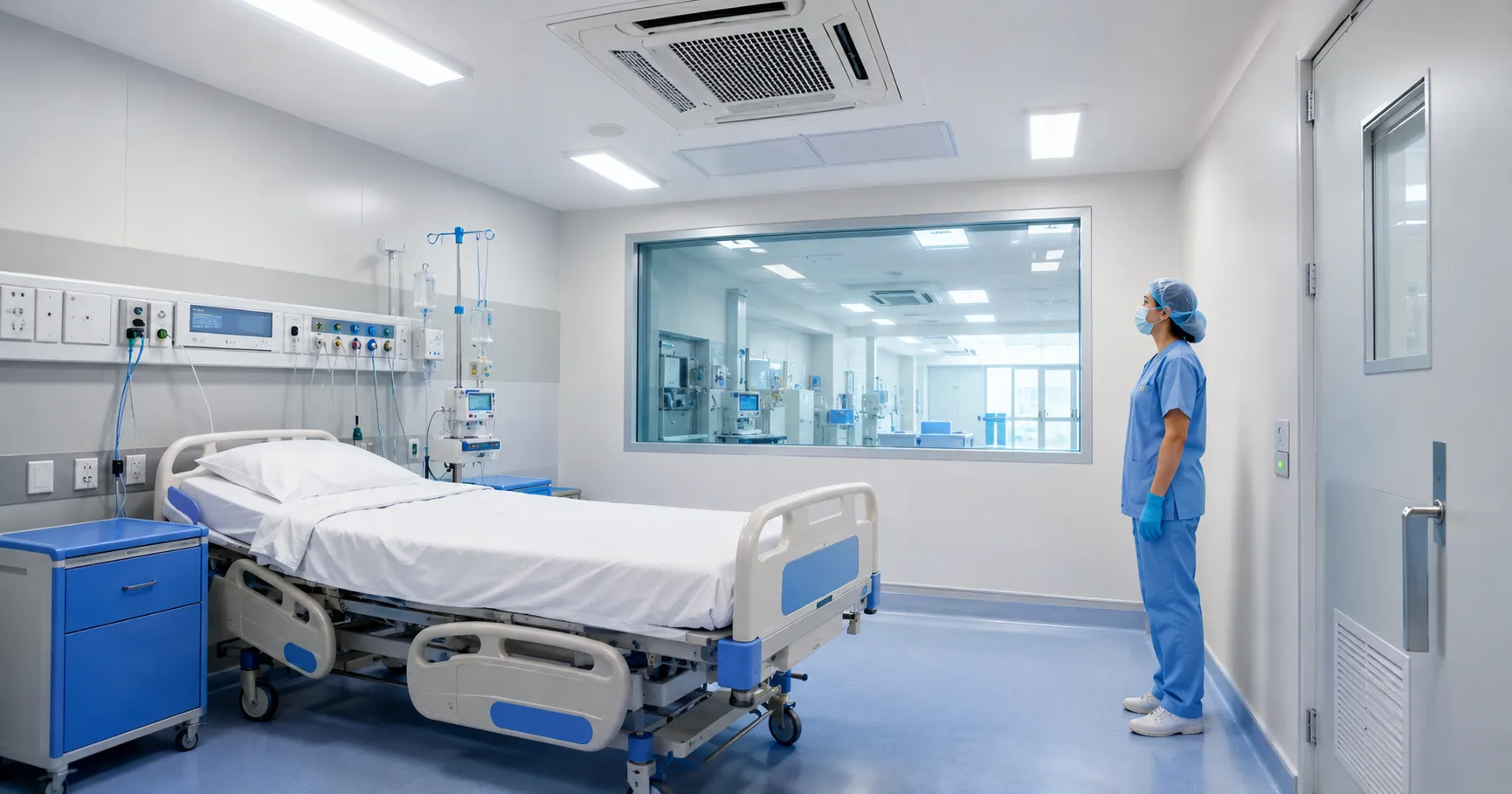
Positive pressure rooms are used in healthcare facilities to protect vulnerable patients and maintain cleaner airflow in selected clinical spaces. They work by maintaining higher room air pressure than in nearby areas, so air tends to flow out of the room rather than into it. This helps reduce the entry of airborne contaminants from corridors or surrounding spaces.
For a healthcare buyer, a positive-pressure room is not just a room with extra air supply. It is a controlled ventilation environment that may include HEPA filtration, pressure monitoring, sealed-room construction, airflow balancing, anteroom planning, maintenance, and staff training. CDC describes a Protective Environment as a specialised patient-care area with positive airflow relative to the corridor, HEPA filtration, high air changes, and limited air leakage into the room.
How Positive Pressure Rooms Support Protective Care
Positive-pressure rooms are mainly used to protect patients who may be highly vulnerable to airborne environmental contaminants. They are not the same as negative-pressure rooms, which are designed to help contain airborne infection risks inside a room.
Cleaner Airflow Direction — Positive pressure moves air from the room toward adjacent spaces. This helps reduce the entry of unfiltered corridor air into the patient care space.
Protective Environment Support — These rooms are often associated with protective care for severely immunocompromised patients. CDC guidance notes that Protective Environment rooms should maintain positive pressure and may need an anteroom when airborne precautions are also required.
HEPA Filtration Role — HEPA filtration is commonly used to improve the quality of incoming air. CDC lists central or point-of-use HEPA filtration among the engineering components of a Protective Environment.
Pressure Monitoring Awareness — Staff need to know whether the room is maintaining the correct pressure relationship. In practice, a pressure monitor is only useful when staff understand alarms and know who must respond.
Where Positive Pressure Rooms Are Used
Positive pressure rooms are used in areas where cleaner airflow helps protect the patient, procedure area, or clinical process. Their use depends on patient risk, department type, local standards, and facility design.
Protective Patient Rooms — These rooms may be used for patients with weakened immune systems. The goal is to reduce exposure to airborne contaminants from surrounding areas.
Transplant and Oncology Units — Some transplant and oncology care settings use positive-pressure protective environments for selected patients. Facilities sourcing through business suppliers should confirm airflow targets, HEPA filtration requirements, pressure-monitoring options, and installation support before procurement.
Operating and Procedure Areas — Some operating rooms and procedure rooms use positive pressure to help keep cleaner air moving outward from the controlled space. ASHRAE healthcare ventilation material recognises that positive and negative room pressure can be created through air system design, with pressure differential causing airflow in or out of a room.
Clean Utility and Sterile Support Areas — Positive pressure may also be used in selected clean storage, sterile supply, and preparation areas. The purpose is to protect clean materials from surrounding contamination, not to isolate infectious patients.
Design and Specification Points
Positive pressure room design should involve facility engineers, infection prevention teams, clinical leaders, HVAC specialists, and procurement staff. The room must perform reliably during routine clinical activity.
Pressure Differential — The room needs enough pressure difference to maintain outward airflow. This depends on supply air, leakage points, door opening, exhaust balance, and room sealing.
Air Changes Per Hour — Air changes per hour describe how often air is supplied and replaced. Higher airflow can support cleaner conditions, but diffuser placement, return location, room geometry, and maintenance strongly affect real performance.
HEPA Filter Selection — HEPA filters can improve air quality when installed and maintained correctly. Buyers should confirm the filter type, replacement access, pressure-drop impact, and local service support.
Sealed Room Construction — Doors, walls, ceilings, windows, service penetrations, and utility openings must be properly sealed. Small leaks can reduce room performance and cause pressure control to become unstable.
Monitoring and Alarm Systems — Room pressure monitors help staff confirm safe operating status. Alarms should be visible, easy to understand, and linked to a clear response process.
Procurement Guidance for Healthcare Buyers
Buying a positive pressure room system may involve room design, HVAC equipment, HEPA filtration, pressure sensors, control panels, commissioning, validation, and long-term maintenance. Procurement should focus on performance and service life, not only on equipment price.
Total Cost of Ownership — Buyers should include design work, installation, filters, sensors, controls, testing, maintenance, energy use, replacement parts, and validation services. A low-cost system may become expensive if it cannot hold pressure consistently.
Compliance and Documentation — Procurement teams should request drawings, airflow calculations, filtration specifications, monitoring details, installation manuals, commissioning reports, warranty terms, and maintenance schedules. Compliance should be reviewed against applicable local regulatory standards and standards such as ASHRAE, CE, FDA, or their regional equivalents where relevant.
Supplier Transparency — Suppliers and manufacturers' business advertisements should provide clear information about airflow capacity, HEPA filtration, pressure monitoring, alarm functions, control systems, and service support. Generic claims about clean air are not enough for clinical procurement.
Training and Facility Readiness — Staff should understand the room's purpose, what pressure alarms mean, and how door use affects performance. Facility teams should also know how to inspect, test, record, and repair the system.
Healthcare groups managing multiple hospitals or specialist units may benefit from partnering with businesses. Standardised pressure monitors, filters, service routines, and supplier responsibilities can make long-term management easier.
Maintenance and Monitoring Planning
Positive-pressure rooms need regular inspection because room performance can change over time. Filters load, sensors drift, door seals wear, dampers move, and airflow balance can change after building or HVAC work.
Daily Pressure Checks — Staff should confirm that the room is operating correctly before using it for protective care. Digital displays, alarms, or gauges should be included in the facility's routine checks.
Filter and Airflow Maintenance — HEPA filters, supply diffusers, return points, dampers, and ducts should be maintained in accordance with manufacturer guidance and facility policy. Poor filter access can make routine maintenance harder and more expensive.
Door and Seal Inspection — Doors, seals, ceiling joints, and service penetrations should be checked regularly. A room may lose pressure performance if air leaks develop or if doors are left open for long periods.
Record Keeping — Facilities should document inspections, alarms, testing results, repairs, and filter changes. Records help infection prevention teams, engineers, and procurement teams understand system reliability.
International Sourcing Considerations
Positive pressure room systems can be sourced internationally when buyers define the clinical use, airflow target, filtration needs, monitoring method, installation conditions, documentation requirements, and service expectations. Buyers should confirm whether they need a full room package, an HVAC upgrade, a pressure monitor, a HEPA filter unit, a control panel, or a retrofit solution.
For project-based sourcing, buyers can contact the team to discuss availability, documentation, export needs, and procurement requirements.
Final Thoughts
Positive pressure rooms support cleaner airflow in selected healthcare areas. They are especially useful where the goal is to protect vulnerable patients or clean clinical processes from surrounding contamination.
The right system should be based on clinical risk, airflow design, HEPA filtration needs, pressure monitoring, room sealing, maintenance capacity, and local compliance requirements. Buyers should review technical documentation and supplier support before starting a project.
Disclaimer
Medigear.uk is a global medical equipment supplier, exporter, and distributor. The content published on this site is intended for educational and product awareness purposes only. Nothing on this page constitutes medical advice, clinical guidance, or treatment recommendations. All healthcare procurement and clinical decisions should be made by qualified medical professionals and compliant procurement teams operating within the regulatory frameworks of their respective countries.