Medical imaging has changed dramatically over the last decade, but one advancement stands out for its impact on diagnostic precision: 3D imaging. Healthcare providers are no longer limited to viewing flat, two-dimensional scans when evaluating complex anatomy or disease progression. Modern 3D imaging systems now help clinicians examine organs, bones, blood vessels, and soft tissues with far greater depth and spatial understanding.
For hospitals, diagnostic centres, and speciality clinics, 3D imaging technology is becoming an important area of investment because it enables faster assessments, clearer visualisation, and improved treatment planning across multiple medical departments.
Healthcare procurement teams exploring advanced imaging infrastructure often coordinate sourcing discussions through Medigear Buyer Solutions when evaluating diagnostic technology upgrades.
Why Traditional 2D Imaging Has Limitations
Conventional imaging methods display anatomy in flat image slices. While these systems remain essential in healthcare, certain conditions can be difficult to evaluate accurately using only two-dimensional views.
Complex fractures, vascular abnormalities, organ structures, and surgical pathways often require better depth visualisation. Physicians may need to mentally reconstruct anatomy from multiple image slices, which can increase interpretation time and diagnostic uncertainty.
3D imaging addresses this challenge by creating volumetric visualisations that allow clinicians to examine anatomical structures from different angles and perspectives.
Better Anatomical Visualisation Supports More Accurate Diagnosis
One of the biggest advantages of 3D imaging is improved anatomical detail.
Viewing Structures From Multiple Angles – Clinicians can rotate and examine anatomical regions in real time, improving understanding of structural relationships that may not appear clearly in standard imaging views.
Improved Detection of Small Abnormalities – Tiny fractures, tumours, vascular narrowing, or tissue irregularities may be easier to identify when viewed using 3D reconstruction technology.
Enhanced Depth Perception – Three-dimensional visualisation helps healthcare teams better understand the size, shape, and positioning of abnormalities before treatment decisions are made.
Facilities modernising radiology infrastructure often compare the evolving technologies discussed in "How Digital Radiography Is Transforming Healthcare," as digital imaging integration continues to influence advanced diagnostic workflows.
Surgical Planning Has Become More Precise
3D imaging has become especially valuable in pre-surgical planning.
Supporting Complex Orthopaedic Procedures – Surgeons can evaluate fractures, joint alignment, and implant positioning with improved clarity before entering the operating room.
Improving Cardiovascular Procedure Preparation – Cardiology specialists use 3D imaging to assess blood vessels, heart structures, and procedural access pathways more accurately.
Helping Neurosurgical Assessments – Brain imaging reconstruction assists specialists in evaluating sensitive anatomical areas while reducing procedural uncertainty.
Healthcare providers working across surgical and cardiac departments often review broader equipment planning resources, such as the Equipment Used in the Cardiology Department, when coordinating investments in advanced imaging.
Faster Decision-Making in Emergency and Trauma Care
Time-sensitive cases benefit significantly from access to etailed imaging
Rapid Trauma Assessment – 3D CT reconstruction enables emergency physicians to evaluate injuries more comprehensively during trauma response.
Clearer Fracture Evaluation –Orthopaedic teams can quickly identify fracture complexity and alignment issues using reconstructed imaging views.
Improved Surgical Coordination – Multi-disciplinary teams can review shared 3D visualisations during emergency treatment planning.
Portable diagnostic technologies also continue to support emergency workflows, especially when combined with advanced visualisation software. Many healthcare teams researching mobility-focused systems explore related insights from Portable X-Ray Machines: Benefits and Applications to understand the deployment of flexible imaging better.
3D Imaging Is Expanding Across Multiple Healthcare Specialities
The use of 3D imaging is no longer limited to radiology departments alone.
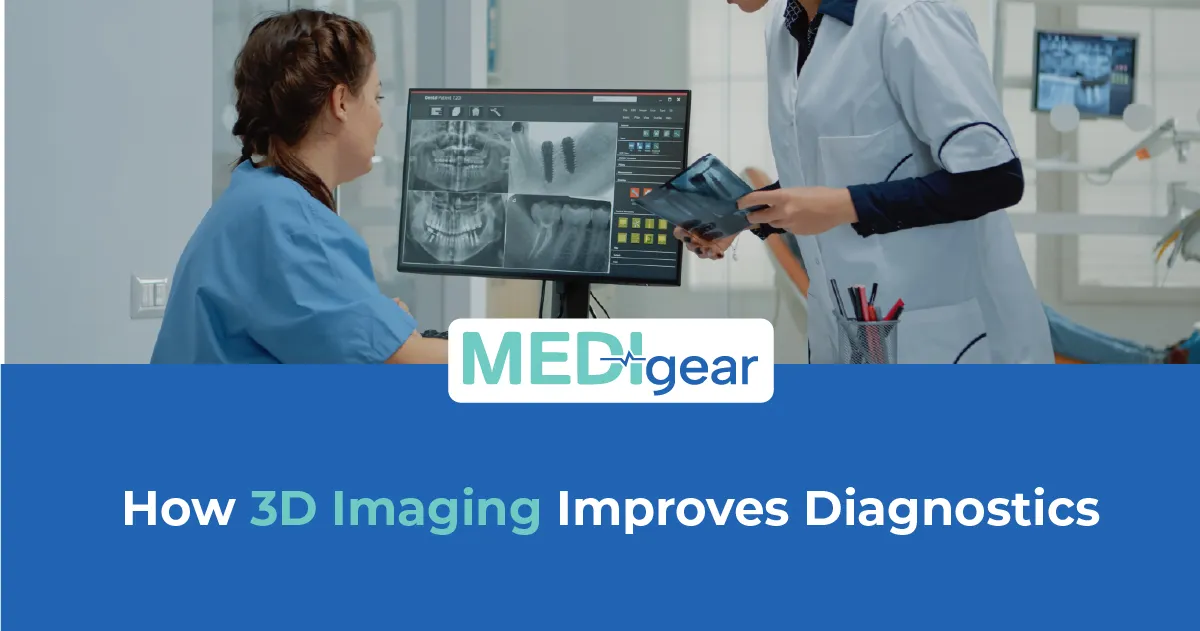
Dentistry and Maxillofacial Imaging – Dental specialists use 3D scans for implant planning, jaw evaluation, and orthodontic assessments.
Oncology Diagnostics – Cancer specialists benefit from improved tumour visualisation, which helps monitor disease progression and plan treatment.
Pulmonary and Thoracic Evaluation – Detailed lung and chest imaging helps clinicians assess respiratory structures more comprehensively.
Sports Medicine Applications – High-resolution imaging supports injury evaluation for muscles, ligaments, and joint structures.
Healthcare suppliers that support imaging distribution networks frequently collaborate through Medigear Supplier Partnerships to improve equipment access across speciality healthcare settings.
Artificial Intelligence Is Enhancing 3D Imaging Workflows.
AI integration is further increasing the value of 3D diagnostic systems.
Automated Reconstruction Speed – Advanced software can generate 3D models faster than older manual reconstruction methods.
Image Enhancement Tools – AI-assisted processing improves clarity while reducing imaging noise and motion distortion.
Workflow Prioritisation – Some systems automatically flag critical imaging findings for faster clinical review.
AI-supported imaging platforms are becoming increasingly important for healthcare facilities managing high patient volumes and growing diagnostic demand.
Operational Advantages for Healthcare Facilities
Healthcare organisations are also considering operational efficiency when investing in 3D imaging systems.
Reducing Repeat Imaging Requirements – Better image clarity may reduce the need for additional scans in certain cases.
Improving Patient Communication – Three-dimensional visuals help clinicians explain conditions and procedures more clearly to patients.
Supporting Medical Education and Training – 3D imaging provides improved visualisation for clinical teaching and staff development.
Organisations introducing advanced imaging solutions to healthcare buyers often leverage Medigear Healthcare Advertising Opportunities to connect with hospitals, clinics, and diagnostic centres
Important Considerations Before Investing in 3D Imaging Systems
Healthcare buyers should evaluate more than imaging quality alone when considering new systems.
Software Compatibility Requirements – Integration with existing hospital information systems and PACS platforms is essential for a smooth workflow.
Storage and Data Management Needs – 3D imaging files are larger and require a stronger storage infrastructure.
Training Requirements for Staff – Radiologists, technicians, and specialists may require additional training for advanced reconstruction tools and visualisation software.
Long-Term Upgrade Potential – Facilities often prefer scalable systems capable of future software and AI integration.
For discussions on imaging infrastructure, procurement guidance, or healthcare technology planning support, organisations can connect with the Medigear Contact Team for additional operational assistance.
Disclaimer
Medigear.uk is a medical equipment supplier and distributor. We do not provide medical advice, diagnosis, or treatment recommendations. All information is for educational and product awareness purposes only. Qualified medical professionals should always make healthcare decisions.