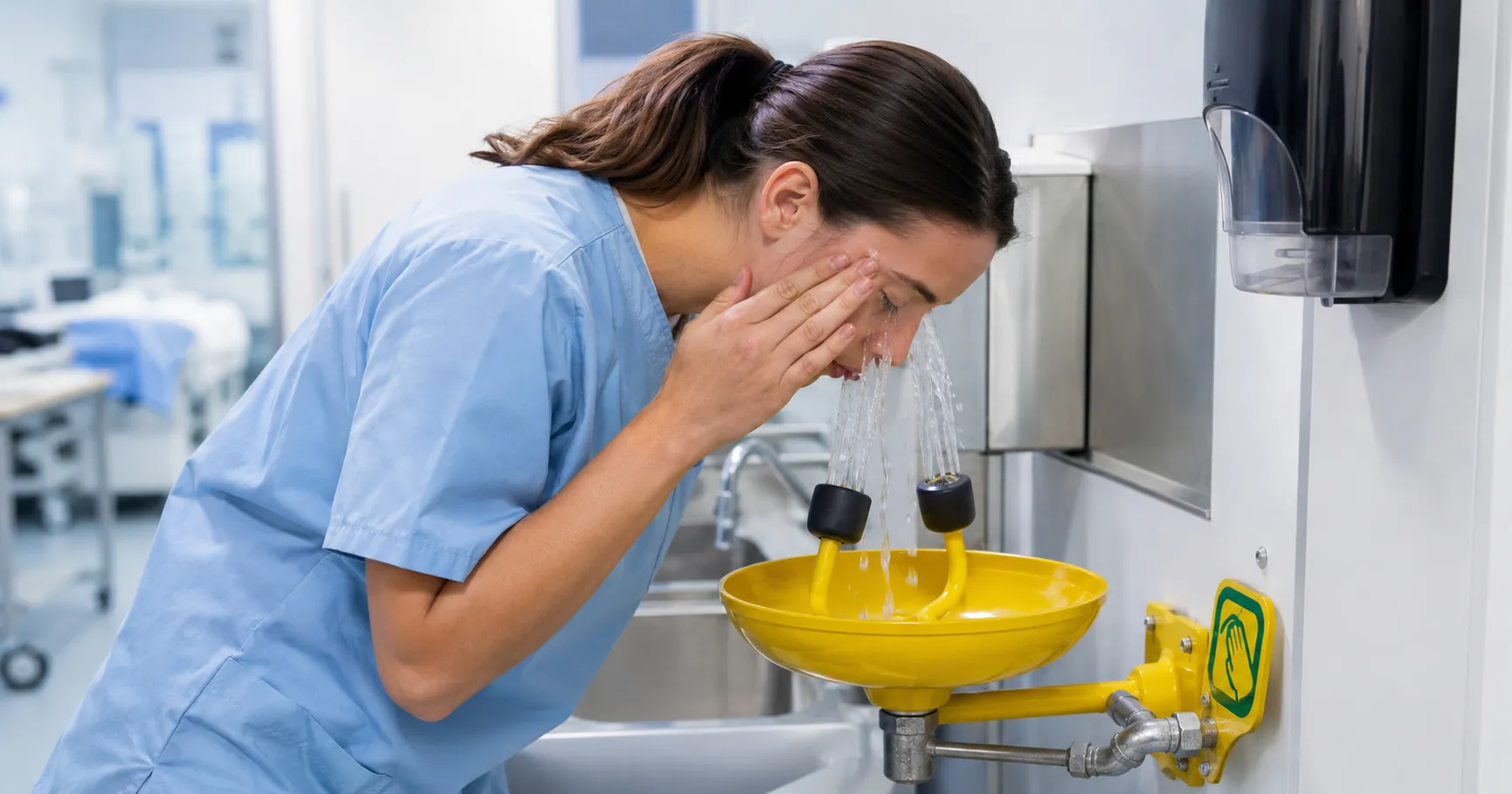
Emergency eyewash stations are safety devices used in healthcare areas where staff may be at risk of chemical splashes. They are commonly installed near laboratories, pharmacies, sterilisation areas, cleaning chemical storage areas, maintenance rooms, dialysis preparation spaces, and other zones where harmful liquids may come into contact with the eyes.
For healthcare buyers, choosing an emergency eyewash station is not just about buying a safety fixture. The decision includes placement, water supply, flushing performance, access time, maintenance, staff training, and compliance with applicable local regulatory standards. OSHA requires suitable quick drenching or flushing facilities where eyes or the body may be exposed to injurious corrosive materials, while exact requirements vary by country and facility type.
How Emergency Eye Wash Stations Support Staff Safety
Emergency eye wash stations provide immediate flushing when chemicals, disinfectants, laboratory reagents, or cleaning agents splash into the eyes. Fast access matters because staff should not need to search for water during an exposure incident.
Immediate Eye-Flushing Access — The station provides workers with a dedicated point for flushing their eyes after exposure. Emergency shower and eyewash equipment provides on-the-spot decontamination in the event of exposure to hazardous materials.
Hands-Free Operation — Many stations are designed to stay open once activated. This allows the affected person to hold both eyes open while flushing, which is important during a stressful incident.
Support for High-Risk Work Areas — Eye wash stations are especially relevant where staff handle corrosive liquids, concentrated disinfectants, laboratory chemicals, or sterilisation products. Procurement teams should review safety data sheets to determine whether eye or body-flushing equipment is required for the materials used in each area. OSHA notes that it does not maintain a single list of corrosive materials requiring eyewash equipment and directs employers to provide product safety data
Visible Safety Preparedness — A clearly marked and accessible eyewash station reminds staff that a chemical-splash response has been planned. In practice, hidden or blocked stations reduce emergency readiness even if the equipment itself is technically suitable.
Where Eye Wash Stations Are Used in Healthcare
Emergency eye wash stations are used in healthcare settings where chemical handling is part of daily work. Their placement should match actual risk, not only room labels.
Clinical Laboratories — Laboratories handle reagents, fixatives, cleaning agents, and testing chemicals. An eyewash station should be close to the work area and easy to reach without passing through doors or other obstacles.
Pharmacy and Compounding Areas — Pharmacy teams may handle concentrated preparations, disinfectants, or hazardous substances depending on the facility’s services. Facilities sourcing through regulated and certified equipment suppliers worldwide should verify that the selected station meets local safety requirements and installation conditions.
Sterilisation and CSSD Areas — Central sterile services departments may use detergents, disinfectants, and processing chemicals. Eyewash placement should support staff working in washing, disinfection, and chemical storage zones.
Maintenance and Housekeeping Areas — Healthcare maintenance and cleaning teams often handle chemicals that are not used directly in patient care areas. These spaces should not be ignored during safety planning because exposure risk can be higher during dilution, transfer, or spill response.
Selection Points for Emergency Eye Wash Stations
Emergency eye wash stations should be selected for safe access, reliable flow, easy activation, and simple maintenance. The right choice depends on the facility layout, chemical risk, and water infrastructure.
Plumbed or Portable Design — Plumbed stations connect to a continuous water supply and are suitable for permanent high-risk areas. Portable stations may be useful where plumbing is unavailable, but they require strict refilling, cleaning, and solution replacement routines.
Tepid Flushing Fluid — Standards such as ANSI/ISEA and their regional equivalents commonly refer to tepid flushing fluid so users can continue flushing safely and comfortably. Industry guidance linked to ANSI/ISEA explains that flushing for the required duration is easier when the fluid is neither too hot nor too cold.
Activation and Flow Control — The station should activate quickly and remain open without constant hand pressure. This helps the affected person focus on eye flushing rather than holding a valve or lever.
Location and Access — The station should be located near chemical risk areas and kept free of equipment, boxes, and furniture, with doors locked. In an emergency, staff should reach the unit quickly and without confusion.
Clear Signage and Visibility — Signage should be easy to see, even in busy or crowded work areas. The station should also have enough surrounding space for the user and assisting staff.
Procurement Guidance for Healthcare Buyers
The purchase of an emergency eyewash station should include both product selection and site planning. The equipment must match the risk area and the facility’s ability to maintain it.
Total Cost of Ownership — Buyers should consider the station, installation, plumbing work, mixing valves, signage, testing, spare parts, and maintenance time. A low-cost unit can become expensive if it is difficult to test or repair.
Compliance Documentation — Procurement teams should request product specifications, installation instructions, testing guidance, maintenance instructions, warranty terms, and conformity documents. Compliance should be checked against applicable local regulatory standards or standards such as ANSI/ISEA, CE, FDA, or their regional equivalents where relevant.
Supplier Transparency — Suppliers and manufacturers advertising to global healthcare buyers should provide clear details on flow performance, activation method, mounting style, water connection, portable tank capacity, and spare part availability. Vague product descriptions can make compliance review difficult.
Training and Emergency Response Planning — Staff should know where the station is, how to activate it, and how to report use or faults. Safety training should also explain that emergency eye flushing does not replace medical assessment after chemical exposure.
Healthcare groups managing several laboratories, clinics, or service departments may benefit from structured distribution and reseller partnership arrangements. Standardising eyewash models can simplify testing, spare parts management, staff training, and replacement planning.
Maintenance and Testing Planning
Emergency eyewash stations need regular inspection because they may remain unused for long periods before an emergency. Equipment that looks new may still fail if water flow, nozzles, valves, or portable fluid conditions are not checked.
Routine Activation Checks — Plumbed stations should be activated per facility policy to verify flow and reduce the risk of stagnation. Portable stations should be checked for fluid level, cleanliness, expiry, seal condition, and refill schedule.
Nozzle and Bowl Cleanliness — Dust caps, spray heads, bowls, and drainage areas should be clean and unobstructed. Blocked nozzles can affect flushing direction and reduce the station’s effectiveness.
Access Control — The station must remain visible and reachable. Storage boxes, trolleys, bins, and equipment should not block emergency access.
Record Keeping — Facilities should document inspections, faults, repairs, and staff reports. Records help procurement and safety teams understand replacement needs and recurring maintenance issues.
International Sourcing Considerations
Emergency eyewash stations can be sourced internationally when buyers specify the intended use area, product type, installation method, water connection, documentation requirements, packaging, and lead time. Buyers should confirm whether they need plumbed, wall-mounted, pedestal, countertop, combination shower, or portable models.
For project-based sourcing, buyers can contact the Medigear.uk team for supply support to discuss product availability, documentation, export needs, and procurement requirements.
Final Thoughts
Emergency eye wash stations are important safety devices in healthcare areas where chemical exposure may occur. They support fast response, reduce delays, and help staff manage splash incidents more safely.
The right station should be easy to find, easy to activate, simple to maintain, and suitable for the chemical risks in the area. Buyers should review placement, water supply, compliance documents, staff training, testing routines, and supplier support before ordering.
Disclaimer
Medigear.uk is a global medical equipment supplier, exporter, and distributor. The content published on this site is intended for educational and product awareness purposes only. Nothing on this page constitutes medical advice, clinical guidance, or treatment recommendations. All healthcare procurement and clinical decisions should be made by qualified medical professionals and compliant procurement teams operating within the regulatory frameworks of their respective countries.