
Introduction
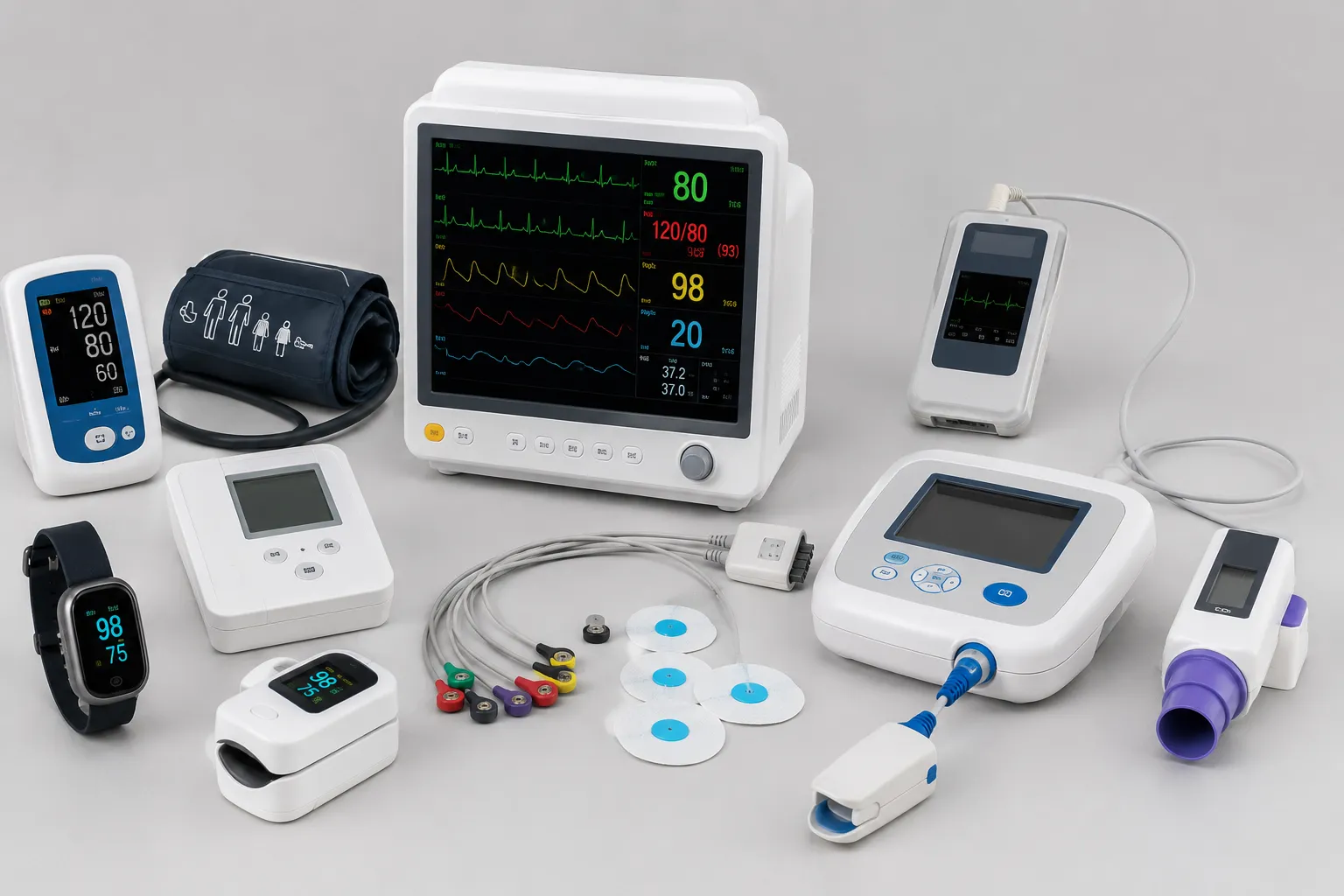
Patient monitoring equipment tracks the body's vital signs and alerts clinicians the moment any change occurs. But the term "patient monitor" encompasses a wide range — from a pocket pulse oximeter to a networked ICU system that monitors a dozen parameters at once. Knowing the types, what each measures, and where each belongs is the first step in equipping a service properly without overspending or leaving gaps.
This guide explains the main types of patient monitoring equipment, the vital signs they measure, how they map to different care settings, and how to choose the right monitor — with regulatory notes for the UK, the EU, the US, the Gulf (GCC) states and South Africa.
The short version — three families of monitor
Most patient monitoring equipment falls into one of three groups. The right one depends on how sick the patient is and how many parameters you need to monitor. Most patient monitoring equipment falls into one of three groups. The right choice depends on how sick the patient is, how many parameters need to be monitored, and whether monitoring occurs at the bedside or remotely.
• Spot-check — single or few parameters: pulse oximeters and basic vital-signs monitors for quick checks in lower-acuity settings.
• Continuous bedside — multiparameter monitors: full vital-signs monitoring with alarms for wards, theatre, emergency and intensive care.
• Remote — telemetry and wearables: mobile and home monitoring that transmits data to clinicians wherever the patient is.Whether monitoring occurs at the bedside or remotely.
The vital signs monitors measure
Most types are defined by which parameters they track. The core vital signs are:
-
Heart rate & ECG — the rate and rhythm of the heart, from a simple pulse to a full electrocardiogram tracing.
-
Oxygen saturation (SpO2) — how much oxygen the blood is carrying, measured non-invasively by pulse oximetry.
-
Blood pressure (NIBP / IBP) — non-invasive cuff readings, or continuous invasive pressure via an arterial line in critical care.
-
Respiratory rate — breaths per minute, a key early-warning sign of deterioration.
-
Temperature — core or peripheral body temperature, continuous or spot-check.
-
Capnography (EtCO2) — end-tidal carbon dioxide, vital in anaesthesia, sedation and ventilated patients.
The main types of patient monitor — at a glance
|
Type |
What it measures |
Typical setting |
|
Pulse oximeter |
SpO2 and pulse rate |
Wards, clinics, home, transport |
|
Vital-signs monitor |
HR, NIBP, SpO2, temperature |
General wards, clinics, recovery |
|
Multiparameter monitor |
The above plus ECG, capnography, and invasive pressures |
ICU, theatre, emergency, HDU |
|
Cardiac / ECG monitor & telemetry |
Continuous ECG and rhythm |
Cardiology, telemetry units |
|
Capnography monitor |
EtCO2 and respiration |
Anaesthesia, sedation, ventilation |
|
Fetal/maternal monitor |
Fetal heart rate & uterine activity |
Obstetrics, labour wards |
|
Remote/wearable monitor |
Vital signs, sent to clinicians |
Home, hospital-at-home, chronic care |
|
Central monitoring station |
Aggregates many bedside monitors |
Nurses' stations, ICU, and telemetry |
Each type, explained
-
Pulse oximeters. The simplest monitor — a finger or ear probe reading oxygen saturation and pulse. Handheld, wearable, or benchtop, they're everywhere from clinics and ambulances to homes.
-
Vital-signs monitors. Spot-check or continuous monitoring of core vitals (heart rate, blood pressure, SpO2, temperature) for general wards, clinics and recovery — the workhorse of lower-acuity care.
-
Multiparameter monitors. High-acuity monitors adding continuous ECG, capnography and invasive pressures, with configurable alarms. The standard at the ICU, theatre and emergency bedside.
-
Cardiac monitors & telemetry. Continuous ECG and rhythm analysis. Telemetry lets patients move freely while their heart trace streams wirelessly to a central station.
-
Capnography monitors. Measure end-tidal CO2 to confirm ventilation and detect problems early — essential in anaesthesia, procedural sedation and for ventilated patients.
-
Fetal & maternal monitors. Track fetal heart rate and uterine activity (cardiotocography) during pregnancy and labour, often in conjunction with central obstetric stations.
-
Remote & wearable monitors. Connected patches, wristbands and home devices that stream vital signs to clinicians — the backbone of remote patient monitoring and hospital-at-home.
-
Central monitoring stations. Software and displays that aggregate many bedside or telemetry monitors, giving staff a single view of a whole ward or unit.
"Not sure which monitor you need?"
Let's match it to your setting. Tell us the parameters you need, your patients' acuity, and your market — we'll recommend the right monitoring equipment and connectivity.
No pressure, no obligation. → Talk to the team
Which monitor fits where
-
Intensive care (ICU/HDU). Multiparameter monitors with ECG, invasive pressures and capnography, networked to a central station for continuous, high-acuity surveillance.
-
General wards. Vital-signs monitors for regular observations and early-warning scoring, increasingly with continuous or wearable options for at-risk patients.
-
Theatre and recovery. Anaesthesia-grade multiparameter monitoring with capnography and gas analysis during surgery and post-operative recovery.
-
Emergency and transport. Rugged, portable monitors that run on battery and move with the patient between ambulance, resus and ward.
-
Home and remote care. Wearables and connected devices for remote patient monitoring, chronic-disease management and hospital-at-home programmes.
Connectivity and central monitoring
A modern monitor rarely works alone. Bedside units feed central monitoring stations so staff can monitor an entire unit at once, and integrate with the electronic medical record so that observations flow into the patient's chart automatically. When choosing equipment, connectivity matters as much as the parameters: check how the monitor talks to your central station and EMR, how alarms are escalated, and whether the system can scale as your service grows. Standardising on a single ecosystem across a unit usually pays off in training, spares, and interoperability.
How to choose — ask these five questions
-
Which parameters must you measure — and which might you need later?
-
How acute are your patients, and does monitoring need to be continuous?
-
Is the monitor staying at the bedside, moving with the patient, or going home?
-
How must it connect — to a central station, the EMR, an early-warning system?
-
Is it approved for your market and supported with service and consumables?
Answer these, and the right type of monitor usually becomes obvious — then it's a question of matching brand, budget and ecosystem.
Approval around the world
Patient monitors are regulated medical devices and must be approved for the market where they're used. Connected and remote-monitoring software may carry additional data and software requirements.
|
Region |
Main regulator |
Conformity/clearance |
|
United Kingdom |
UKCA mark (CE accepted transitionally) |
|
|
European Union |
European Commission & national authorities |
CE marking under EU MDR 2017/745 |
|
United States |
510(k) clearance (most monitors) |
|
|
Gulf (GCC) |
SFDA (Saudi Arabia) & GCC bodies |
National registration / GCC conformity |
|
South Africa |
Medical device licensing |
For clinical-standards guidance on monitoring and early warning, bodies such as NICE are a useful reference, and the World Health Organisation supports wider access to monitoring in lower-resource settings. If you're sourcing for an organisation, our buyer hub sets out how to purchase with confidence.
Frequently Asked Questions
The main types are vital-signs (multiparameter) monitors, cardiac/ECG monitors, telemetry, pulse oximeters, blood pressure monitors, capnography monitors, and remote or wearable monitors. Specialised types include fetal/maternal, neuromonitoring and haemodynamic monitors. What you need depends on the parameters measured and the care setting.
A vital-signs monitor typically captures core parameters such as heart rate, blood pressure, oxygen saturation, and temperature for spot checks or lower-acuity care. A multiparameter monitor adds more channels — such as continuous ECG, capnography and invasive pressures — for higher-acuity settings like ICU and theatre.
Remote patient monitoring (RPM) uses connected or wearable devices to track a patient's vital signs outside a clinical setting, typically at home, and send data to clinicians. It supports chronic disease management, early warning, and hospital-at-home programmes.
Match the monitor to the parameters you need to measure, the acuity and setting, portability requirements, alarm and connectivity needs (such as EMR integration and central monitoring), and your budget. Make sure the device is approved for your market and supported with service and consumables.
More from Business
Buyers — source patient monitoring equipment for your clinic, hospital or care service.
Suppliers — list your medical equipment and reach healthcare buyers worldwide.
Advertise — promote your products and services to a clinical audience.
Business overview — explore everything MediGear offers healthcare organisations.
Disclaimer
This article is for general information only and does not constitute clinical, medical, procurement, legal or regulatory advice. Device capabilities, parameters and regulatory requirements vary by product and country and change over time. Before purchase, always confirm that a monitor is appropriate for your intended clinical use and is approved for your market (for example, UKCA, CE under the EU MDR, FDA, SFDA/GCC, or SAHPRA). Consult qualified clinical, biomedical engineering and procurement professionals, and your local regulator, for decisions specific to your organisation. medigear.uk accepts no liability for actions taken on the basis of this content.
"Choose with confidence" Find the right monitors for your service.
From pulse oximeters to full multiparameter and central monitoring systems, we help clinics, hospitals and care services across the UK, Europe, the US, the Gulf and South Africa choose monitoring equipment that fits — with service and support you can rely on.