
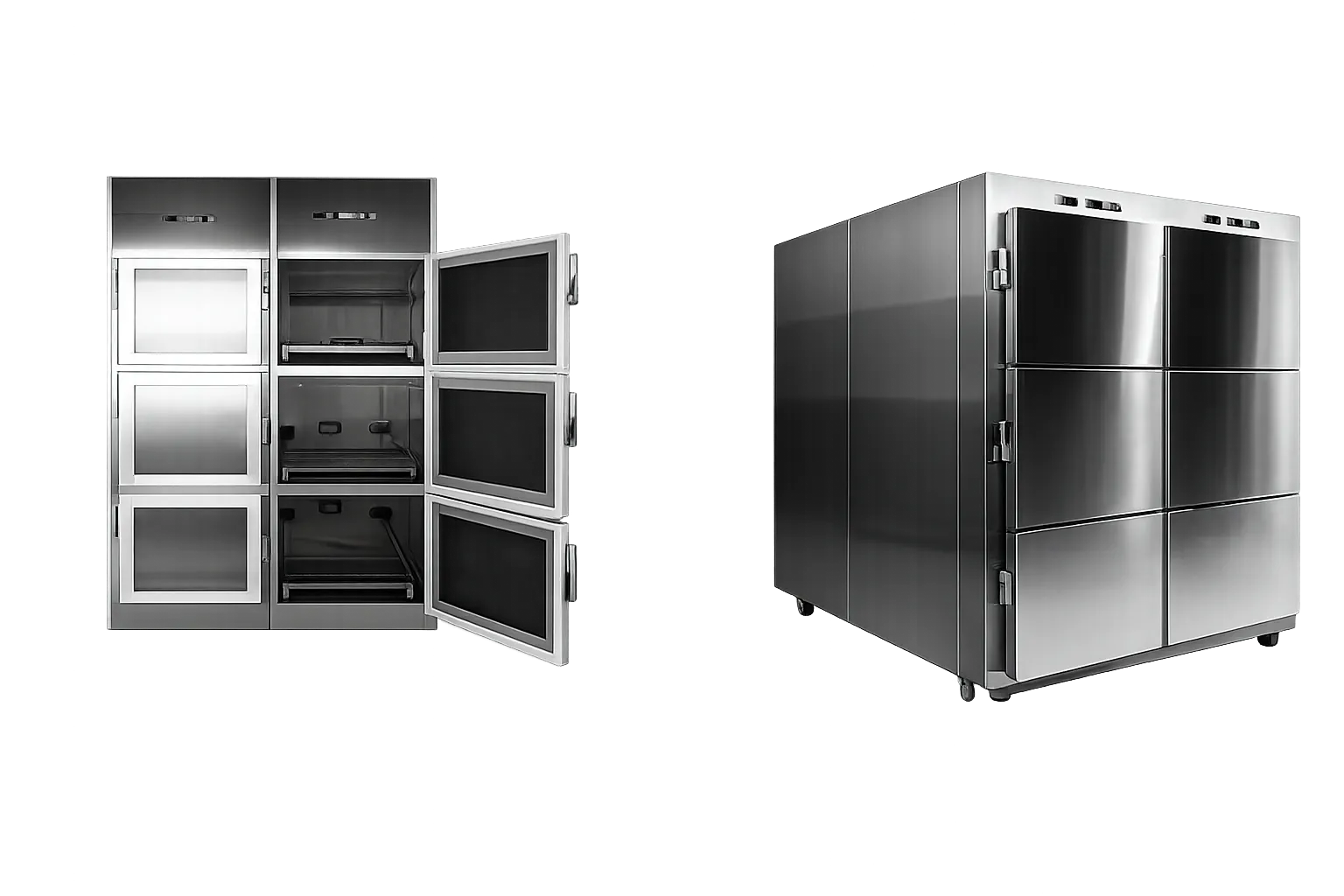
In large hospital mortuary placements, the RD-6 supports a six-body holding capacity for routine post-death body storage between admission and onward release. NHS Estates teams sourcing through Medigear.uk specify the unit for university teaching hospitals, regional referral centres, multi-speciality hospital trusts where annual deaths-per-bed footfall justifies six-body capacity in a single cabinet, and large pathology departments aligned with HTM 20-04 mortuary refrigeration capacity-planning guidance for tertiary-care estate sites.
In pathology and coronial workflows, the six-chamber 2×3 grid design supports parallel case management across higher case loads than the four-body siblings. Chamber A1 typically holds routine pre-PM cases at the standard 0 °C to -10 °C range; chamber A2 can hold a delayed forensic case at -15 °C awaiting Coroner direction; chambers B1 and B2 can hold pre-release cases pending family arrangements; chambers C1 and C2 remain available for unexpected admissions or viewing-temperature preparation — all independently controlled without thermal coupling across the cabinet.
For large independent funeral-services groups, multi-branch funeral businesses, and regional removal operators serving multi-district areas, the RD-6, delivered through Medigear.uk, handles higher weekly throughput than four-body units can accommodate. The six-body capacity supports the weekly throughput levels typical of metropolitan funeral services operations, and the 2×3 grid layout fits funeral preparation rooms with adequate floor width and ceiling clearance.
In mass-fatality response, pandemic-response, regional disaster contingency, and seasonal-surge scenarios where six-body capacity must be deployed at speed, Medigear.uk supplies the RD-6 to regional coronial overflow teams, trust contingency stores, and emergency mortuary stand-up operations. The plug-and-set commissioning, four-mode alarm system, and remote alarm relay option together support unattended overnight operation at resilience-critical placements, where a complete failure would require emergency body transfer at scale across six chambers rather than four.