
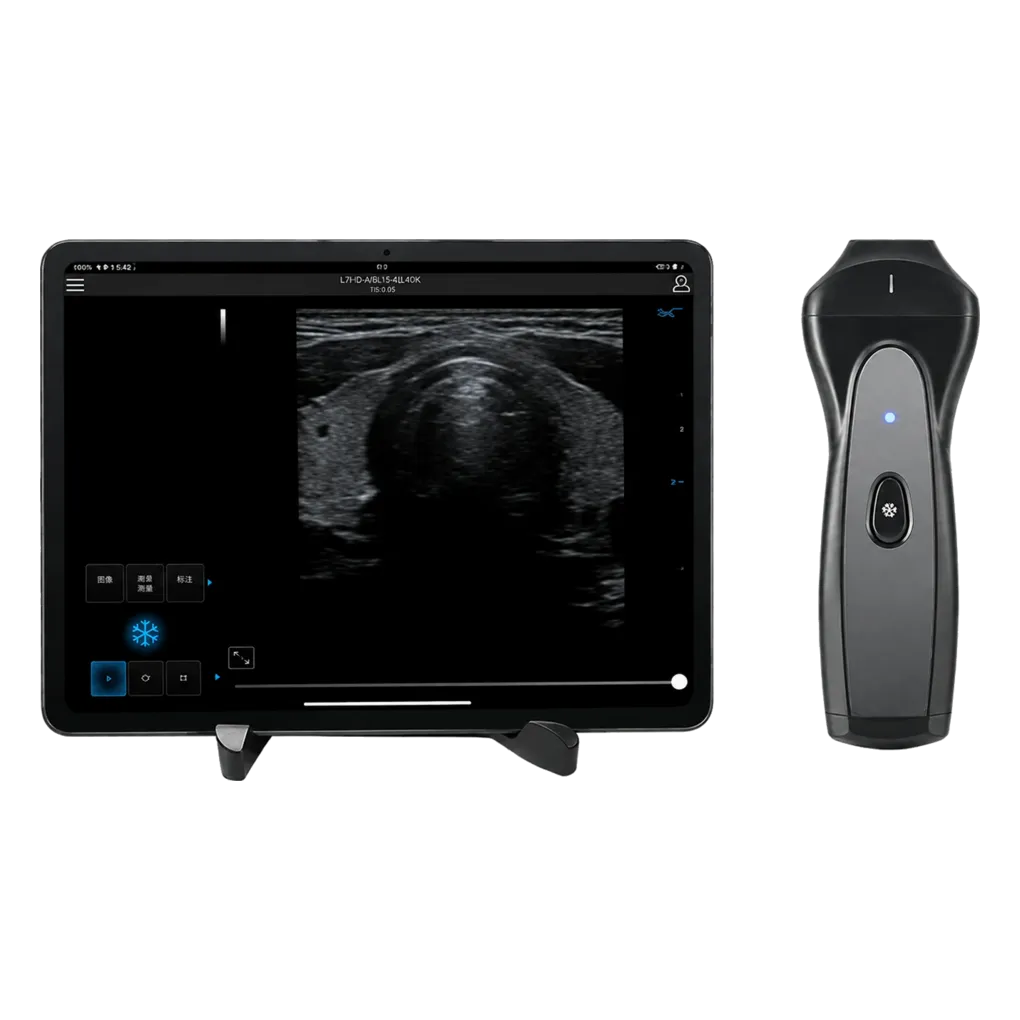
The cardiology and emergency medicine departments are the primary settings for the PIU1C. Standard transthoracic echocardiographic windows can be obtained with a 229 g wireless phased-array probe without a cart. The inverse harmonic modes at iH3.6 and iH4.0 MHz improve endocardial border definition in patients with challenging acoustic windows, thereby expanding the PIU1C's clinical range beyond that of standard-harmonic probes. PW Doppler to ±160 cm covers the full velocity range required for aortic stenosis, mitral, and tricuspid assessment. Medigear.uk supports cardiology and emergency procurement with full specification documentation and volume pricing.
Intensive care and high-dependency units gain direct value from the PIU1C's wireless, cableless design. Ventricular function assessment, tamponade screening, inferior vena cava collapsibility for fluid responsiveness, and wall motion assessment can be performed without patient transfer. The inverse harmonic modes specifically address the poor acoustic windows common in ICU patients — lung hyperinflation, post-operative chest wall changes, and pleural effusion. The IPX7-rated housing supports submersion disinfection in isolation settings. Medigear.uk can advise on ICU fleet configurations.
Anaesthesiology and perioperative teams use the PIU1C for pre-operative cardiac screening, intraoperative haemodynamic monitoring, and post-operative volume assessment. The ±160 cm PW range supports assessment of aortic outflow tract velocity during intraoperative volume management. Community cardiology services use the PIU1C for initial screening and referral triage when fixed echo infrastructure is lacking.
General diagnostic wards, oncology, and gastroenterology services benefit from the PIU1C's depth range of 40–300 mm and 3.5–6.0 MHz frequency selection for abdominal organ assessment, ascitic fluid mapping, and pleural effusion detection. Medigear.uk provides purchasing and after-sales support for individual practitioners, procurement teams, and distribution partners, building a wireless cardiac imaging portfolio.