
Introduction
Choosing between portable and fixed medical diagnostic equipment is rarely just a clinical decision. It shapes how your team works, where care can be delivered, what your premises need to accommodate, and how far your budget stretches over the next decade. Get it right, and you build a service that's efficient, resilient and ready to grow. Get it wrong, and you're left with an expensive room nobody can reach — or a fleet of trolleys straining to do a department's worth of work.
This guide breaks down the trade-offs that actually matter, so you can match the right format to your setting — whether you run a major hospital, a small private clinic, a mobile unit or a home-care service. It applies wherever you practise, with regulatory notes for the UK, the European Union, the United States, the Gulf (GCC) states and South Africa.
The short version — if you only read one thing
Portable equipment brings the diagnosis to the patient. Fixed equipment brings the patient to a purpose-built, high-performance setup. Neither is better in the abstract — it depends on volume, location, image quality, space and total cost of ownership.
- Choose fixed — high volume, one site: sustained throughput and top-tier image quality in a single location point firmly to a fixed installation.
- Choose portable — care that travels: wards, homes and remote sites where the patient can't easily come to the device make portability essential.
- Choose hybrid — mixed or growing: a fixed core plus portable units for flexibility is often the most resilient real-world answer.
What counts as "portable" and "fixed"?
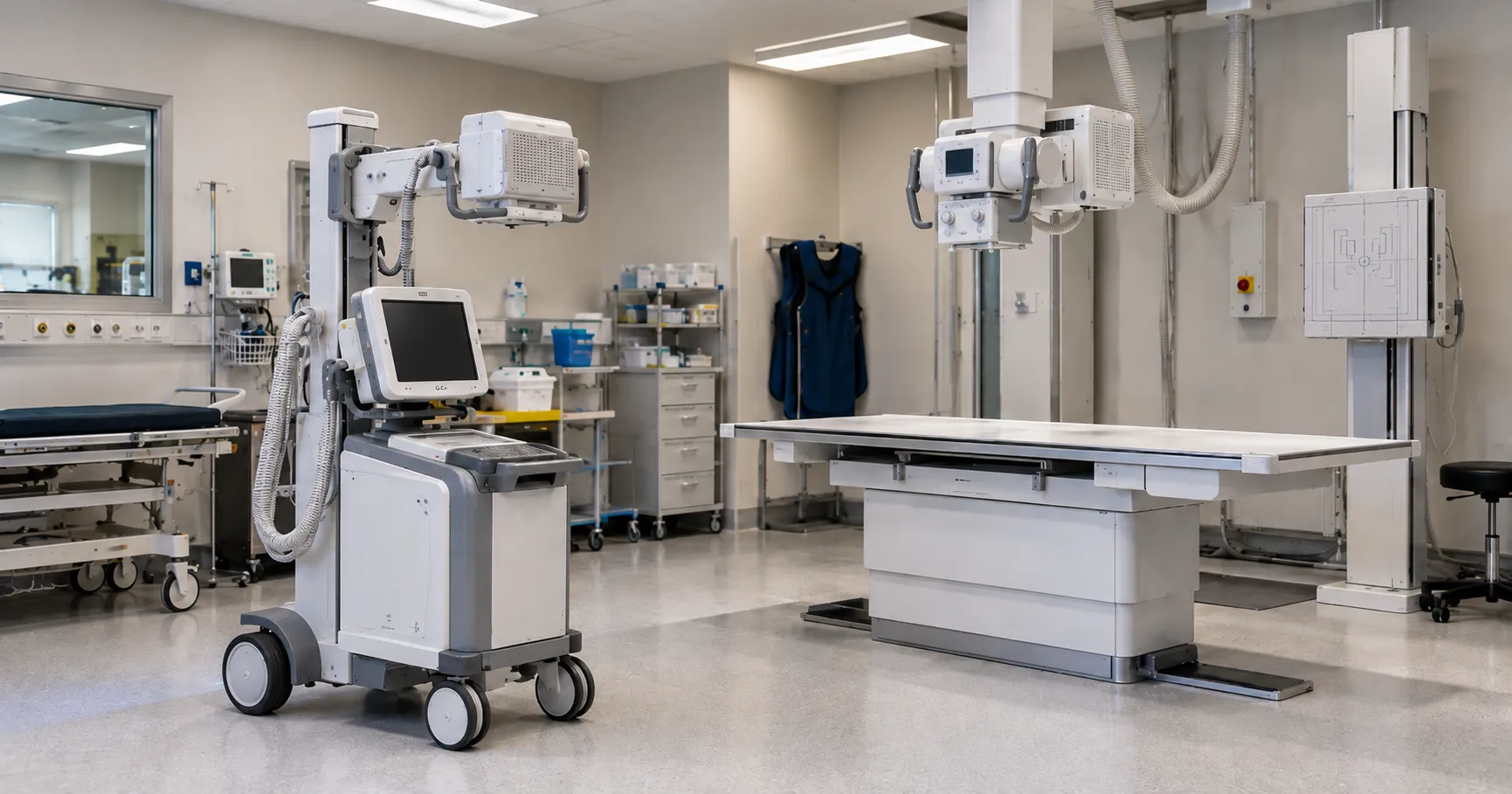
Portable. Designed to be moved — handheld, trolley-mounted or compact benchtop units carried between rooms, taken to a bedside or transported in a vehicle. Examples: handheld and trolley ultrasound, portable ECG and patient monitors, transportable X-ray, pulse oximeters, point-of-care analysers.
Fixed. Installed in a dedicated space, often needing structural support, three-phase power, radiation shielding, plumbing or environmental controls. Examples: MRI and CT scanners, fixed radiography and fluoroscopy rooms, and high-end stationary ultrasound consoles built for all-day use.
A middle ground exists, too: "transportable" systems are technically mobile but heavy enough to live mostly in one place. Where a device sits on that spectrum affects almost everything — from installation cost to how quickly you can redeploy it.
Portable vs fixed: head-to-head
|
Factor |
Portable |
Fixed |
|---|---|---|
|
Mobility |
Goes to the patient — bedside, home, remote sites |
Patient comes to the device |
|
Image/data quality |
Very good and improving; may trail flagship systems at the top end |
Typically the highest resolution available |
|
Upfront cost |
Lower to moderate |
Moderate to very high |
|
Installation |
Minimal — often plug-and-go |
Significant — shielding, power, sometimes building works |
|
Space required |
Small footprint, shared rooms |
Dedicated room or suite |
|
Throughput |
Good for distributed, lower-volume use |
Built for sustained high volume |
|
Downtime impact |
One unit down — swap in another |
One room down — service stops until repaired |
|
Best for |
Wards, emergency, community, home care, screening |
Imaging departments, high-volume clinics, complex work |
Seven factors that actually matter
-
Where care happens. If patients can't easily reach a fixed room — wards, homes, ambulances, rural clinics — portability becomes a clinical necessity, not a convenience. Point-of-care diagnostics shorten the path to treatment by removing transfers.
-
Volume and throughput. Fixed systems are built for sustained, repeated use with fast workflows and operator ergonomics. Push department-level volume through a single trolley, and it becomes a bottleneck. Match the format to a realistic daily load.
-
Image and data quality. Portable has closed much of the gap and suits most indications. But for the most demanding studies, flagship fixed systems still set the ceiling. Buy for what the work needs — guided by health technology assessment bodies such as NICE (UK) — not for the highest spec by default.
-
Space and infrastructure. A fixed kit can require reinforced floors, shielding, and dedicated power and cooling — costs that are easy to underestimate. Portable sidesteps most of this, ideal for leased, listed or multi-use premises.
-
Total cost of ownership. Look past the sticker price to installation, training, consumables, servicing, calibration, customs and replacement. The cheapest device to buy is not always the cheapest to own.
-
Resilience and redundancy. A fixed scanner failure can halt a service. A failing portable unit can be swapped out to keep going. A fleet offers redundancy that a single installation can't.
-
Infection control. Taking the device to the patient avoids moving vulnerable or infectious people through shared spaces — provided cleaning and decontamination protocols are robust.
"Not sure which way to go?"
Let's weigh it up together. Tell us your caseload, your space, your market and your budget — we'll shortlist equipment that genuinely fits. No pressure, no obligation. → Talk to the team
Common scenarios — and what tends to win
-
Primary care or small private clinic. Limited space, varied caseload, tight budget. Portable ultrasound, ECG, and point-of-care devices keep rooms multipurpose rather than tying space to a single function.
-
Hospital imaging department. High volume and demanding image quality. Fixed systems anchor the service, almost always complemented by portable units for wards and theatre.
-
Emergency and critical care. Speed and bedside access matter; patients are often too unstable to move. Portable monitors, ultrasound, and X-ray allow teams to assess without transferring the patient.
-
Community, home and outreach care. Care happens wherever the patient is. Portability isn't optional — it's the entire delivery model, aligning with the global push toward care closer to home, so a ruggedised, battery-capable kit is essential.
-
Mobile screening and field deployments. Vehicles, camps and remote sites — common across rural districts and the Gulf and African regions — demand compact, transport-tolerant equipment with reliable battery life and quick setup. Portable is the natural fit.
How the choice plays out by category
-
Ultrasound. The category where portable has advanced most — handheld and trolley systems now cover a huge range, while fixed consoles remain the choice for the most detailed studies.
-
ECG and patient monitoring. Overwhelmingly portable for ward and bedside use, with fixed central-station monitoring tying it together in critical care.
-
X-ray. Both formats are common. Fixed rooms handle high-volume radiography — governed by professional standards such as the Royal College of Radiologists (UK) and the American College of Radiology (US) — while mobile units serve wards, theatres and ICUs.
-
CT and MRI. Predominantly fixed due to size, shielding and power — though mobile and relocatable units exist for capacity and access challenges.
-
Point-of-care testing. Almost entirely portable by design, bringing lab-style results to the bedside in minutes — a model the World Health Organization champions for widening access to diagnostics.
Maintenance, training and the long view
The device is only as good as the support around it. Build in a realistic plan for operator training, routine servicing, calibration and software updates from day one — areas where professional bodies such as IPEM (UK) and the AAPM (US) set the standard. Fixed systems usually come with structured service contracts tied to the installation; portable fleets benefit from clear ownership of cleaning, charging, storage and asset tracking so units don't go missing or fall out of calibration. In regions where service networks and spare parts are harder to reach, local support and warranty coverage should weigh heavily in the decision.
A simple way to decide — ask these five questions, in order
-
Can the patient reliably come to a fixed location? If not, go portable.
-
What clinical quality does the work genuinely require — and does a portable system meet it?
-
What's your real daily volume in one place?
-
What will installation and the next ten years of ownership actually cost?
-
Is the device approved for your market, with local service and spares within reach?
If the answers pull in different directions, a hybrid setup — a fixed core plus portable units for flexibility and reach — is frequently the most robust choice, and it's how many established services are structured.
Regulation around the world
Wherever you buy, a medical device must be approved for the market where it will be used. The marking or clearance pathway differs by region — here's the at-a-glance picture for the main markets.
|
Region |
Main regulator |
Conformity / clearance |
|---|---|---|
|
United Kingdom |
UKCA mark (CE accepted transitionally) |
|
|
European Union |
European Commission & national authorities |
CE marking under EU MDR 2017/745 |
|
United States |
510(k) clearance or PMA approval |
|
|
Gulf (GCC) |
SFDA (Saudi Arabia), MOHAP (UAE) & GCC bodies |
National registration / GCC conformity |
|
South Africa |
Medical device establishment & product licensing |
Whatever you choose, confirm the device has valid approval for your market, is from a reputable supplier, and is supported by servicing, calibration, and operator training. For clinical-appropriateness evidence, bodies such as NICE are a useful reference. If you're sourcing for an organisation, our buyer hub sets out how to purchase with confidence.
More from Business
-
Buyers — source and import compliant equipment for your clinic, hospital or care service.
-
Suppliers — list and export your medical equipment to healthcare buyers worldwide.
-
Advertise — promote your products and services to a clinical audience.
-
Business overview — explore everything MediGear offers healthcare organisations.
Disclaimer
This article is for general information only and does not constitute clinical, medical, procurement, legal or regulatory advice. Product capabilities, regulatory requirements and pricing vary by country and change over time. Before purchase, always confirm that a device is appropriate for your intended clinical use and approved for your market — for example, UKCA (UK), CE marking under EU MDR (EU), FDA clearance or approval (US), SFDA or other GCC registration (Gulf), and SAHPRA licensing (South Africa). Consult qualified clinical, biomedical engineering and procurement professionals, and your local regulator, for decisions specific to your organisation. medigear.uk accepts no liability for actions taken on the basis of this content.
Find the right fit for your service.
We supply portable and fixed diagnostic equipment to clinics, hospitals and care services across the UK, Europe, the US, the Gulf and South Africa — and we'd rather help you choose well than sell you the biggest box.
Frequently asked questions
For many common indications, yes — modern portable systems deliver clinically reliable results. The gap is most evident at the very top end of image quality for the most demanding studies, where flagship fixed systems still lead. Match the device to the clinical task rather than assuming one format is universally more accurate.
Portables are usually cheaper to buy and install, while fixed systems often cost more upfront but can be an excellent value per study at high volume. Always compare the total cost of ownership — installation, servicing, consumables and replacement — not just the purchase price.
Yes, and many services do. A fixed core for high-volume, high-specification work, plus portable units for bedside, ward, and community reach, is one of the most resilient and flexible setups available.
Approvals vary by market: a UKCA mark in Great Britain, CE marking under EU MDR across the EU, FDA 510(k) clearance or PMA approval in the United States, SFDA registration in Saudi Arabia and other Gulf states, and SAHPRA licensing in South Africa. Always confirm the device meets the rules of the market where it will be used.