
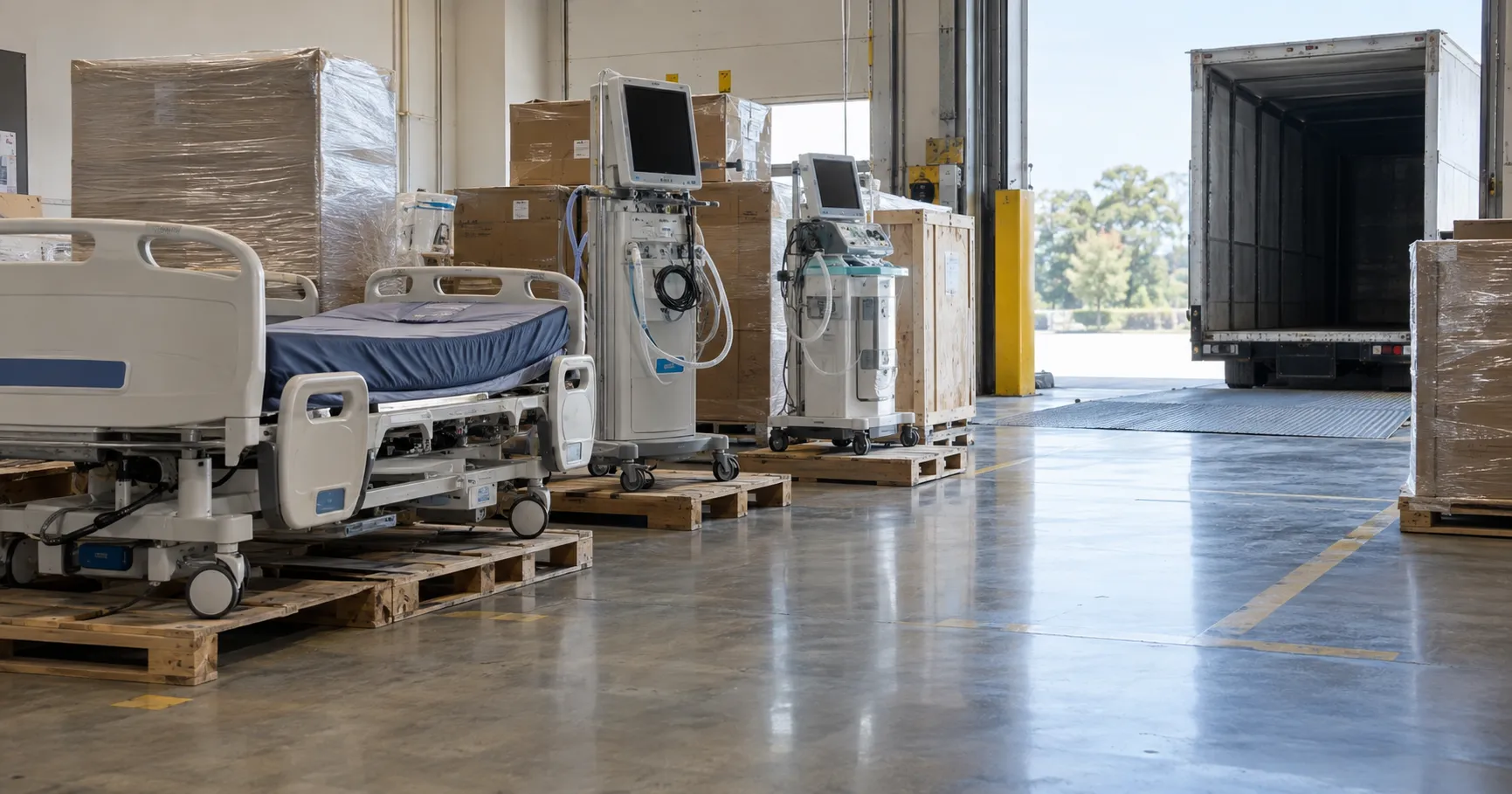
Introduction
Sourcing medical equipment internationally can unlock better prices, faster availability, and a wider choice — but only if it clears customs. Medical equipment import and export regulations sit on top of ordinary trade rules: a device must be approved for the destination market, handled by a recognised importer, correctly classified for customs, and supported by the right paperwork. Miss one of these, and a shipment can be delayed, fined, or turned away entirely.
This guide walks through what's involved in importing and exporting medical devices, the documents you'll need, the common pitfalls, and how the rules differ across the UK, the EU, the US, the Gulf (GCC) states, and South Africa.
The short version — four things every shipment needs
Whatever the country, cross-border medical equipment trade comes down to the same essentials. Get these right, and most shipments move smoothly.
-
Market registration — the device must be registered or certified for the destination: CE, UKCA, FDA, SFDA or SAHPRA.
-
Importer of record — a licensed local importer, distributor or authorised representative who takes legal responsibility.
-
Documentation — conformity certificate, invoice, packing list, certificate of origin and any permits.
-
Correct customs handling — the right HS code, duties and labelling for the destination.
What importing and exporting actually involve
Cross-border trade in medical devices has several moving parts. Each one can hold up a shipment if it's missing.
-
Market registration/approval - The device must hold valid approval for the destination — CE in the EU, UKCA in Great Britain, FDA clearance in the US, SFDA or GCC registration in the Gulf, SAHPRA licensing in South Africa.
-
Importer of record / local agent - Most markets require a licensed local importer, distributor or authorised representative who is legally responsible for the device once it lands.
-
Import licences & permits - Many countries require importers to be registered and certain devices to carry specific import permits before they can clear customs.
-
Customs, duties & HS codes - Every device needs the correct customs classification (HS code), which sets the duty and tariff. Misclassification causes delays and penalties.
-
Documentation - Expect to provide the Declaration of Conformity or certificate, commercial invoice, packing list, certificate of origin and, often, a Certificate of Free Sale.
-
Labelling & language - Labels, instructions and safety information frequently must appear in the destination country's language and meet local format rules.
Import requirements by market — at a glance
|
Region |
Regulator |
Key import requirement |
|
United Kingdom |
UKCA/CE (CE accepted to 2028–2030); MHRA registration |
|
|
European Union |
CE marking under EU MDR; EU authorised representative |
|
|
United States |
FDA clearance; establishment registration & listing |
|
|
Gulf (GCC) |
SFDA & GCC bodies |
National registration; licensed local importer |
|
South Africa |
SAHPRA licence; registered importer/distributor |
"Shipping across borders?"
We'll help clear the border. Tell us what you're moving and where — we'll help you line up the registration, documentation and import requirements so your equipment arrives without surprises.
No pressure, no obligation. → Talk to the team
How the main markets differ
-
United Kingdom. Devices need UKCA marking (CE accepted on a transitional basis) and MHRA registration. CE marks remain accepted in GB under transitional deadlines (currently 30 June 2028–2030 by device type), with an MHRA consultation in 2026 proposing indefinite recognition. Northern Ireland follows EU rules, so check both where relevant.
-
European Union. CE marking under EU MDR is required, and non-EU manufacturers must appoint an EU authorised representative. Goods move freely once inside the single market.
-
United States. The FDA requires clearance, plus establishment registration and device listing. Importers must follow FDA import procedures, and shipments can be detained for review.
-
Gulf (GCC). Markets such as Saudi Arabia and the UAE require national registration and a licensed local importer or agent; many recognise CE or FDA evidence to speed approval.
-
South Africa. SAHPRA licenses both establishments and devices; importers and distributors must be registered, and imports of used devices may face restrictions.
Tariffs, duties and HS codes
Every device crossing a border needs a customs classification — its HS code — which sets the duty rate and flags any restrictions. Most medical instruments fall under Chapter 90 of the Harmonised System, but the exact sub-heading matters: it determines the tariff, whether the device qualifies for any medical-use duty relief, and how quickly it clears. Many countries reduce or waive duty on certain medical devices, sometimes under World Trade Organisation arrangements or national exemptions, but eligibility varies and isn't automatic — you usually have to claim it correctly. Import VAT or sales tax often applies on top of duty. Finally, the Incoterms you agree on — for example, DDP, where the seller covers duties and delivery, versus DAP, where the buyer clears customs — determine who bears the cost and risk, so settle these before you ship, not after.
Shipping medical equipment: what to plan for
-
Calibration and fragility - Imaging and monitoring systems are sensitive; shock and vibration in transit can knock them out of calibration. Use proper crating and shock indicators, and budget for recalibration and testing on arrival.
-
Temperature and humidity - Some devices, reagents and consumables need controlled conditions in transit and storage — confirm requirements and use suitable packaging or cold-chain where needed.
-
Batteries and dangerous goods - Portable equipment often contains lithium batteries, regulated as dangerous goods with specific packing, labelling and air-freight rules (IATA). Declare them correctly.
-
Connected devices and data - Networked and software-driven equipment may face additional cybersecurity or data requirements at import — check the destination's rules for connected medical devices.
-
Spare parts and servicing - Confirm that spares, consumables and service support can also reach the destination — equipment that can't be maintained locally quickly becomes a liability.
-
Insurance and lead times - Arrange cargo insurance for high-value equipment and build in realistic timelines — customs review and registration checks can add days or weeks.
What trips importers up
-
Wrong or missing market approval. Assumed a CE or FDA mark works everywhere. It doesn't — the device must be approved for the specific destination.
-
Incorrect HS classification. The wrong customs code means the wrong duty, delays and possible penalties. Confirm the code before shipping.
-
No local importer or representative. Many markets won't clear goods without a registered local importer or authorised representative on file.
-
Used-device restrictions. Some countries restrict or ban the import of used and refurbished equipment — check before you ship.
-
Labelling and language gaps. Missing local-language labels or instructions for use can hold a shipment at the border.
A five-step import/export checklist
-
Confirm the device is approved/registered for the destination market.
-
Appoint a licensed importer of record or authorised representative.
-
Classify the device correctly (HS code) and check duties and any permits.
-
Assemble the document set — conformity certificate, invoice, packing list, certificate of origin.
-
Check labelling, language and any device restrictions before shipping.
Work with a supplier and freight partner that routinely handle medical devices — the right paperwork up front is far cheaper than a shipment stuck in customs.
Who governs trade where
|
Region |
Regulator |
Trade-related role |
|
United Kingdom |
Device registration & UKCA conformity |
|
|
European Union |
EU MDR / CE marking framework |
|
|
United States |
Clearance, registration & import oversight |
|
|
Gulf (GCC) |
SFDA & GCC bodies |
National registration & import licensing |
|
South Africa |
Establishment & device licensing |
For UK specifics, see the government's guidance on regulating medical devices, and the World Health Organisation for the global context on access and quality. If you're sourcing for an organisation, our buyer hub sets out how to purchase and import with confidence.
More from Business
-
Buyers — source and import compliant equipment for your clinic, hospital or care service.
-
Suppliers — list and export your medical equipment to healthcare buyers worldwide.
-
Advertise — promote your products and services to a clinical audience.
-
Business overview — explore everything MediGear offers healthcare organisations.
Disclaimer
This article is for general information only and does not constitute clinical, medical, procurement, legal, customs or regulatory advice. Import and export rules, duties, licensing and documentation requirements vary by country and device and change frequently. Before shipping, always confirm current requirements with the relevant regulator and customs authority (for example, MHRA, the European Commission, FDA, SFDA/GCC or SAHPRA) and with a qualified customs or regulatory professional for the markets involved. medigear.uk accepts no liability for actions taken on the basis of this content.
Frequently Asked Questions
Typically you need the device registered or approved for your market (such as UKCA, CE, FDA, SFDA or SAHPRA), an importer of record or authorised representative, any required import licence or permit, correct customs classification (HS code), and a full document set including the Declaration of Conformity, commercial invoice and certificate of origin. Requirements vary by country and device class.
It depends on the country and the device. Many markets require importers and distributors to be registered or licensed, and some devices need specific import permits. Several countries also restrict or prohibit the import of used or refurbished devices, so always check local rules before shipping.
Common export documents include the commercial invoice and packing list, certificate of origin, the device's conformity certificate or Declaration of Conformity, and sometimes a Certificate of Free Sale or export licence. The destination country's registration and labelling rules also apply.
Sometimes, but rules vary widely. Some countries welcome certified refurbished devices, while others restrict or ban the import of used medical equipment to protect quality and safety. Always confirm the destination country's position and ensure conformity documentation covers the specific unit.
Cross borders without the customs headaches.
We supply and ship medical equipment to clinics, hospitals and care services across the UK, Europe, the US, the Gulf and South Africa — with the registration, documentation and import support to get it there cleanly.