
Introduction
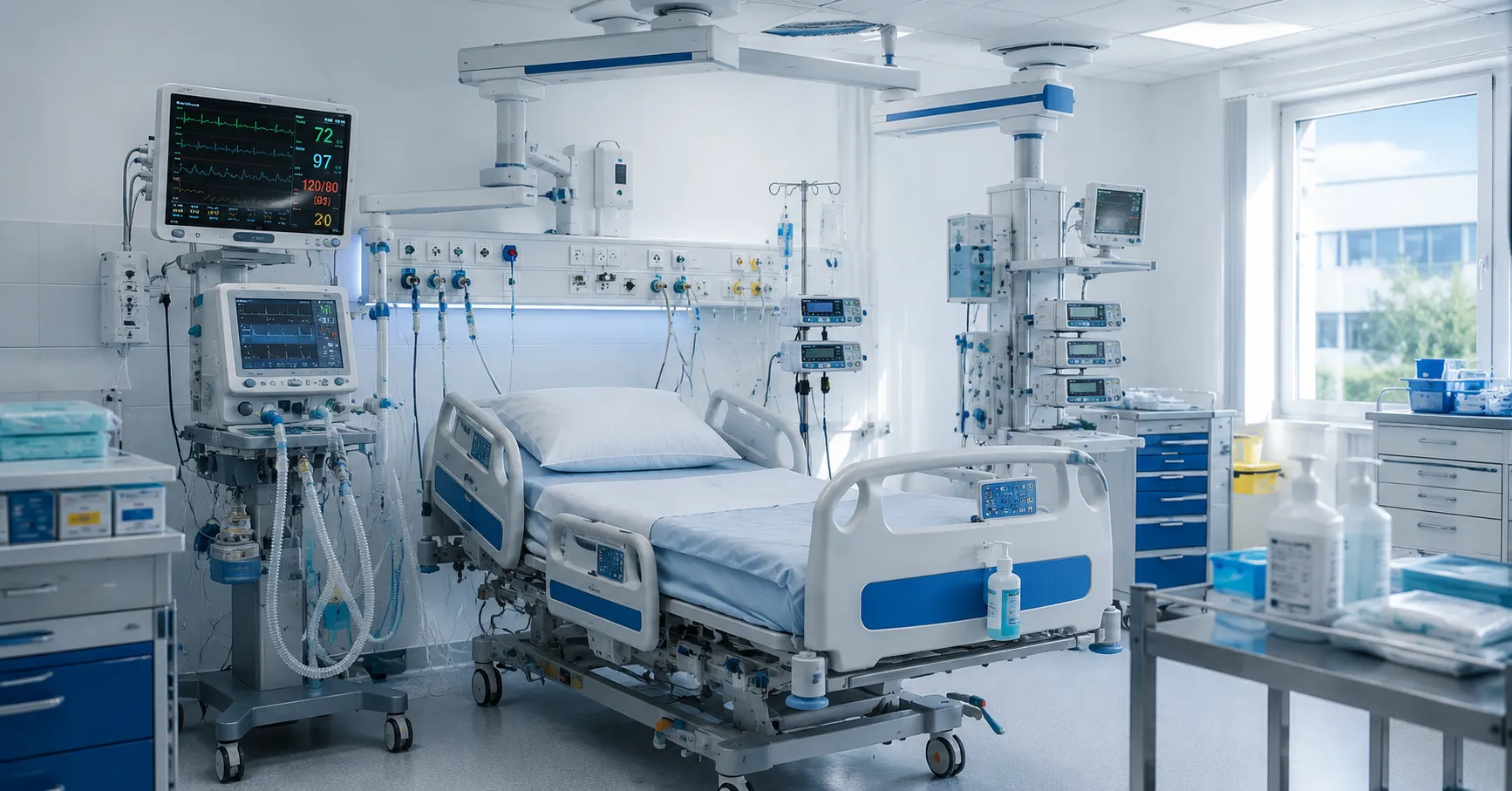
Setting up an intensive care unit is one of the most demanding equipping projects a hospital undertakes. Each bed space is a small life-support ecosystem — monitoring, ventilation, infusion, power and emergency kit all working together, around the clock, with no room for failure. Miss a category or under-spec a device, and you create a gap that shows up at the worst possible moment.
This guide gives you the full ICU equipment checklist, organised by category, plus the planning steps, budgeting considerations and compliance points to get it right — whether you're commissioning a new unit, expanding capacity, or upgrading an existing one.
The short version — what every ICU bed space needs
Strip it back, and every ICU bed needs three things working together — eyes on the patient, support for breathing and circulation, and instant access to an emergency kit.
-
Monitoring — a multiparameter monitor per bed, linked to a central station for whole-unit visibility.
-
Ventilation & infusion — a ventilator, oxygen and suction, plus infusion and syringe pumps for drugs and fluids.
-
Emergency kit — a defibrillator, crash cart and resuscitation equipment within reach of every bed.
ICU equipment by category
-
Patient monitoring - Multiparameter monitors (ECG, SpO2, NIBP/IBP, temperature, capnography) at every bed, plus a central monitoring station. See our guide to types of patient monitoring equipment.
-
Respiratory support - Mechanical ventilators, oxygen supply, medical suction, humidifiers, and non-invasive options (BiPAP/CPAP). Blood-gas analysis nearby.
-
Infusion & medication - Volumetric infusion pumps and syringe drivers — several per bed — for fluids, sedation and vasoactive drugs.
-
ICU beds & furniture - Electric profiling ICU beds, pressure-relieving mattresses, overbed tables, and bedside storage built for infection control.
-
Emergency & resuscitation - Defibrillators, fully stocked crash carts, intubation and airway equipment, and emergency drugs within reach of every bed.
-
Diagnostics & imaging - Point-of-care testing, portable ultrasound and mobile X-ray so unstable patients can be assessed at the bedside.
-
Infection control - Hand-hygiene stations, PPE, isolation provision, clinical waste handling and easy-clean surfaces throughout.
-
Power, gas & utilities - Uninterruptible power (UPS) and backup generators, piped medical gas and vacuum, and adequate clinical lighting.
ICU equipment checklist
|
Category |
Equipment |
Per bed or shared |
|
Monitoring |
Multiparameter monitor; central station; pulse oximeter |
Monitor per bed; station shared |
|
Respiratory |
Ventilator; oxygen & suction; humidifier; BiPAP/CPAP; ABG analyser |
Ventilator per bed; ABG shared |
|
Infusion |
Volumetric pumps; syringe drivers; IV poles |
Several per bed |
|
Beds |
Electric ICU bed; pressure mattress; patient hoist |
Bed per space; hoist shared |
|
Emergency |
Defibrillator; crash cart; intubation set |
Shared, within reach of all beds |
|
Diagnostics |
Point-of-care analyser; portable ultrasound; mobile X-ray |
Shared |
|
Infection control |
Hand hygiene; PPE; waste & isolation provision |
Throughout |
|
Utilities |
UPS / backup power; medical gas & vacuum; lighting |
Unit-wide infrastructure |
A planning rule of thumb: one monitor and one ventilator per bed, several infusion pumps per bed, and spares of each to cover maintenance and surges.
"Planning a new ICU?"
We'll help you equip it end-to-end. Tell us your bed count, budget, and market — we'll build an equipment list, balance new and refurbished units, and make sure everything's compliant and supported.
No pressure, no obligation. → Talk to the team
What else does setting up an ICU involve
-
Layout and space. Bed spacing, line of sight from the nursing station, isolation rooms, and space for equipment, staff, and family all shape how the unit works in practice.
-
Infrastructure. Reliable power with UPS and generator backup, piped medical gas and vacuum, ventilation/air handling, and IT/network capacity are foundational — and often the longest-lead items.
-
Staffing and training. Equipment is only safe in trained hands. Plan staff ratios and competency training alongside procurement, not after it.
-
Connectivity. Monitors, ventilators and pumps that integrate with the central station and electronic record reduce errors and workload.
-
Maintenance and spares. Service contracts, calibration schedules, consumables and a stock of spare devices keep the unit running when something fails.
Setting up an ICU, step by step
-
Define capacity and acuity — how many beds, what level of care, any isolation needs.
-
Confirm infrastructure — power, medical gas, ventilation and space — and start any building works early.
-
Build the equipment list by category, with quantities per bed plus spares.
-
Decide new vs refurbished per item to balance budget against lifespan and warranty.
-
Confirm market approval, arrange installation, training and service contracts, then commission and test.
Order long-lead items — ventilators and beds especially — first, and leave time to install, integrate, and train before go-live.
Budget and procurement
An ICU is capital-intensive, so where you spend matters. A common strategy is to buy new for the highest-risk, fast-moving devices and certified refurbished for the rest — stretching the budget without compromising care. Build the total cost of ownership into every line item: installation, training, consumables, calibration, service contracts, and replacement, not just the purchase price. Because much ICU equipment is higher-risk, check the device risk class and the certification for your market, and confirm spares and support are locally available for the unit's working life.
Approval and standards by region
|
Region |
Regulator |
Requirement |
|
United Kingdom |
UKCA mark (CE accepted to 2028–2030) |
|
|
European Union |
CE marking under EU MDR 2017/745 |
|
|
United States |
510(k) clearance or PMA approval |
|
|
Gulf (GCC) |
SFDA & GCC bodies |
National registration / GCC conformity |
|
South Africa |
Medical device licensing |
For clinical standards on critical care, bodies such as NICE and the World Health Organisation are useful references. If you're equipping a unit, our buyer hub sets out how to purchase with confidence.
Disclaimer
This article is for general information only and does not constitute clinical, medical, procurement, engineering or regulatory advice. ICU design, equipment requirements, staffing ratios and standards vary by country, facility and clinical model, and change over time. The checklist is a general planning aid, not a specification — always work with qualified clinical, biomedical engineering, infection-control and procurement professionals, and confirm that every device is approved for your market (for example, UKCA, CE under EU MDR, FDA, SFDA/GCC or SAHPRA). medigear.uk accepts no liability for actions taken on the basis of this content.
Frequently Asked Questions
Every ICU bed requires patient monitoring (a multiparameter monitor), respiratory support (ventilator, oxygen, and suction), infusion and syringe pumps, an electric ICU bed with a pressure-relieving mattress, and access to emergency and resuscitation equipment such as a defibrillator and crash cart. Shared resources include point-of-care diagnostics, imaging, infection-control supplies and reliable power and medical gas.
As a planning rule, allow one patient monitor and one ventilator per ICU bed, plus spares for backup and maintenance downtime, and a central monitoring station for the unit. Infusion and syringe pumps are needed in greater numbers, as each patient may use several at once.
A high-dependency unit (HDU) provides a level of care between a general ward and full intensive care. ICU equipment is more comprehensive — more advanced ventilation, invasive monitoring and a higher staff-to-patient ratio — whereas an HDU has similar core monitoring but typically without full mechanical ventilation for every bed.
Yes, certified refurbished equipment can be a cost-effective way to equip an ICU, particularly for monitors, infusion pumps and imaging. For life-supporting devices such as ventilators, choose carefully, insist on certified refurbishment, a warranty and reliable service support, and confirm the device is approved for your market.
It varies widely with scale and whether building works are involved. Equipping an existing, suitable space can take weeks once procurement and installation are arranged, while a new build with infrastructure, medical gas and power works can take many months. Long lead-time items such as ventilators should be ordered early.
All ICU devices must be approved for the market where they're used — UKCA or CE in the UK and EU, FDA clearance in the US, and SFDA or SAHPRA registration in the Gulf and South Africa. Life-supporting equipment is usually higher-risk (for example Class IIb), so expect comprehensive documentation, and plan for calibration, servicing and infection-control compliance.
Equip your ICU end-to-end.
From monitors and ventilators to beds, pumps and emergency kit, we help hospitals across the UK, Europe, the US, the Gulf and South Africa stand up intensive care units — compliant, supported and on budget.