
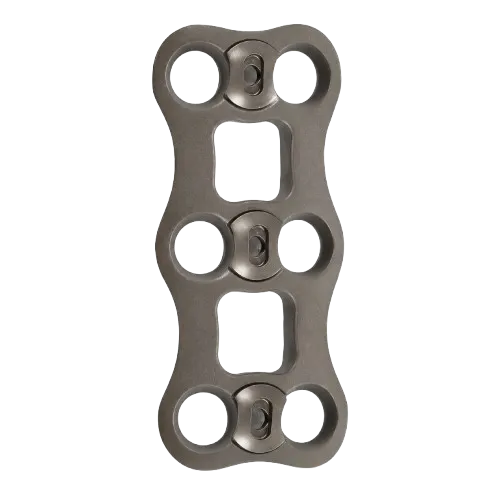
Hospital spine theatres form the core setting for the Anterior Cervical Plate-I, where it is used across both trauma and degenerative anterior cervical discectomy and fusion cases. Fall-safety governance does not apply to an implant the way it applies to bedside equipment. Still, procurement governance does: NHS spine units evaluating a locking plate system need traceable certification and consistent stock availability, which is where Medigear comes in. UK's role as a stocking supplier matters to tender decisions.
Multi-level degenerative cervical disease is a second distinct setting, where surgeons building longer constructs rely on the 8- and 10-hole Plate-I options to bridge several disc levels in one continuous fixation. The independent per-screw locking becomes particularly relevant here, since a longer construct means more screws placed in sequence, and a surgeon needs to secure each one without disturbing screws already seated earlier in the case.
Revision and complex reconstruction surgery represents a third setting, in which Plate-I's compatibility with XC Medico's cervical cage range allows a combined cage-and-plate construct when a standalone cage is deemed insufficient. Surgeons working on revision cases often value the graft visualisation window to confirm fusion status against a patient's surgical history, and Medigear.uk can supply matched cage and plate stock for these combined constructs.
Private and day-case surgical centres constitute a fourth setting, as elective ACDF pathways increasingly move outside large NHS trusts to smaller specialist units and independent providers. These buyers typically order in smaller batches than a trust-wide contract, and Medigear.uk supports single or small-quantity ordering alongside the bulk distributor accounts it also serves, so a specialist clinic is not required to commit to trust-scale volumes to access the same plate system.