
Introduction
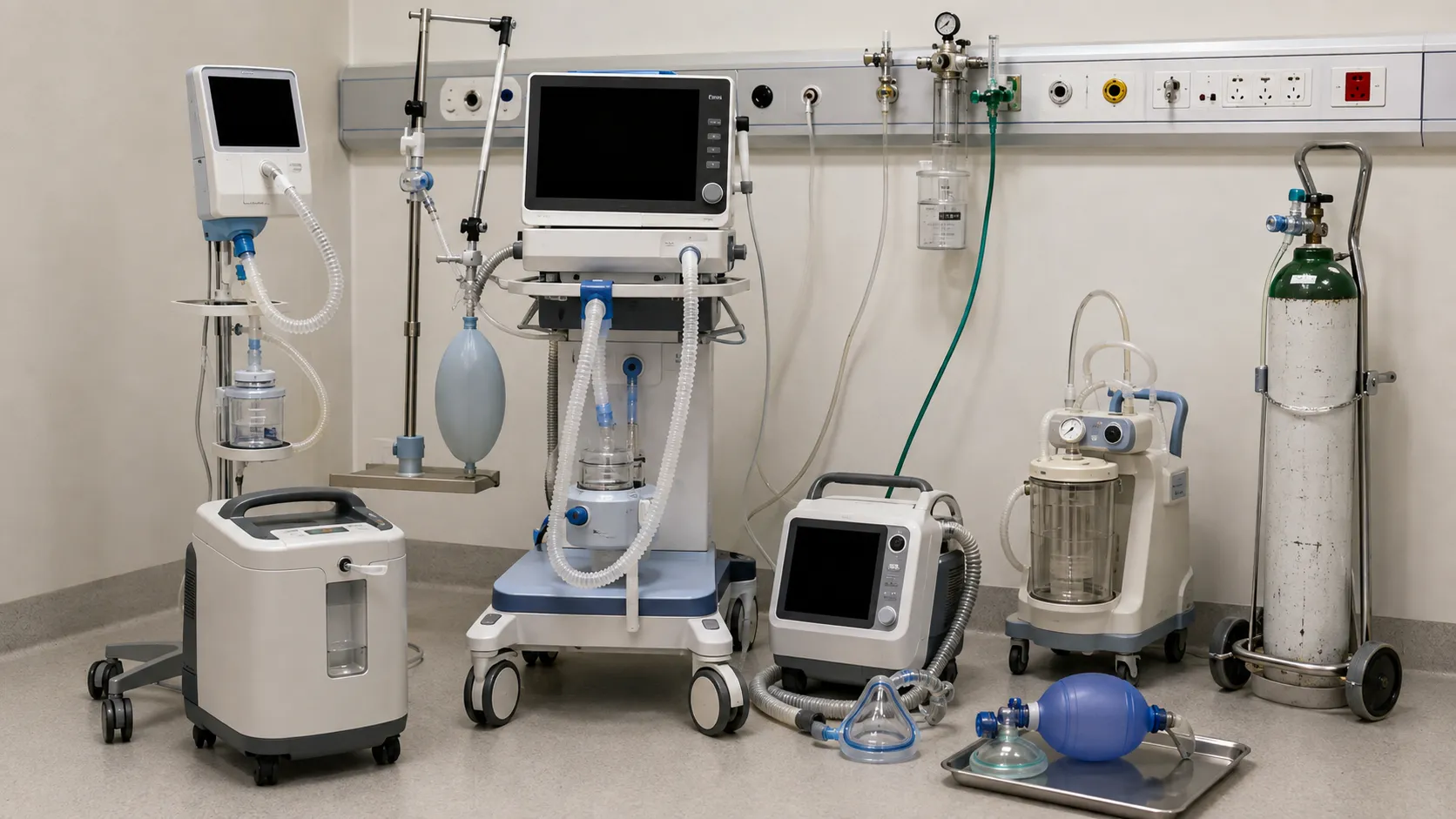
Breathing support in intensive care ranges from supplemental oxygen and non-invasive therapy to full mechanical ventilation, and the right equipment depends on how much help the patient's respiratory system needs. ICU respiratory equipment spans ventilators that take over breathing, the non-invasive systems that support it, and the oxygen delivery and monitoring that run alongside all of them. Understanding those groups helps any unit plan, compare options and budget sensibly.
This guide walks through the main types of respiratory equipment used in ICUs worldwide, what each does, where it fits, and how to choose — with notes on approval across the UK, the EU, the US, the Gulf (GCC) states, and South Africa.
The short version — respiratory equipment in three groups
Most ICU respiratory equipment falls into one of three groups — invasive and non-invasive ventilation, oxygen delivery and airway management, and respiratory monitoring and assessment.
-
Ventilation — ICU ventilators and non-invasive options such as CPAP and high-flow that support or replace breathing.
-
Oxygen delivery — oxygen concentrators, blenders and systems that supply and control what patients breathe.
-
Monitoring & assessment — spirometry, pulse oximetry and gas analysis that measure respiratory function.
Types of respiratory equipment in ICUs
-
ICU ventilators. Full-featured critical-care ventilators that control or support breathing with volume, pressure and advanced modes.
-
Non-invasive ventilation (NIV). BiPAP and CPAP systems that support breathing without intubation, widely used in type-2 respiratory failure and sleep apnoea.
-
High-flow nasal oxygen. Heated, humidified high-flow systems delivering up to 60 L/min, now standard for respiratory failure.
-
Transport ventilators. Compact ventilators for moving ventilated patients within a hospital or between facilities.
-
Oxygen delivery systems. Oxygen concentrators, medical gas systems, flow meters, masks and nasal cannulae.
-
Airway management. Suction units, intubation equipment and tracheostomy accessories for the ventilated patient.
-
Spirometry & lung function. Spirometers and lung function systems for diagnosing and monitoring obstructive and restrictive disease.
-
Respiratory monitoring. Pulse oximeters, capnography, blood-gas analysers and ventilator monitoring for continuous assessment.
What each type does
|
Category |
Examples |
Used for |
|
ICU ventilator |
Full-feature critical-care ventilators |
Controlling or supporting breathing |
|
NIV |
BiPAP, CPAP systems |
Non-invasive breathing support |
|
High-flow oxygen |
Heated high-flow systems |
High-flow O2 without intubation |
|
Transport ventilator |
Compact portable ventilators |
Moving ventilated patients |
|
Oxygen delivery |
Concentrators, gas systems, masks |
Delivering supplemental oxygen |
|
Airway management |
Suction, intubation, tracheostomy |
Managing the artificial airway |
|
Spirometry |
Spirometers, lung function |
Diagnosing respiratory disease |
|
Monitoring |
Oximeters, capnography, blood gas |
Continuous respiratory assessment |
Ventilation and respiratory support compared
Respiratory support is graded from supplemental oxygen to full mechanical ventilation, and clinicians step up or down based on the patient's needs.
|
Support level |
What it does |
Best for |
Consider |
|
Supplemental O2 |
Increases inspired oxygen |
Mild hypoxaemia |
Does not support breathing |
|
High-flow nasal O2 |
High-flow humidified O2 |
Moderate respiratory failure |
Better tolerated than NIV |
|
NIV (CPAP/BiPAP) |
Pressure support without intubation |
Type-2 failure, sleep apnoea |
Interface tolerance |
|
Invasive ventilation |
Full breathing control |
Severe respiratory failure |
Intubation; ICU resource |
Most ICUs use high-flow and NIV to avoid intubation where possible, reserving invasive ventilation for patients who cannot be managed non-invasively.
Equipping an ICU or respiratory unit?
We'll help you choose the right kit. Tell us the patient group, your budget and your market — we'll help you pick respiratory equipment that fits your unit and is approved for use where you'll use it.
No pressure, no obligation. → Talk to the team
Respiratory equipment by setting
-
Intensive care units - full-feature ICU ventilators, high-flow, NIV, monitoring and oxygen for the most critically ill.
-
High-dependency units - NIV, high-flow oxygen, step-down ventilation and close monitoring for less critical patients.
-
General wards - supplemental oxygen, NIV and pulse oximetry for patients at risk of deterioration.
-
Respiratory & sleep clinics - spirometry, NIV setup and ambulatory monitoring for chronic respiratory disease.
-
Low-resource settings - basic oxygen systems, manual ventilation and pulse oximetry where infrastructure is limited.
Choosing respiratory equipment
-
Define the patient acuity and the level of respiratory support the unit must provide.
-
Match invasive and non-invasive ventilation capacity to that need.
-
Plan oxygen supply, humidification and airway accessories around the ventilators.
-
Confirm market approval, the device risk class and electrical safety.
-
Plan consumables, circuits, filters and service support into the running cost.
Ventilator circuits, filters and oxygen consumables dominate the running cost of a respiratory unit — weigh new against certified refurbished, confirm parts availability, and plan validation before you buy.
Emerging respiratory technology
-
Adaptive ventilation modes. Automated modes adjust support breath by breath to the patient's own effort.
-
Remote ventilator monitoring. Connected ventilators report data to central stations and remote teams.
-
Home NIV and CPAP. Smaller, quieter machines support sleep apnoea and COPD at home.
-
High-flow at home. Portable high-flow systems extend oxygen therapy to the community.
-
Lung-protective strategies. Evidence-based mode selection and monitoring reduce ventilator-induced lung injury.
Approval by region
|
Region |
Regulator |
Requirement |
|
United Kingdom |
UKCA mark (CE accepted to 2028–2030) |
|
|
European Union |
CE marking under the EU MDR |
|
|
United States |
510(k) clearance or PMA approval |
|
|
Gulf (GCC) |
SFDA & GCC bodies |
National registration / GCC conformity |
|
South Africa |
Medical device licensing |
Ventilators and respiratory equipment sit at the highest-risk level of medical-device regulation. For clinical and quality guidance, the NICE and World Health Organisation resources are useful references. Our buyer hub sets out how to purchase with confidence.
More from Business
-
Buyers — source ICU ventilators, CPAP, high-flow oxygen and respiratory equipment for your unit.
-
Suppliers — list your respiratory and ventilation equipment and reach buyers worldwide.
-
Advertise — promote your products and services to a clinical audience.
-
Business overview — explore everything MediGear offers healthcare organisations.
Disclaimer
This article is for general information only and does not constitute clinical, intensive care, medical, procurement or regulatory advice. Respiratory equipment, requirements and regulations vary by country, setting and need, and change over time. Always confirm that equipment suits the intended clinical use and is approved for your market (for example, UKCA, CE under the EU MDR, FDA, SFDA/GCC or SAHPRA), observe electrical-safety and medical-gas standards, and consult qualified intensive care, respiratory medicine, biomedical engineering and procurement professionals for decisions specific to your organisation. medigear.uk accepts no liability for actions taken based on this content.
The right respiratory equipment for your ICU.
From ICU ventilators, CPAP and high-flow oxygen therapy to NIV, oxygen systems, spirometry and monitoring, we supply respiratory equipment to ICUs and hospitals across the UK, Europe, the US, the Gulf and South Africa.
Frequently Asked Questions
ICU respiratory equipment covers full-feature critical-care ventilators for invasive mechanical ventilation, non-invasive ventilation systems such as BiPAP and CPAP, heated high-flow nasal oxygen systems, transport ventilators for patient transfers, oxygen delivery including concentrators and gas systems, airway management such as suction and tracheostomy accessories, spirometry and lung function, and monitoring with pulse oximeters, capnography and blood-gas analysers.
CPAP delivers a single constant positive airway pressure throughout the breathing cycle, keeping the airway open — widely used in sleep apnoea and mild respiratory support. BiPAP delivers two levels of pressure, higher during inspiration and lower during expiration, actively assisting breathing and reducing the work of breathing more than CPAP. Both are forms of non-invasive ventilation used before intubation when possible.
High-flow nasal oxygen delivers heated, humidified oxygen and air through a nasal cannula at flow rates up to 60 L/min, with a controlled oxygen concentration. This matches or exceeds the patient's peak inspiratory flow, reducing the work of breathing, washing out dead space and improving oxygenation, often avoiding the need for non-invasive ventilation or intubation in moderate respiratory failure.
Yes. ICU ventilators are available as certified refurbished units and can reduce capital costs significantly. Confirm certified refurbishment, a warranty, calibration and parts and service support, check circuit and consumable compatibility, and confirm the device is approved for your market. Ventilators must be validated and tested before clinical use, including leak and alarm testing.
Ventilators and critical respiratory devices sit at the highest risk class and must be approved for the market — UKCA or CE under the EU MDR in the UK and EU, FDA clearance in the US, and SFDA or SAHPRA registration in the Gulf and South Africa. Medical-gas and electrical-safety standards also apply, and planned maintenance and calibration are mandatory.
Ventilators require breathing circuits including tubing and patient interfaces, bacterial and viral filters, humidifier chambers and water, heat-and-moisture exchangers, suction catheters and oxygen supplies. Circuits and filters are typically single-use or changed between patients. Humidification is standard for invasive ventilation. Budget these consumables into the total cost of care alongside the equipment.